

168
T. Fujita
Table 7.1 Comparison of
different excited-state theories
Theory
Orbital
U(r 1 , r 2 )
Asymptotic U
CIS
Hartree-Fock 1/|r 1 − r 2 |
1/r
TDDFT(GGA) Kohn-Sham V GGA (r 1 )δ(r 1 ,
r 2 )
0
GW/BSE
Dyson
W (r 1 , r 2 )
1/(ε M r)
those of excited-state Hamiltonian in the CIS method. (ia|jb) is the exchange integral as in 1.21, and (ij|U|ab) describes the e–h attractive interaction by a potential
U (r 1 , r 2 ). Note that the exchange integral is same for the CIS, TDA-TDDFT, and
GW/TDA-BSE, except that different orbitals are used. The CIS, TDA-TDDFT, and
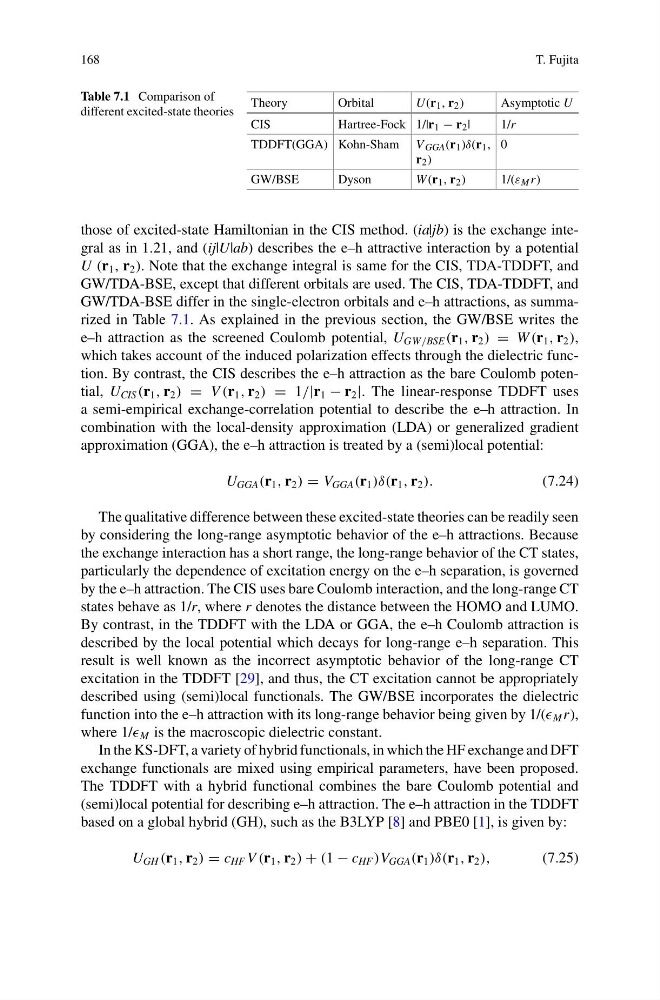
GW/TDA-BSE differ in the single-electron orbitals and e–h attractions, as summarized in Table 7.1. As explained in the previous section, the GW/BSE writes the
e–h attraction as the screened Coulomb potential, U GW/BSE (r 1 , r 2 ) = W (r 1 , r 2 ),
which takes account of the induced polarization effects through the dielectric function. By contrast, the CIS describes the e–h attraction as the bare Coulomb potential, U CIS (r 1 , r 2 ) = V (r 1 , r 2 ) = 1/|r 1 − r 2 |. The linear-response TDDFT uses
a semi-empirical exchange-correlation potential to describe the e–h attraction. In
combination with the local-density approximation (LDA) or generalized gradient
approximation (GGA), the e–h attraction is treated by a (semi)local potential:
U GGA (r 1 , r 2 ) = V GGA (r 1 )δ(r 1 , r 2 ).
(7.24)
The qualitative difference between these excited-state theories can be readily seen
by considering the long-range asymptotic behavior of the e–h attractions. Because
the exchange interaction has a short range, the long-range behavior of the CT states,
particularly the dependence of excitation energy on the e–h separation, is governed
by the e–h attraction. The CIS uses bare Coulomb interaction, and the long-range CT
states behave as 1/r, where r denotes the distance between the HOMO and LUMO.
By contrast, in the TDDFT with the LDA or GGA, the e–h Coulomb attraction is
described by the local potential which decays for long-range e–h separation. This
result is well known as the incorrect asymptotic behavior of the long-range CT
excitation in the TDDFT [29], and thus, the CT excitation cannot be appropriately
described using (semi)local functionals. The GW/BSE incorporates the dielectric
function into the e–h attraction with its long-range behavior being given by 1/( M r),
where 1/ M is the macroscopic dielectric constant.
In the KS-DFT, a variety of hybrid functionals, in which the HF exchange and DFT
exchange functionals are mixed using empirical parameters, have been proposed.
The TDDFT with a hybrid functional combines the bare Coulomb potential and
(semi)local potential for describing e–h attraction. The e–h attraction in the TDDFT
based on a global hybrid (GH), such as the B3LYP [8] and PBE0 [1], is given by:
U GH (r 1 , r 2 ) = c HF V (r 1 , r 2 ) + (1 − c HF )V GGA (r 1 )δ(r 1 , r 2 ),
(7.25)
T. Fujita
Table 7.1 Comparison of
different excited-state theories
Theory
Orbital
U(r 1 , r 2 )
Asymptotic U
CIS
Hartree-Fock 1/|r 1 − r 2 |
1/r
TDDFT(GGA) Kohn-Sham V GGA (r 1 )δ(r 1 ,
r 2 )
0
GW/BSE
Dyson
W (r 1 , r 2 )
1/(ε M r)
those of excited-state Hamiltonian in the CIS method. (ia|jb) is the exchange integral as in 1.21, and (ij|U|ab) describes the e–h attractive interaction by a potential
U (r 1 , r 2 ). Note that the exchange integral is same for the CIS, TDA-TDDFT, and
GW/TDA-BSE, except that different orbitals are used. The CIS, TDA-TDDFT, and
GW/TDA-BSE differ in the single-electron orbitals and e–h attractions, as summarized in Table 7.1. As explained in the previous section, the GW/BSE writes the
e–h attraction as the screened Coulomb potential, U GW/BSE (r 1 , r 2 ) = W (r 1 , r 2 ),
which takes account of the induced polarization effects through the dielectric function. By contrast, the CIS describes the e–h attraction as the bare Coulomb potential, U CIS (r 1 , r 2 ) = V (r 1 , r 2 ) = 1/|r 1 − r 2 |. The linear-response TDDFT uses
a semi-empirical exchange-correlation potential to describe the e–h attraction. In
combination with the local-density approximation (LDA) or generalized gradient
approximation (GGA), the e–h attraction is treated by a (semi)local potential:
U GGA (r 1 , r 2 ) = V GGA (r 1 )δ(r 1 , r 2 ).
(7.24)
The qualitative difference between these excited-state theories can be readily seen
by considering the long-range asymptotic behavior of the e–h attractions. Because
the exchange interaction has a short range, the long-range behavior of the CT states,
particularly the dependence of excitation energy on the e–h separation, is governed
by the e–h attraction. The CIS uses bare Coulomb interaction, and the long-range CT
states behave as 1/r, where r denotes the distance between the HOMO and LUMO.
By contrast, in the TDDFT with the LDA or GGA, the e–h Coulomb attraction is
described by the local potential which decays for long-range e–h separation. This
result is well known as the incorrect asymptotic behavior of the long-range CT
excitation in the TDDFT [29], and thus, the CT excitation cannot be appropriately
described using (semi)local functionals. The GW/BSE incorporates the dielectric
function into the e–h attraction with its long-range behavior being given by 1/( M r),
where 1/ M is the macroscopic dielectric constant.
In the KS-DFT, a variety of hybrid functionals, in which the HF exchange and DFT
exchange functionals are mixed using empirical parameters, have been proposed.
The TDDFT with a hybrid functional combines the bare Coulomb potential and
(semi)local potential for describing e–h attraction. The e–h attraction in the TDDFT
based on a global hybrid (GH), such as the B3LYP [8] and PBE0 [1], is given by:
U GH (r 1 , r 2 ) = c HF V (r 1 , r 2 ) + (1 − c HF )V GGA (r 1 )δ(r 1 , r 2 ),
(7.25)