

7 First-Principles Investigations of Electronically …
167
the ground and an excited electronic state. The BSE can be transformed into a nonHermitian eigenvalue problem for excited states, which is similar to linear-response
time-dependent DFT (TDDFT).
Instead of providing a detailed theoretical formulation, we briefly consider the
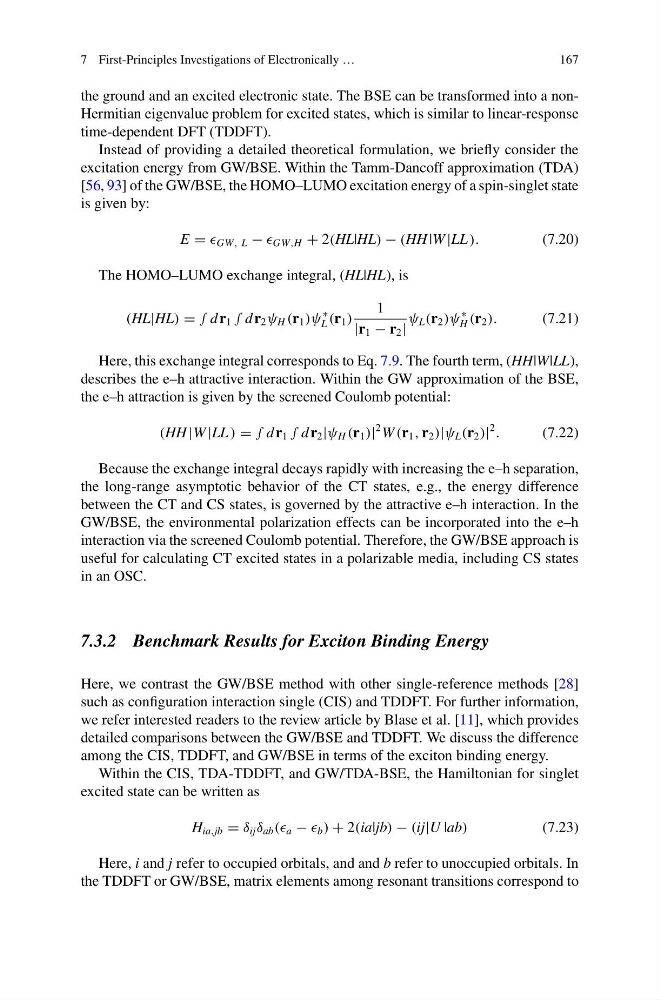
excitation energy from GW/BSE. Within the Tamm-Dancoff approximation (TDA)
[56, 93] of the GW/BSE, the HOMO–LUMO excitation energy of a spin-singlet state
is given by:
E = GW, L − GW,H + 2(HL|HL) − (HH |W |LL ).
(7.20)
The HOMO–LUMO exchange integral, (HL|HL), is
(HL|HL) = ∫ d r 1 ∫ d r 2 ψ H (r 1 )ψ
∗
L (r 1 )
1
|r 1 − r 2 |
ψ L (r 2 )ψ
∗
H (r 2 ).
(7.21)
Here, this exchange integral corresponds to Eq. 7.9. The fourth term, (HH|W|LL),
describes the e–h attractive interaction. Within the GW approximation of the BSE,
the e–h attraction is given by the screened Coulomb potential:
(HH |W |LL ) = ∫ d r 1 ∫ d r 2 |ψ H (r 1 )|
2 W (r 1 , r 2 )|ψ L (r 2 )|
2
.
(7.22)
Because the exchange integral decays rapidly with increasing the e–h separation,
the long-range asymptotic behavior of the CT states, e.g., the energy difference
between the CT and CS states, is governed by the attractive e–h interaction. In the
GW/BSE, the environmental polarization effects can be incorporated into the e–h
interaction via the screened Coulomb potential. Therefore, the GW/BSE approach is
useful for calculating CT excited states in a polarizable media, including CS states
in an OSC.
7.3.2 Benchmark Results for Exciton Binding Energy
Here, we contrast the GW/BSE method with other single-reference methods [28]
such as configuration interaction single (CIS) and TDDFT. For further information,
we refer interested readers to the review article by Blase et al. [11], which provides
detailed comparisons between the GW/BSE and TDDFT. We discuss the difference
among the CIS, TDDFT, and GW/BSE in terms of the exciton binding energy.
Within the CIS, TDA-TDDFT, and GW/TDA-BSE, the Hamiltonian for singlet
excited state can be written as
H ia,jb = δ ij δ ab ( a − b ) + 2(ia|jb) − (ij|U |ab)
(7.23)
Here, i and j refer to occupied orbitals, and and b refer to unoccupied orbitals. In
the TDDFT or GW/BSE, matrix elements among resonant transitions correspond to
167
the ground and an excited electronic state. The BSE can be transformed into a nonHermitian eigenvalue problem for excited states, which is similar to linear-response
time-dependent DFT (TDDFT).
Instead of providing a detailed theoretical formulation, we briefly consider the
excitation energy from GW/BSE. Within the Tamm-Dancoff approximation (TDA)
[56, 93] of the GW/BSE, the HOMO–LUMO excitation energy of a spin-singlet state
is given by:
E = GW, L − GW,H + 2(HL|HL) − (HH |W |LL ).
(7.20)
The HOMO–LUMO exchange integral, (HL|HL), is
(HL|HL) = ∫ d r 1 ∫ d r 2 ψ H (r 1 )ψ
∗
L (r 1 )
1
|r 1 − r 2 |
ψ L (r 2 )ψ
∗
H (r 2 ).
(7.21)
Here, this exchange integral corresponds to Eq. 7.9. The fourth term, (HH|W|LL),
describes the e–h attractive interaction. Within the GW approximation of the BSE,
the e–h attraction is given by the screened Coulomb potential:
(HH |W |LL ) = ∫ d r 1 ∫ d r 2 |ψ H (r 1 )|
2 W (r 1 , r 2 )|ψ L (r 2 )|
2
.
(7.22)
Because the exchange integral decays rapidly with increasing the e–h separation,
the long-range asymptotic behavior of the CT states, e.g., the energy difference
between the CT and CS states, is governed by the attractive e–h interaction. In the
GW/BSE, the environmental polarization effects can be incorporated into the e–h
interaction via the screened Coulomb potential. Therefore, the GW/BSE approach is
useful for calculating CT excited states in a polarizable media, including CS states
in an OSC.
7.3.2 Benchmark Results for Exciton Binding Energy
Here, we contrast the GW/BSE method with other single-reference methods [28]
such as configuration interaction single (CIS) and TDDFT. For further information,
we refer interested readers to the review article by Blase et al. [11], which provides
detailed comparisons between the GW/BSE and TDDFT. We discuss the difference
among the CIS, TDDFT, and GW/BSE in terms of the exciton binding energy.
Within the CIS, TDA-TDDFT, and GW/TDA-BSE, the Hamiltonian for singlet
excited state can be written as
H ia,jb = δ ij δ ab ( a − b ) + 2(ia|jb) − (ij|U |ab)
(7.23)
Here, i and j refer to occupied orbitals, and and b refer to unoccupied orbitals. In
the TDDFT or GW/BSE, matrix elements among resonant transitions correspond to