

166
T. Fujita
The GW is based on the one-body Green’s function [53]. The one-body Green’s
function describes an electron addition or an electron removal process; the poles of
the Green’s function correspond to the energy differences between the neutral and
charged (anionic or cationic) electronic states, including the ionization potential and
electron affinity. Within the perturbative approach of the GW method, the charged
excitation energy is obtained as the energy of a quasiparticle state for an electron (p
≥ LUMO) or a hole (p ≤ HOMO):
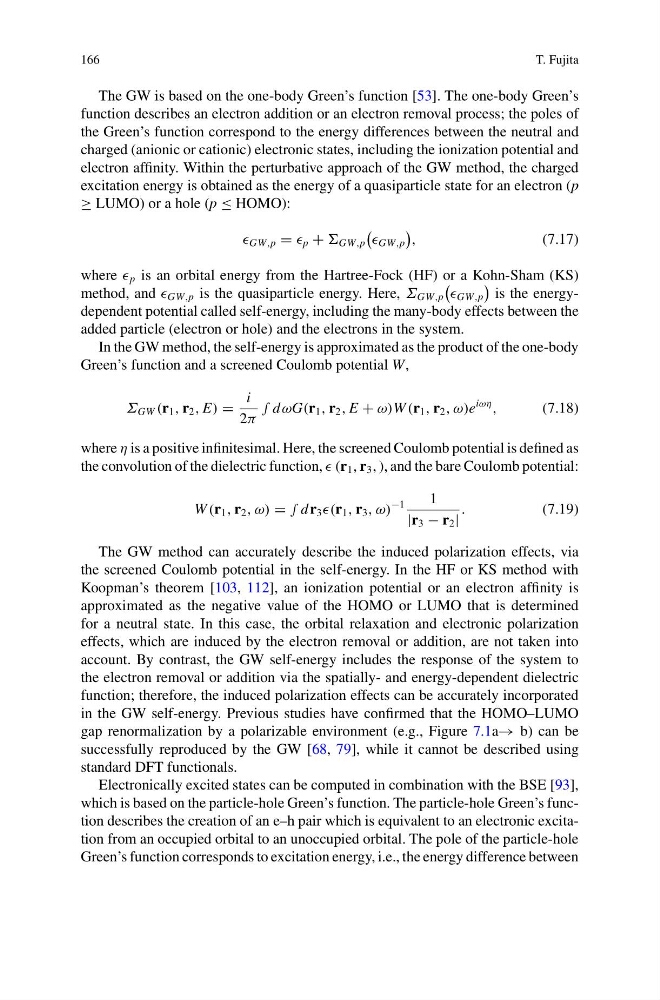
GW,p = p + GW,p
GW,p
,
(7.17)
where p is an orbital energy from the Hartree-Fock (HF) or a Kohn-Sham (KS)
method, and GW,p is the quasiparticle energy. Here, Σ GW,p
GW,p
is the energydependent potential called self-energy, including the many-body effects between the
added particle (electron or hole) and the electrons in the system.
In the GW method, the self-energy is approximated as the product of the one-body
Green’s function and a screened Coulomb potential W,
Σ GW (r 1 , r 2 , E) =
i
2π
∫ d ωG(r 1 , r 2 , E + ω)W (r 1 , r 2 , ω)e
iωη
,
(7.18)
where η is a positive infinitesimal. Here, the screened Coulomb potential is defined as
the convolution of the dielectric function, (r 1 , r 3 , ), and the bare Coulomb potential:
W (r 1 , r 2 , ω) = ∫ d r 3 (r 1 , r 3 , ω)
−1
1
|r 3 − r 2 |
.
(7.19)
The GW method can accurately describe the induced polarization effects, via
the screened Coulomb potential in the self-energy. In the HF or KS method with
Koopman’s theorem [103, 112], an ionization potential or an electron affinity is
approximated as the negative value of the HOMO or LUMO that is determined
for a neutral state. In this case, the orbital relaxation and electronic polarization
effects, which are induced by the electron removal or addition, are not taken into
account. By contrast, the GW self-energy includes the response of the system to
the electron removal or addition via the spatially- and energy-dependent dielectric
function; therefore, the induced polarization effects can be accurately incorporated
in the GW self-energy. Previous studies have confirmed that the HOMO–LUMO
gap renormalization by a polarizable environment (e.g., Figure 7.1a→ b) can be
successfully reproduced by the GW [68, 79], while it cannot be described using
standard DFT functionals.
Electronically excited states can be computed in combination with the BSE [93],
which is based on the particle-hole Green’s function. The particle-hole Green’s function describes the creation of an e–h pair which is equivalent to an electronic excitation from an occupied orbital to an unoccupied orbital. The pole of the particle-hole
Green’s function corresponds to excitation energy, i.e., the energy difference between
T. Fujita
The GW is based on the one-body Green’s function [53]. The one-body Green’s
function describes an electron addition or an electron removal process; the poles of
the Green’s function correspond to the energy differences between the neutral and
charged (anionic or cationic) electronic states, including the ionization potential and
electron affinity. Within the perturbative approach of the GW method, the charged
excitation energy is obtained as the energy of a quasiparticle state for an electron (p
≥ LUMO) or a hole (p ≤ HOMO):
GW,p = p + GW,p
GW,p
,
(7.17)
where p is an orbital energy from the Hartree-Fock (HF) or a Kohn-Sham (KS)
method, and GW,p is the quasiparticle energy. Here, Σ GW,p
GW,p
is the energydependent potential called self-energy, including the many-body effects between the
added particle (electron or hole) and the electrons in the system.
In the GW method, the self-energy is approximated as the product of the one-body
Green’s function and a screened Coulomb potential W,
Σ GW (r 1 , r 2 , E) =
i
2π
∫ d ωG(r 1 , r 2 , E + ω)W (r 1 , r 2 , ω)e
iωη
,
(7.18)
where η is a positive infinitesimal. Here, the screened Coulomb potential is defined as
the convolution of the dielectric function, (r 1 , r 3 , ), and the bare Coulomb potential:
W (r 1 , r 2 , ω) = ∫ d r 3 (r 1 , r 3 , ω)
−1
1
|r 3 − r 2 |
.
(7.19)
The GW method can accurately describe the induced polarization effects, via
the screened Coulomb potential in the self-energy. In the HF or KS method with
Koopman’s theorem [103, 112], an ionization potential or an electron affinity is
approximated as the negative value of the HOMO or LUMO that is determined
for a neutral state. In this case, the orbital relaxation and electronic polarization
effects, which are induced by the electron removal or addition, are not taken into
account. By contrast, the GW self-energy includes the response of the system to
the electron removal or addition via the spatially- and energy-dependent dielectric
function; therefore, the induced polarization effects can be accurately incorporated
in the GW self-energy. Previous studies have confirmed that the HOMO–LUMO
gap renormalization by a polarizable environment (e.g., Figure 7.1a→ b) can be
successfully reproduced by the GW [68, 79], while it cannot be described using
standard DFT functionals.
Electronically excited states can be computed in combination with the BSE [93],
which is based on the particle-hole Green’s function. The particle-hole Green’s function describes the creation of an e–h pair which is equivalent to an electronic excitation from an occupied orbital to an unoccupied orbital. The pole of the particle-hole
Green’s function corresponds to excitation energy, i.e., the energy difference between