

7 First-Principles Investigations of Electronically …
161
inversely proportional to the donor-acceptor (or e–h) distance, r DA . However, the
dependence of P
± on the e–h separation in an organic material has yet to be elucidated.
7.2.3 Excited States in Molecular Aggregates
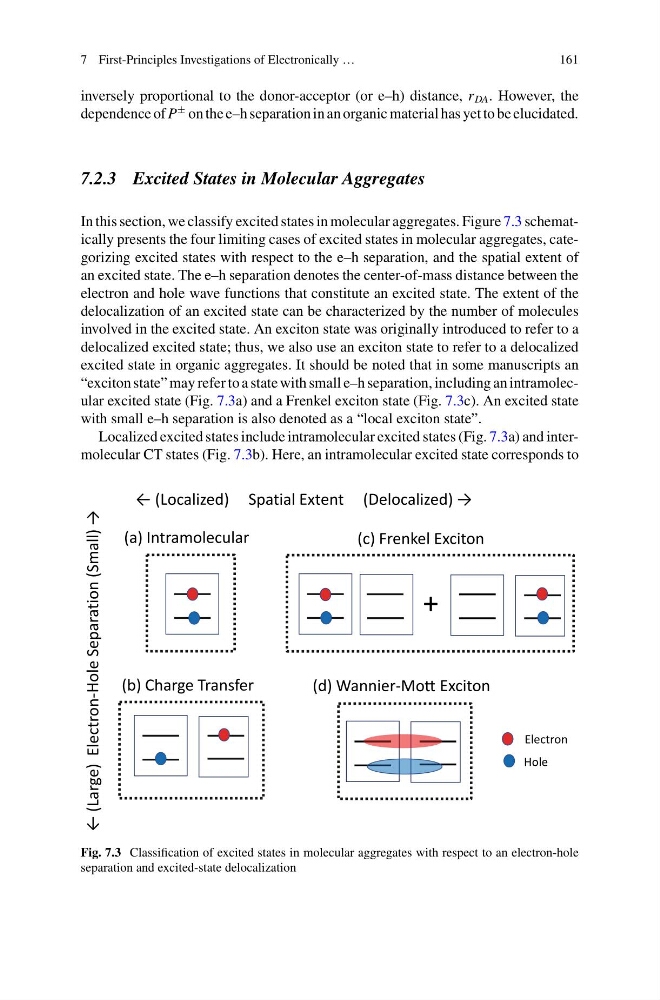
In this section, we classify excited states in molecular aggregates. Figure 7.3 schematically presents the four limiting cases of excited states in molecular aggregates, categorizing excited states with respect to the e–h separation, and the spatial extent of
an excited state. The e–h separation denotes the center-of-mass distance between the
electron and hole wave functions that constitute an excited state. The extent of the
delocalization of an excited state can be characterized by the number of molecules
involved in the excited state. An exciton state was originally introduced to refer to a
delocalized excited state; thus, we also use an exciton state to refer to a delocalized
excited state in organic aggregates. It should be noted that in some manuscripts an
“exciton state” may refer to a state with small e–h separation, including an intramolecular excited state (Fig. 7.3a) and a Frenkel exciton state (Fig. 7.3c). An excited state
with small e–h separation is also denoted as a “local exciton state”.
Localized excited states include intramolecular excited states (Fig. 7.3a) and intermolecular CT states (Fig. 7.3b). Here, an intramolecular excited state corresponds to
(Large
Electron+
-MoƩ
Electron
Hole
Fig. 7.3 Classification of excited states in molecular aggregates with respect to an electron-hole
separation and excited-state delocalization
161
inversely proportional to the donor-acceptor (or e–h) distance, r DA . However, the
dependence of P
± on the e–h separation in an organic material has yet to be elucidated.
7.2.3 Excited States in Molecular Aggregates
In this section, we classify excited states in molecular aggregates. Figure 7.3 schematically presents the four limiting cases of excited states in molecular aggregates, categorizing excited states with respect to the e–h separation, and the spatial extent of
an excited state. The e–h separation denotes the center-of-mass distance between the
electron and hole wave functions that constitute an excited state. The extent of the
delocalization of an excited state can be characterized by the number of molecules
involved in the excited state. An exciton state was originally introduced to refer to a
delocalized excited state; thus, we also use an exciton state to refer to a delocalized
excited state in organic aggregates. It should be noted that in some manuscripts an
“exciton state” may refer to a state with small e–h separation, including an intramolecular excited state (Fig. 7.3a) and a Frenkel exciton state (Fig. 7.3c). An excited state
with small e–h separation is also denoted as a “local exciton state”.
Localized excited states include intramolecular excited states (Fig. 7.3a) and intermolecular CT states (Fig. 7.3b). Here, an intramolecular excited state corresponds to
(Large
Electron+
-MoƩ
Electron
Hole
Fig. 7.3 Classification of excited states in molecular aggregates with respect to an electron-hole
separation and excited-state delocalization