

160
T. Fujita
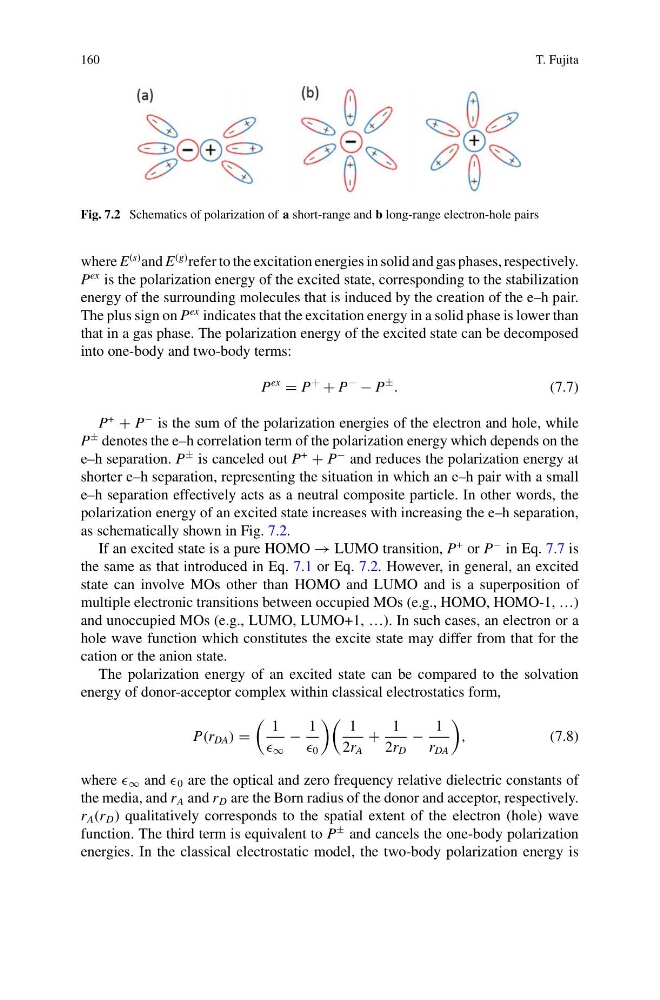
Fig. 7.2 Schematics of polarization of a short-range and b long-range electron-hole pairs
where E
(s) and E
(g) refer to the excitation energies in solid and gas phases, respectively.
P
ex is the polarization energy of the excited state, corresponding to the stabilization
energy of the surrounding molecules that is induced by the creation of the e–h pair.
The plus sign on P
ex indicates that the excitation energy in a solid phase is lower than
that in a gas phase. The polarization energy of the excited state can be decomposed
into one-body and two-body terms:
P
ex
= P
+
+ P
−
− P
±
.
(7.7)
P
+
+ P
− is the sum of the polarization energies of the electron and hole, while
P
± denotes the e–h correlation term of the polarization energy which depends on the
e–h separation. P
± is canceled out P
+
+ P
− and reduces the polarization energy at
shorter e–h separation, representing the situation in which an e–h pair with a small
e–h separation effectively acts as a neutral composite particle. In other words, the
polarization energy of an excited state increases with increasing the e–h separation,
as schematically shown in Fig. 7.2.
If an excited state is a pure HOMO → LUMO transition, P
+ or P
− in Eq. 7.7 is
the same as that introduced in Eq. 7.1 or Eq. 7.2. However, in general, an excited
state can involve MOs other than HOMO and LUMO and is a superposition of
multiple electronic transitions between occupied MOs (e.g., HOMO, HOMO-1, …)
and unoccupied MOs (e.g., LUMO, LUMO+1, …). In such cases, an electron or a
hole wave function which constitutes the excite state may differ from that for the
cation or the anion state.
The polarization energy of an excited state can be compared to the solvation
energy of donor-acceptor complex within classical electrostatics form,
P(r DA ) =
1
∞
−
1
0
1
2r A
+
1
2r D
−
1
r DA
,
(7.8)
where ∞ and 0 are the optical and zero frequency relative dielectric constants of
the media, and r A and r D are the Born radius of the donor and acceptor, respectively.
r A (r D ) qualitatively corresponds to the spatial extent of the electron (hole) wave
function. The third term is equivalent to P
± and cancels the one-body polarization
energies. In the classical electrostatic model, the two-body polarization energy is
T. Fujita
Fig. 7.2 Schematics of polarization of a short-range and b long-range electron-hole pairs
where E
(s) and E
(g) refer to the excitation energies in solid and gas phases, respectively.
P
ex is the polarization energy of the excited state, corresponding to the stabilization
energy of the surrounding molecules that is induced by the creation of the e–h pair.
The plus sign on P
ex indicates that the excitation energy in a solid phase is lower than
that in a gas phase. The polarization energy of the excited state can be decomposed
into one-body and two-body terms:
P
ex
= P
+
+ P
−
− P
±
.
(7.7)
P
+
+ P
− is the sum of the polarization energies of the electron and hole, while
P
± denotes the e–h correlation term of the polarization energy which depends on the
e–h separation. P
± is canceled out P
+
+ P
− and reduces the polarization energy at
shorter e–h separation, representing the situation in which an e–h pair with a small
e–h separation effectively acts as a neutral composite particle. In other words, the
polarization energy of an excited state increases with increasing the e–h separation,
as schematically shown in Fig. 7.2.
If an excited state is a pure HOMO → LUMO transition, P
+ or P
− in Eq. 7.7 is
the same as that introduced in Eq. 7.1 or Eq. 7.2. However, in general, an excited
state can involve MOs other than HOMO and LUMO and is a superposition of
multiple electronic transitions between occupied MOs (e.g., HOMO, HOMO-1, …)
and unoccupied MOs (e.g., LUMO, LUMO+1, …). In such cases, an electron or a
hole wave function which constitutes the excite state may differ from that for the
cation or the anion state.
The polarization energy of an excited state can be compared to the solvation
energy of donor-acceptor complex within classical electrostatics form,
P(r DA ) =
1
∞
−
1
0
1
2r A
+
1
2r D
−
1
r DA
,
(7.8)
where ∞ and 0 are the optical and zero frequency relative dielectric constants of
the media, and r A and r D are the Born radius of the donor and acceptor, respectively.
r A (r D ) qualitatively corresponds to the spatial extent of the electron (hole) wave
function. The third term is equivalent to P
± and cancels the one-body polarization
energies. In the classical electrostatic model, the two-body polarization energy is