

162
T. Fujita
an electronic transition within a single organic molecule, such as a π → π
* transition in most π conjugated molecules. Hereafter, we denote a localized intramolecular
excited state as an LE state. The intermolecular CT state consists of an electron localized within a molecule and a hole localized within another molecule. In the following,
we use the term “CT state” to refer to a localized CT state comprising a localized
electron and a localized hole. In this classification, the CT states include CS states
in an OSC, although the distance at which a CT state can be regarded as a free
electron and a free hole is unclear. The CT state should be distinguished from the
Wannier-Mott exciton state, as explained later. The number of molecules involved in
a localized CT state is two. By contrast, the Wannier-Mott exciton state is composed
of delocalized electron and hole wave functions, in which the excitation is shared by
multiple molecules via these delocalized orbitals.
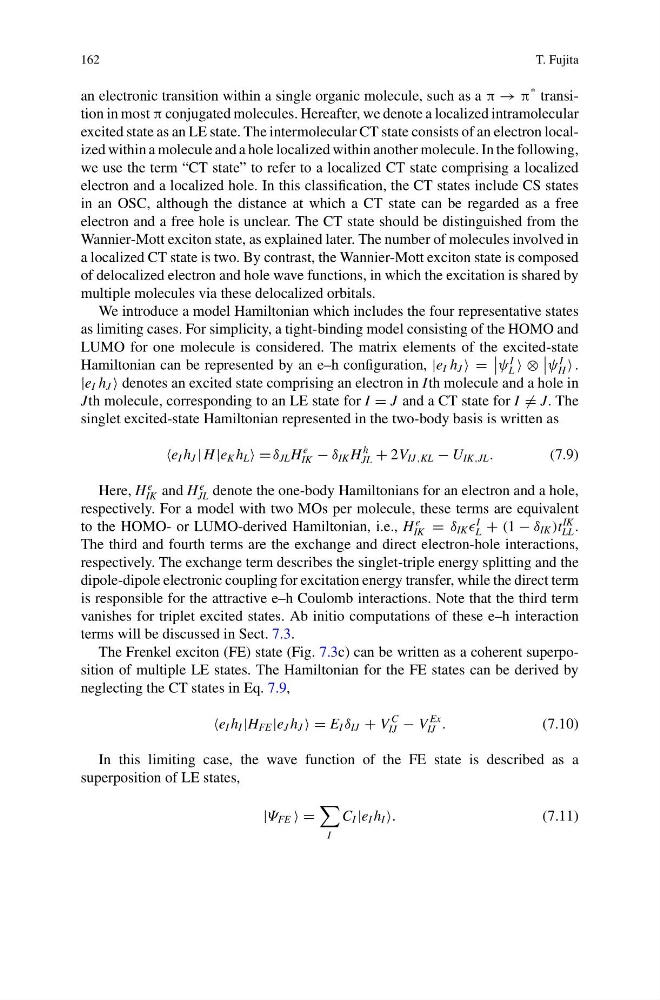
We introduce a model Hamiltonian which includes the four representative states
as limiting cases. For simplicity, a tight-binding model consisting of the HOMO and
LUMO for one molecule is considered. The matrix elements of the excited-state
Hamiltonian can be represented by an e–h configuration, |e I h J =
ψ
I
L ⊗
ψ
I
H .
|e I h J denotes an excited state comprising an electron in Ith molecule and a hole in
Jth molecule, corresponding to an LE state for I = J and a CT state for I = J. The
singlet excited-state Hamiltonian represented in the two-body basis is written as
e I h J | H |e K h L =δ JL H
e
IK − δ IK H
h
JL + 2V IJ ,KL − U IK,JL .
(7.9)
Here, H
e
IK and H
e
JL denote the one-body Hamiltonians for an electron and a hole,
respectively. For a model with two MOs per molecule, these terms are equivalent
to the HOMO- or LUMO-derived Hamiltonian, i.e., H
e
IK = δ IK
I
L + (1 − δ IK )t
IK
LL .
The third and fourth terms are the exchange and direct electron-hole interactions,
respectively. The exchange term describes the singlet-triple energy splitting and the
dipole-dipole electronic coupling for excitation energy transfer, while the direct term
is responsible for the attractive e–h Coulomb interactions. Note that the third term
vanishes for triplet excited states. Ab initio computations of these e–h interaction
terms will be discussed in Sect. 7.3.
The Frenkel exciton (FE) state (Fig. 7.3c) can be written as a coherent superposition of multiple LE states. The Hamiltonian for the FE states can be derived by
neglecting the CT states in Eq. 7.9,
e I h I |H FE |e J h J = E I δ IJ + V
C
IJ − V
Ex
IJ .
(7.10)
In this limiting case, the wave function of the FE state is described as a
superposition of LE states,
|Ψ FE =
I
C I |e I h I .
(7.11)
T. Fujita
an electronic transition within a single organic molecule, such as a π → π
* transition in most π conjugated molecules. Hereafter, we denote a localized intramolecular
excited state as an LE state. The intermolecular CT state consists of an electron localized within a molecule and a hole localized within another molecule. In the following,
we use the term “CT state” to refer to a localized CT state comprising a localized
electron and a localized hole. In this classification, the CT states include CS states
in an OSC, although the distance at which a CT state can be regarded as a free
electron and a free hole is unclear. The CT state should be distinguished from the
Wannier-Mott exciton state, as explained later. The number of molecules involved in
a localized CT state is two. By contrast, the Wannier-Mott exciton state is composed
of delocalized electron and hole wave functions, in which the excitation is shared by
multiple molecules via these delocalized orbitals.
We introduce a model Hamiltonian which includes the four representative states
as limiting cases. For simplicity, a tight-binding model consisting of the HOMO and
LUMO for one molecule is considered. The matrix elements of the excited-state
Hamiltonian can be represented by an e–h configuration, |e I h J =
ψ
I
L ⊗
ψ
I
H .
|e I h J denotes an excited state comprising an electron in Ith molecule and a hole in
Jth molecule, corresponding to an LE state for I = J and a CT state for I = J. The
singlet excited-state Hamiltonian represented in the two-body basis is written as
e I h J | H |e K h L =δ JL H
e
IK − δ IK H
h
JL + 2V IJ ,KL − U IK,JL .
(7.9)
Here, H
e
IK and H
e
JL denote the one-body Hamiltonians for an electron and a hole,
respectively. For a model with two MOs per molecule, these terms are equivalent
to the HOMO- or LUMO-derived Hamiltonian, i.e., H
e
IK = δ IK
I
L + (1 − δ IK )t
IK
LL .
The third and fourth terms are the exchange and direct electron-hole interactions,
respectively. The exchange term describes the singlet-triple energy splitting and the
dipole-dipole electronic coupling for excitation energy transfer, while the direct term
is responsible for the attractive e–h Coulomb interactions. Note that the third term
vanishes for triplet excited states. Ab initio computations of these e–h interaction
terms will be discussed in Sect. 7.3.
The Frenkel exciton (FE) state (Fig. 7.3c) can be written as a coherent superposition of multiple LE states. The Hamiltonian for the FE states can be derived by
neglecting the CT states in Eq. 7.9,
e I h I |H FE |e J h J = E I δ IJ + V
C
IJ − V
Ex
IJ .
(7.10)
In this limiting case, the wave function of the FE state is described as a
superposition of LE states,
|Ψ FE =
I
C I |e I h I .
(7.11)