

1 Basic Principles of Modern Organic Solar Cells
9
(A
− ) and positively (D
+ ), respectively (Fig. 1.7d). Irrespective of the excitation of
the molecules (A) and (D), the charge-transferred states (D
+ A
− ) obtained are the
same. Thus, a charge transfer (CT) exciton is formed, wherein the positive and
negative charges are separated on neighboring D and A molecules due to photoinduced electron transfer (Fig. 1.7b). This CT exciton can dissociate to a free electron and a hole due to the thermal energy at room temperature. By utilizing this
donor–acceptor (D/A) sensitization, organic semiconductors have become capable
of generating photocurrents of significant magnitudes, of the order of milliamperes,
by solar radiation. Note that the terminology, CT exciton and CT state that appeared
in Sect. 1.2.1.2 and Sect. 1.2.2.2. are identical.
1.2.1.3 Exciton Diffusion
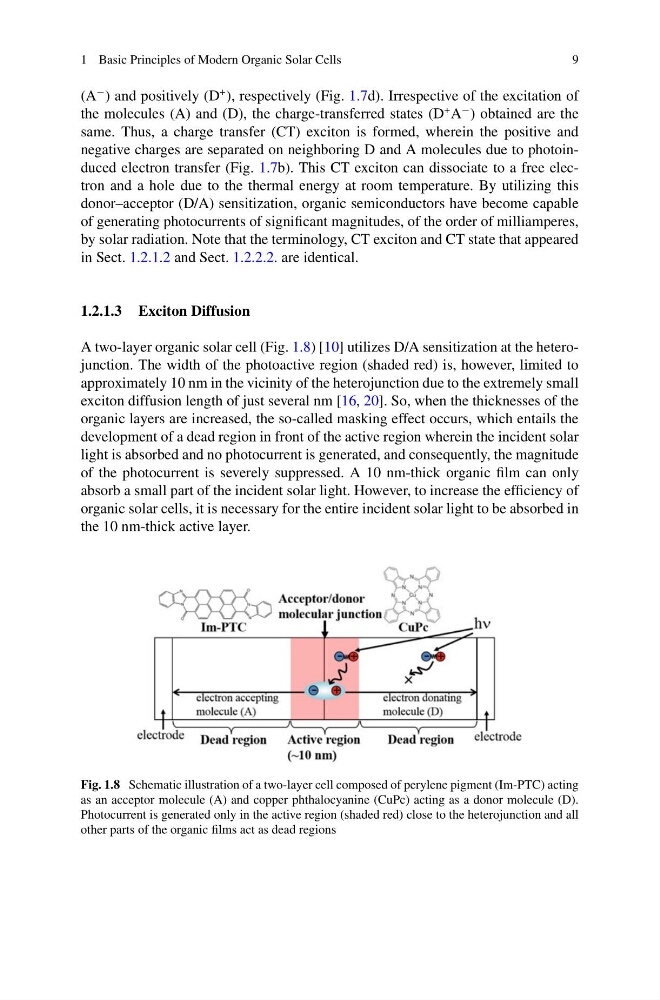
A two-layer organic solar cell (Fig. 1.8) [10] utilizes D/A sensitization at the heterojunction. The width of the photoactive region (shaded red) is, however, limited to
approximately 10 nm in the vicinity of the heterojunction due to the extremely small
exciton diffusion length of just several nm [16, 20]. So, when the thicknesses of the
organic layers are increased, the so-called masking effect occurs, which entails the
development of a dead region in front of the active region wherein the incident solar
light is absorbed and no photocurrent is generated, and consequently, the magnitude
of the photocurrent is severely suppressed. A 10 nm-thick organic film can only
absorb a small part of the incident solar light. However, to increase the efficiency of
organic solar cells, it is necessary for the entire incident solar light to be absorbed in
the 10 nm-thick active layer.
Fig. 1.8 Schematic illustration of a two-layer cell composed of perylene pigment (Im-PTC) acting
as an acceptor molecule (A) and copper phthalocyanine (CuPc) acting as a donor molecule (D).
Photocurrent is generated only in the active region (shaded red) close to the heterojunction and all
other parts of the organic films act as dead regions
9
(A
− ) and positively (D
+ ), respectively (Fig. 1.7d). Irrespective of the excitation of
the molecules (A) and (D), the charge-transferred states (D
+ A
− ) obtained are the
same. Thus, a charge transfer (CT) exciton is formed, wherein the positive and
negative charges are separated on neighboring D and A molecules due to photoinduced electron transfer (Fig. 1.7b). This CT exciton can dissociate to a free electron and a hole due to the thermal energy at room temperature. By utilizing this
donor–acceptor (D/A) sensitization, organic semiconductors have become capable
of generating photocurrents of significant magnitudes, of the order of milliamperes,
by solar radiation. Note that the terminology, CT exciton and CT state that appeared
in Sect. 1.2.1.2 and Sect. 1.2.2.2. are identical.
1.2.1.3 Exciton Diffusion
A two-layer organic solar cell (Fig. 1.8) [10] utilizes D/A sensitization at the heterojunction. The width of the photoactive region (shaded red) is, however, limited to
approximately 10 nm in the vicinity of the heterojunction due to the extremely small
exciton diffusion length of just several nm [16, 20]. So, when the thicknesses of the
organic layers are increased, the so-called masking effect occurs, which entails the
development of a dead region in front of the active region wherein the incident solar
light is absorbed and no photocurrent is generated, and consequently, the magnitude
of the photocurrent is severely suppressed. A 10 nm-thick organic film can only
absorb a small part of the incident solar light. However, to increase the efficiency of
organic solar cells, it is necessary for the entire incident solar light to be absorbed in
the 10 nm-thick active layer.
Fig. 1.8 Schematic illustration of a two-layer cell composed of perylene pigment (Im-PTC) acting
as an acceptor molecule (A) and copper phthalocyanine (CuPc) acting as a donor molecule (D).
Photocurrent is generated only in the active region (shaded red) close to the heterojunction and all
other parts of the organic films act as dead regions