

8
M. Hiramoto
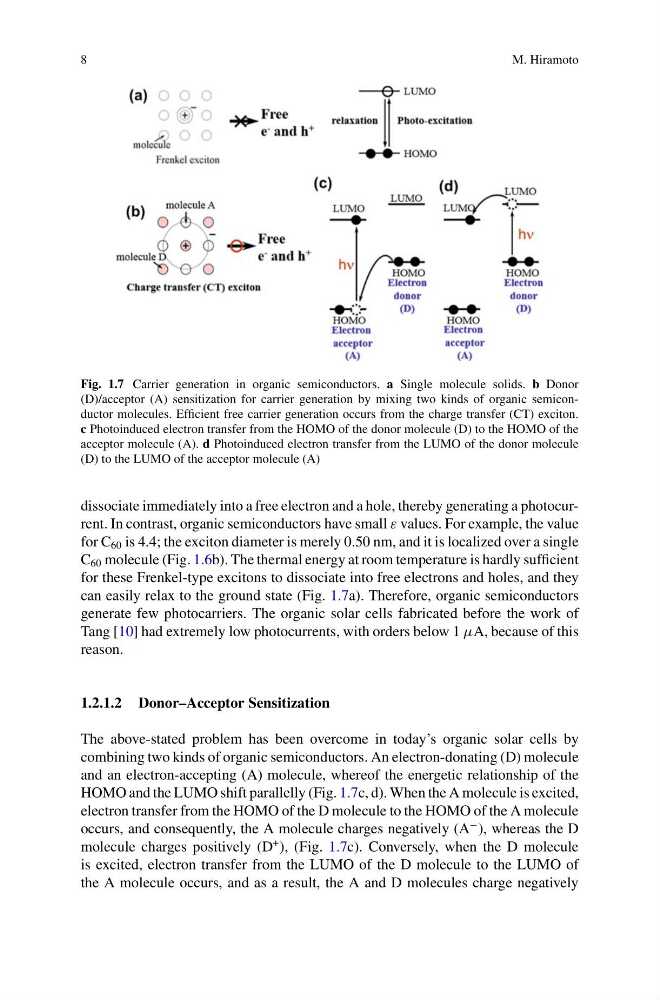
Fig. 1.7 Carrier generation in organic semiconductors. a Single molecule solids. b Donor
(D)/acceptor (A) sensitization for carrier generation by mixing two kinds of organic semiconductor molecules. Efficient free carrier generation occurs from the charge transfer (CT) exciton.
c Photoinduced electron transfer from the HOMO of the donor molecule (D) to the HOMO of the
acceptor molecule (A). d Photoinduced electron transfer from the LUMO of the donor molecule
(D) to the LUMO of the acceptor molecule (A)
dissociate immediately into a free electron and a hole, thereby generating a photocurrent. In contrast, organic semiconductors have small ε values. For example, the value
for C 60 is 4.4; the exciton diameter is merely 0.50 nm, and it is localized over a single
C 60 molecule (Fig. 1.6b). The thermal energy at room temperature is hardly sufficient
for these Frenkel-type excitons to dissociate into free electrons and holes, and they
can easily relax to the ground state (Fig. 1.7a). Therefore, organic semiconductors
generate few photocarriers. The organic solar cells fabricated before the work of
Tang [10] had extremely low photocurrents, with orders below 1 μA, because of this
reason.
1.2.1.2 Donor–Acceptor Sensitization
The above-stated problem has been overcome in today’s organic solar cells by
combining two kinds of organic semiconductors. An electron-donating (D) molecule
and an electron-accepting (A) molecule, whereof the energetic relationship of the
HOMO and the LUMO shift parallelly (Fig. 1.7c, d). When the A molecule is excited,
electron transfer from the HOMO of the D molecule to the HOMO of the A molecule
occurs, and consequently, the A molecule charges negatively (A
− ), whereas the D
molecule charges positively (D
+ ), (Fig. 1.7c). Conversely, when the D molecule
is excited, electron transfer from the LUMO of the D molecule to the LUMO of
the A molecule occurs, and as a result, the A and D molecules charge negatively
M. Hiramoto
Fig. 1.7 Carrier generation in organic semiconductors. a Single molecule solids. b Donor
(D)/acceptor (A) sensitization for carrier generation by mixing two kinds of organic semiconductor molecules. Efficient free carrier generation occurs from the charge transfer (CT) exciton.
c Photoinduced electron transfer from the HOMO of the donor molecule (D) to the HOMO of the
acceptor molecule (A). d Photoinduced electron transfer from the LUMO of the donor molecule
(D) to the LUMO of the acceptor molecule (A)
dissociate immediately into a free electron and a hole, thereby generating a photocurrent. In contrast, organic semiconductors have small ε values. For example, the value
for C 60 is 4.4; the exciton diameter is merely 0.50 nm, and it is localized over a single
C 60 molecule (Fig. 1.6b). The thermal energy at room temperature is hardly sufficient
for these Frenkel-type excitons to dissociate into free electrons and holes, and they
can easily relax to the ground state (Fig. 1.7a). Therefore, organic semiconductors
generate few photocarriers. The organic solar cells fabricated before the work of
Tang [10] had extremely low photocurrents, with orders below 1 μA, because of this
reason.
1.2.1.2 Donor–Acceptor Sensitization
The above-stated problem has been overcome in today’s organic solar cells by
combining two kinds of organic semiconductors. An electron-donating (D) molecule
and an electron-accepting (A) molecule, whereof the energetic relationship of the
HOMO and the LUMO shift parallelly (Fig. 1.7c, d). When the A molecule is excited,
electron transfer from the HOMO of the D molecule to the HOMO of the A molecule
occurs, and consequently, the A molecule charges negatively (A
− ), whereas the D
molecule charges positively (D
+ ), (Fig. 1.7c). Conversely, when the D molecule
is excited, electron transfer from the LUMO of the D molecule to the LUMO of
the A molecule occurs, and as a result, the A and D molecules charge negatively