

1 Basic Principles of Modern Organic Solar Cells
7
1.2 Principles
1.2.1 Photocurrent
1.2.1.1 Excitons
The dissociation of photogenerated electron–hole pairs (excitons) is a key factor for
generating carriers in organic semiconductors. Exciton dissociation is affected by the
relative permittivity of the solid (ε). The attractive force between an electron–hole
pair is given by Coulomb’s law:
F =
1
4πεε 0
q 1 q 2
r 2
.
(1.1)
where q 1 and q 2 are the elementary charges on the electron and the hole, respectively,
and ε 0 and r are the absolute permittivity and the distance between them, respectively.
In a solid with a small value of ε, the positive and negative charges experience a strong
attractive force, whereas, in a solid with a large value of ε, the positive and negative
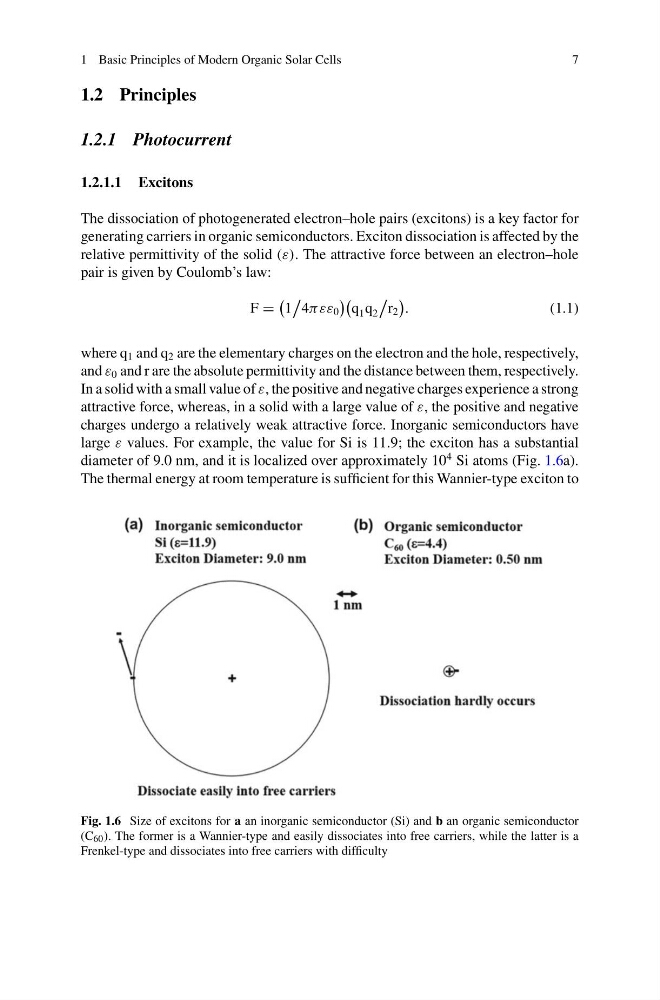
charges undergo a relatively weak attractive force. Inorganic semiconductors have
large ε values. For example, the value for Si is 11.9; the exciton has a substantial
diameter of 9.0 nm, and it is localized over approximately 10
4 Si atoms (Fig. 1.6a).
The thermal energy at room temperature is sufficient for this Wannier-type exciton to
Fig. 1.6 Size of excitons for a an inorganic semiconductor (Si) and b an organic semiconductor
(C 60 ). The former is a Wannier-type and easily dissociates into free carriers, while the latter is a
Frenkel-type and dissociates into free carriers with difficulty
7
1.2 Principles
1.2.1 Photocurrent
1.2.1.1 Excitons
The dissociation of photogenerated electron–hole pairs (excitons) is a key factor for
generating carriers in organic semiconductors. Exciton dissociation is affected by the
relative permittivity of the solid (ε). The attractive force between an electron–hole
pair is given by Coulomb’s law:
F =
1
4πεε 0
q 1 q 2
r 2
.
(1.1)
where q 1 and q 2 are the elementary charges on the electron and the hole, respectively,
and ε 0 and r are the absolute permittivity and the distance between them, respectively.
In a solid with a small value of ε, the positive and negative charges experience a strong
attractive force, whereas, in a solid with a large value of ε, the positive and negative
charges undergo a relatively weak attractive force. Inorganic semiconductors have
large ε values. For example, the value for Si is 11.9; the exciton has a substantial
diameter of 9.0 nm, and it is localized over approximately 10
4 Si atoms (Fig. 1.6a).
The thermal energy at room temperature is sufficient for this Wannier-type exciton to
Fig. 1.6 Size of excitons for a an inorganic semiconductor (Si) and b an organic semiconductor
(C 60 ). The former is a Wannier-type and easily dissociates into free carriers, while the latter is a
Frenkel-type and dissociates into free carriers with difficulty