

10
M. Hiramoto
1.2.1.4 Blended Junctions
To overcome this problem, blended junctions in organic semiconductors, which
contain both donors and acceptors, were fabricated using the co-deposition technique
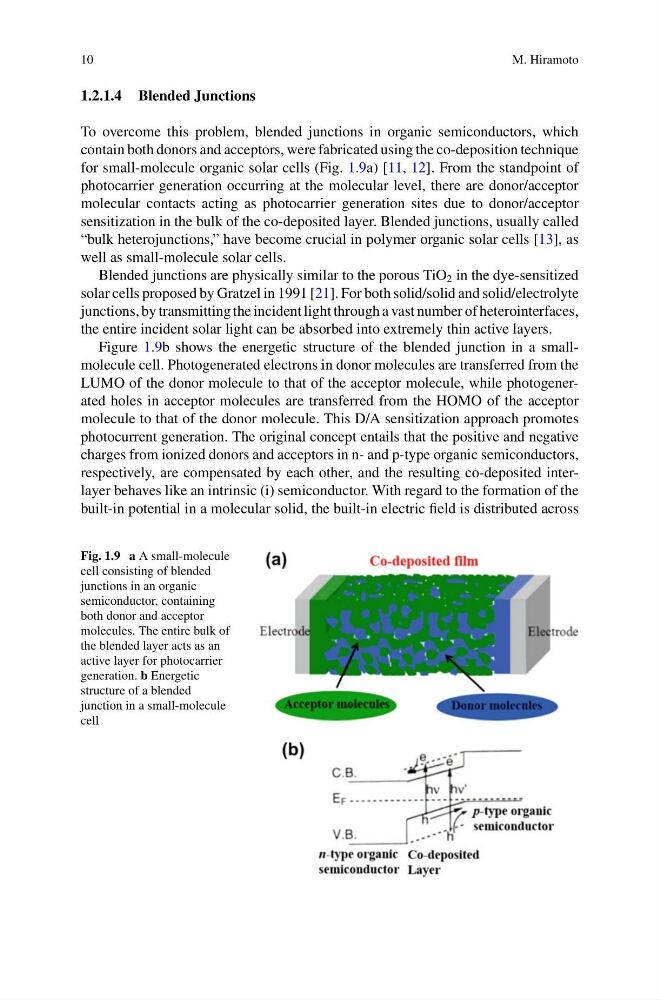
for small-molecule organic solar cells (Fig. 1.9a) [11, 12]. From the standpoint of
photocarrier generation occurring at the molecular level, there are donor/acceptor
molecular contacts acting as photocarrier generation sites due to donor/acceptor
sensitization in the bulk of the co-deposited layer. Blended junctions, usually called
“bulk heterojunctions,” have become crucial in polymer organic solar cells [13], as
well as small-molecule solar cells.
Blended junctions are physically similar to the porous TiO 2 in the dye-sensitized
solar cells proposed by Gratzel in 1991 [21]. For both solid/solid and solid/electrolyte
junctions, by transmitting the incident light through a vast number of heterointerfaces,
the entire incident solar light can be absorbed into extremely thin active layers.
Figure 1.9b shows the energetic structure of the blended junction in a smallmolecule cell. Photogenerated electrons in donor molecules are transferred from the
LUMO of the donor molecule to that of the acceptor molecule, while photogenerated holes in acceptor molecules are transferred from the HOMO of the acceptor
molecule to that of the donor molecule. This D/A sensitization approach promotes
photocurrent generation. The original concept entails that the positive and negative
charges from ionized donors and acceptors in n- and p-type organic semiconductors,
respectively, are compensated by each other, and the resulting co-deposited interlayer behaves like an intrinsic (i) semiconductor. With regard to the formation of the
built-in potential in a molecular solid, the built-in electric field is distributed across
Fig. 1.9 a A small-molecule
cell consisting of blended
junctions in an organic
semiconductor, containing
both donor and acceptor
molecules. The entire bulk of
the blended layer acts as an
active layer for photocarrier
generation. b Energetic
structure of a blended
junction in a small-molecule
cell
M. Hiramoto
1.2.1.4 Blended Junctions
To overcome this problem, blended junctions in organic semiconductors, which
contain both donors and acceptors, were fabricated using the co-deposition technique
for small-molecule organic solar cells (Fig. 1.9a) [11, 12]. From the standpoint of
photocarrier generation occurring at the molecular level, there are donor/acceptor
molecular contacts acting as photocarrier generation sites due to donor/acceptor
sensitization in the bulk of the co-deposited layer. Blended junctions, usually called
“bulk heterojunctions,” have become crucial in polymer organic solar cells [13], as
well as small-molecule solar cells.
Blended junctions are physically similar to the porous TiO 2 in the dye-sensitized
solar cells proposed by Gratzel in 1991 [21]. For both solid/solid and solid/electrolyte
junctions, by transmitting the incident light through a vast number of heterointerfaces,
the entire incident solar light can be absorbed into extremely thin active layers.
Figure 1.9b shows the energetic structure of the blended junction in a smallmolecule cell. Photogenerated electrons in donor molecules are transferred from the
LUMO of the donor molecule to that of the acceptor molecule, while photogenerated holes in acceptor molecules are transferred from the HOMO of the acceptor
molecule to that of the donor molecule. This D/A sensitization approach promotes
photocurrent generation. The original concept entails that the positive and negative
charges from ionized donors and acceptors in n- and p-type organic semiconductors,
respectively, are compensated by each other, and the resulting co-deposited interlayer behaves like an intrinsic (i) semiconductor. With regard to the formation of the
built-in potential in a molecular solid, the built-in electric field is distributed across
Fig. 1.9 a A small-molecule
cell consisting of blended
junctions in an organic
semiconductor, containing
both donor and acceptor
molecules. The entire bulk of
the blended layer acts as an
active layer for photocarrier
generation. b Energetic
structure of a blended
junction in a small-molecule
cell