

6 Charge Carrier Dynamics in Polymer Solar Cells
149
Table 6.1 Photovoltaic conversion efficiency in polymer solar cells with different crystallinities
Polymers
Morphology
η ED
η CD
L C /nm c d π /nm d E LL /eV Refs.
PNOz4T
Highly crystalline ~0.6
~1
~0.1
36
RR-P3HT
(TA) a
Highly crystalline ~0.9
>0.9
~12
0.38
~1.1
27,51,52
RR-P3HT
Less crystalline
~0.95 ~0.8
5.7
0.38
~1.1
27,53
PNTz4T
Less crystalline
>0.95 ~0.75 2.7
0.35
~0.3
36,38
PSBTBT
Less crystalline
~1
~0.75 4.6
0.35
~0.4
34,54,55
PCPDTBT
(DIO) b
Less crystalline
~1
~0.7
~0.3
29
PCPDTBT Slightly ordered
~1
~0.5
~0.3
29
N-P7
Amorphous
~1
~0.65
~0.4
30
RRa-P3HT Amorphous
~1
~0.3
~1.2
27
a TA represents thermal annealing at 140 °C for 30 min. b DIO represents 1,8-diiodeoctane employed
as a solvent additive. c L C represents a coherence length in the π-stacking direction (010). d d π
represents a π–π stacking distance of crystallites
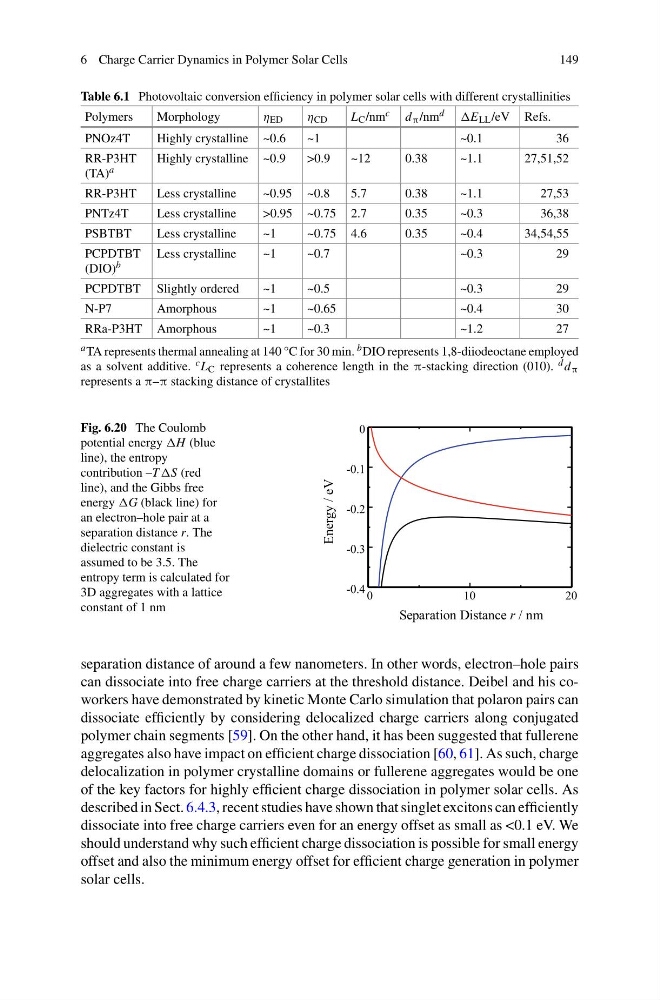
Fig. 6.20 The Coulomb
potential energy H (blue
line), the entropy
contribution –T S (red
line), and the Gibbs free
energy G (black line) for
an electron–hole pair at a
separation distance r. The
dielectric constant is
assumed to be 3.5. The
entropy term is calculated for
3D aggregates with a lattice
constant of 1 nm
0
10
20
-0.4
-0.3
-0.2
-0.1
0
Energy / eV
Separation Distance r / nm
separation distance of around a few nanometers. In other words, electron–hole pairs
can dissociate into free charge carriers at the threshold distance. Deibel and his coworkers have demonstrated by kinetic Monte Carlo simulation that polaron pairs can
dissociate efficiently by considering delocalized charge carriers along conjugated
polymer chain segments [59]. On the other hand, it has been suggested that fullerene
aggregates also have impact on efficient charge dissociation [60, 61]. As such, charge
delocalization in polymer crystalline domains or fullerene aggregates would be one
of the key factors for highly efficient charge dissociation in polymer solar cells. As
described in Sect. 6.4.3, recent studies have shown that singlet excitons can efficiently
dissociate into free charge carriers even for an energy offset as small as <0.1 eV. We
should understand why such efficient charge dissociation is possible for small energy
offset and also the minimum energy offset for efficient charge generation in polymer
solar cells.
149
Table 6.1 Photovoltaic conversion efficiency in polymer solar cells with different crystallinities
Polymers
Morphology
η ED
η CD
L C /nm c d π /nm d E LL /eV Refs.
PNOz4T
Highly crystalline ~0.6
~1
~0.1
36
RR-P3HT
(TA) a
Highly crystalline ~0.9
>0.9
~12
0.38
~1.1
27,51,52
RR-P3HT
Less crystalline
~0.95 ~0.8
5.7
0.38
~1.1
27,53
PNTz4T
Less crystalline
>0.95 ~0.75 2.7
0.35
~0.3
36,38
PSBTBT
Less crystalline
~1
~0.75 4.6
0.35
~0.4
34,54,55
PCPDTBT
(DIO) b
Less crystalline
~1
~0.7
~0.3
29
PCPDTBT Slightly ordered
~1
~0.5
~0.3
29
N-P7
Amorphous
~1
~0.65
~0.4
30
RRa-P3HT Amorphous
~1
~0.3
~1.2
27
a TA represents thermal annealing at 140 °C for 30 min. b DIO represents 1,8-diiodeoctane employed
as a solvent additive. c L C represents a coherence length in the π-stacking direction (010). d d π
represents a π–π stacking distance of crystallites
Fig. 6.20 The Coulomb
potential energy H (blue
line), the entropy
contribution –T S (red
line), and the Gibbs free
energy G (black line) for
an electron–hole pair at a
separation distance r. The
dielectric constant is
assumed to be 3.5. The
entropy term is calculated for
3D aggregates with a lattice
constant of 1 nm
0
10
20
-0.4
-0.3
-0.2
-0.1
0
Energy / eV
Separation Distance r / nm
separation distance of around a few nanometers. In other words, electron–hole pairs
can dissociate into free charge carriers at the threshold distance. Deibel and his coworkers have demonstrated by kinetic Monte Carlo simulation that polaron pairs can
dissociate efficiently by considering delocalized charge carriers along conjugated
polymer chain segments [59]. On the other hand, it has been suggested that fullerene
aggregates also have impact on efficient charge dissociation [60, 61]. As such, charge
delocalization in polymer crystalline domains or fullerene aggregates would be one
of the key factors for highly efficient charge dissociation in polymer solar cells. As
described in Sect. 6.4.3, recent studies have shown that singlet excitons can efficiently
dissociate into free charge carriers even for an energy offset as small as <0.1 eV. We
should understand why such efficient charge dissociation is possible for small energy
offset and also the minimum energy offset for efficient charge generation in polymer
solar cells.