

150
H. Ohkita
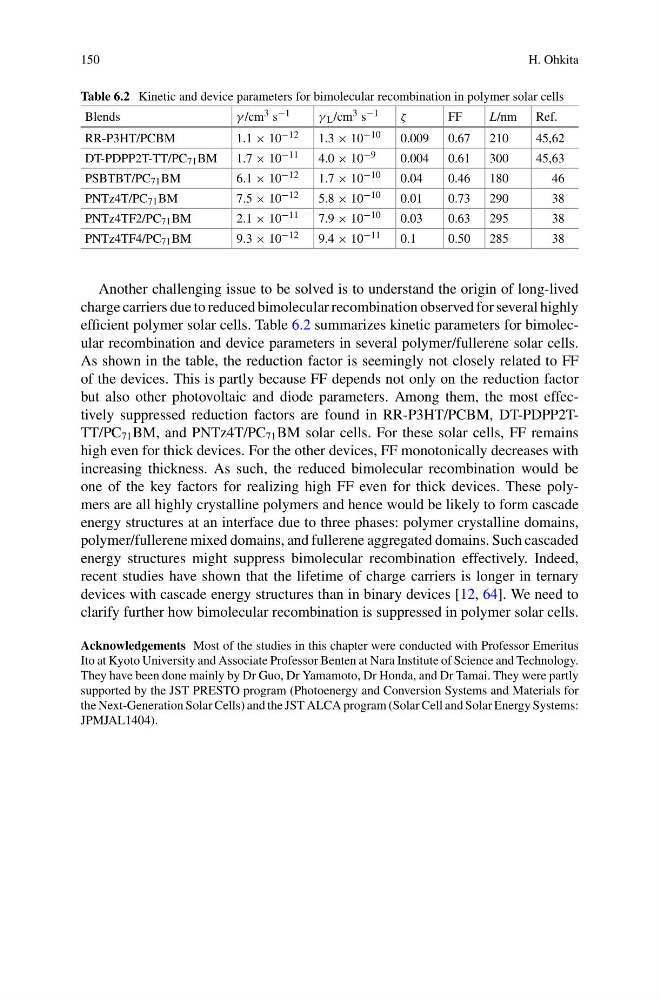
Table 6.2 Kinetic and device parameters for bimolecular recombination in polymer solar cells
Blends
γ /cm 3 s −1
γ L /cm 3 s −1
ζ
FF
L/nm
Ref.
RR-P3HT/PCBM
1.1 × 10 −12
1.3 × 10 −10
0.009
0.67
210
45,62
DT-PDPP2T-TT/PC 71 BM
1.7 × 10 −11
4.0 × 10 −9
0.004
0.61
300
45,63
PSBTBT/PC 71 BM
6.1 × 10 −12
1.7 × 10 −10
0.04
0.46
180
46
PNTz4T/PC 71 BM
7.5 × 10 −12
5.8 × 10 −10
0.01
0.73
290
38
PNTz4TF2/PC 71 BM
2.1 × 10 −11
7.9 × 10 −10
0.03
0.63
295
38
PNTz4TF4/PC 71 BM
9.3 × 10 −12
9.4 × 10 −11
0.1
0.50
285
38
Another challenging issue to be solved is to understand the origin of long-lived
charge carriers due to reduced bimolecular recombination observed for several highly
efficient polymer solar cells. Table 6.2 summarizes kinetic parameters for bimolecular recombination and device parameters in several polymer/fullerene solar cells.
As shown in the table, the reduction factor is seemingly not closely related to FF
of the devices. This is partly because FF depends not only on the reduction factor
but also other photovoltaic and diode parameters. Among them, the most effectively suppressed reduction factors are found in RR-P3HT/PCBM, DT-PDPP2TTT/PC 71 BM, and PNTz4T/PC 71 BM solar cells. For these solar cells, FF remains
high even for thick devices. For the other devices, FF monotonically decreases with
increasing thickness. As such, the reduced bimolecular recombination would be
one of the key factors for realizing high FF even for thick devices. These polymers are all highly crystalline polymers and hence would be likely to form cascade
energy structures at an interface due to three phases: polymer crystalline domains,
polymer/fullerene mixed domains, and fullerene aggregated domains. Such cascaded
energy structures might suppress bimolecular recombination effectively. Indeed,
recent studies have shown that the lifetime of charge carriers is longer in ternary
devices with cascade energy structures than in binary devices [12, 64]. We need to
clarify further how bimolecular recombination is suppressed in polymer solar cells.
Acknowledgements Most of the studies in this chapter were conducted with Professor Emeritus
Ito at Kyoto University and Associate Professor Benten at Nara Institute of Science and Technology.
They have been done mainly by Dr Guo, Dr Yamamoto, Dr Honda, and Dr Tamai. They were partly
supported by the JST PRESTO program (Photoenergy and Conversion Systems and Materials for
the Next-Generation Solar Cells) and the JST ALCA program (Solar Cell and Solar Energy Systems:
JPMJAL1404).
H. Ohkita
Table 6.2 Kinetic and device parameters for bimolecular recombination in polymer solar cells
Blends
γ /cm 3 s −1
γ L /cm 3 s −1
ζ
FF
L/nm
Ref.
RR-P3HT/PCBM
1.1 × 10 −12
1.3 × 10 −10
0.009
0.67
210
45,62
DT-PDPP2T-TT/PC 71 BM
1.7 × 10 −11
4.0 × 10 −9
0.004
0.61
300
45,63
PSBTBT/PC 71 BM
6.1 × 10 −12
1.7 × 10 −10
0.04
0.46
180
46
PNTz4T/PC 71 BM
7.5 × 10 −12
5.8 × 10 −10
0.01
0.73
290
38
PNTz4TF2/PC 71 BM
2.1 × 10 −11
7.9 × 10 −10
0.03
0.63
295
38
PNTz4TF4/PC 71 BM
9.3 × 10 −12
9.4 × 10 −11
0.1
0.50
285
38
Another challenging issue to be solved is to understand the origin of long-lived
charge carriers due to reduced bimolecular recombination observed for several highly
efficient polymer solar cells. Table 6.2 summarizes kinetic parameters for bimolecular recombination and device parameters in several polymer/fullerene solar cells.
As shown in the table, the reduction factor is seemingly not closely related to FF
of the devices. This is partly because FF depends not only on the reduction factor
but also other photovoltaic and diode parameters. Among them, the most effectively suppressed reduction factors are found in RR-P3HT/PCBM, DT-PDPP2TTT/PC 71 BM, and PNTz4T/PC 71 BM solar cells. For these solar cells, FF remains
high even for thick devices. For the other devices, FF monotonically decreases with
increasing thickness. As such, the reduced bimolecular recombination would be
one of the key factors for realizing high FF even for thick devices. These polymers are all highly crystalline polymers and hence would be likely to form cascade
energy structures at an interface due to three phases: polymer crystalline domains,
polymer/fullerene mixed domains, and fullerene aggregated domains. Such cascaded
energy structures might suppress bimolecular recombination effectively. Indeed,
recent studies have shown that the lifetime of charge carriers is longer in ternary
devices with cascade energy structures than in binary devices [12, 64]. We need to
clarify further how bimolecular recombination is suppressed in polymer solar cells.
Acknowledgements Most of the studies in this chapter were conducted with Professor Emeritus
Ito at Kyoto University and Associate Professor Benten at Nara Institute of Science and Technology.
They have been done mainly by Dr Guo, Dr Yamamoto, Dr Honda, and Dr Tamai. They were partly
supported by the JST PRESTO program (Photoenergy and Conversion Systems and Materials for
the Next-Generation Solar Cells) and the JST ALCA program (Solar Cell and Solar Energy Systems:
JPMJAL1404).