

148
H. Ohkita
where V 0 (V OC ) is the initial increment in the TPV signals observed under the
same condition as the TPV measurement. Consequently, the charge carrier density
n is given by Eq. (6.14)
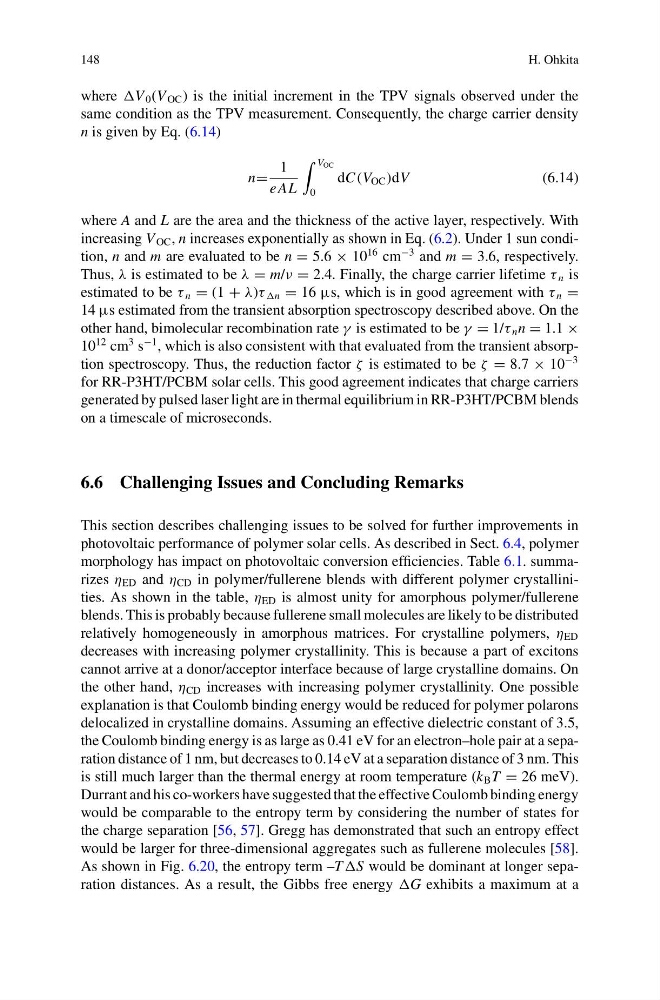
n=
1
e AL
V OC
0
dC(V OC )dV
(6.14)
where A and L are the area and the thickness of the active layer, respectively. With
increasing V OC , n increases exponentially as shown in Eq. (6.2). Under 1 sun condition, n and m are evaluated to be n = 5.6 × 10
16 cm
−3 and m = 3.6, respectively.
Thus, λ is estimated to be λ = m/ν = 2.4. Finally, the charge carrier lifetime τ n is
estimated to be τ n = (1 + λ)τ n = 16 μs, which is in good agreement with τ n =
14 μs estimated from the transient absorption spectroscopy described above. On the
other hand, bimolecular recombination rate γ is estimated to be γ = 1/τ n n = 1.1 ×
10
12 cm
3 s
−1 , which is also consistent with that evaluated from the transient absorption spectroscopy. Thus, the reduction factor ζ is estimated to be ζ = 8.7 × 10
−3
for RR-P3HT/PCBM solar cells. This good agreement indicates that charge carriers
generated by pulsed laser light are in thermal equilibrium in RR-P3HT/PCBM blends
on a timescale of microseconds.
6.6 Challenging Issues and Concluding Remarks
This section describes challenging issues to be solved for further improvements in
photovoltaic performance of polymer solar cells. As described in Sect. 6.4, polymer
morphology has impact on photovoltaic conversion efficiencies. Table 6.1. summarizes η ED and η CD in polymer/fullerene blends with different polymer crystallinities. As shown in the table, η ED is almost unity for amorphous polymer/fullerene
blends. This is probably because fullerene small molecules are likely to be distributed
relatively homogeneously in amorphous matrices. For crystalline polymers, η ED
decreases with increasing polymer crystallinity. This is because a part of excitons
cannot arrive at a donor/acceptor interface because of large crystalline domains. On
the other hand, η CD increases with increasing polymer crystallinity. One possible
explanation is that Coulomb binding energy would be reduced for polymer polarons
delocalized in crystalline domains. Assuming an effective dielectric constant of 3.5,
the Coulomb binding energy is as large as 0.41 eV for an electron–hole pair at a separation distance of 1 nm, but decreases to 0.14 eV at a separation distance of 3 nm. This
is still much larger than the thermal energy at room temperature (k B T = 26 meV).
Durrant and his co-workers have suggested that the effective Coulomb binding energy
would be comparable to the entropy term by considering the number of states for
the charge separation [56, 57]. Gregg has demonstrated that such an entropy effect
would be larger for three-dimensional aggregates such as fullerene molecules [58].
As shown in Fig. 6.20, the entropy term –T S would be dominant at longer separation distances. As a result, the Gibbs free energy G exhibits a maximum at a
H. Ohkita
where V 0 (V OC ) is the initial increment in the TPV signals observed under the
same condition as the TPV measurement. Consequently, the charge carrier density
n is given by Eq. (6.14)
n=
1
e AL
V OC
0
dC(V OC )dV
(6.14)
where A and L are the area and the thickness of the active layer, respectively. With
increasing V OC , n increases exponentially as shown in Eq. (6.2). Under 1 sun condition, n and m are evaluated to be n = 5.6 × 10
16 cm
−3 and m = 3.6, respectively.
Thus, λ is estimated to be λ = m/ν = 2.4. Finally, the charge carrier lifetime τ n is
estimated to be τ n = (1 + λ)τ n = 16 μs, which is in good agreement with τ n =
14 μs estimated from the transient absorption spectroscopy described above. On the
other hand, bimolecular recombination rate γ is estimated to be γ = 1/τ n n = 1.1 ×
10
12 cm
3 s
−1 , which is also consistent with that evaluated from the transient absorption spectroscopy. Thus, the reduction factor ζ is estimated to be ζ = 8.7 × 10
−3
for RR-P3HT/PCBM solar cells. This good agreement indicates that charge carriers
generated by pulsed laser light are in thermal equilibrium in RR-P3HT/PCBM blends
on a timescale of microseconds.
6.6 Challenging Issues and Concluding Remarks
This section describes challenging issues to be solved for further improvements in
photovoltaic performance of polymer solar cells. As described in Sect. 6.4, polymer
morphology has impact on photovoltaic conversion efficiencies. Table 6.1. summarizes η ED and η CD in polymer/fullerene blends with different polymer crystallinities. As shown in the table, η ED is almost unity for amorphous polymer/fullerene
blends. This is probably because fullerene small molecules are likely to be distributed
relatively homogeneously in amorphous matrices. For crystalline polymers, η ED
decreases with increasing polymer crystallinity. This is because a part of excitons
cannot arrive at a donor/acceptor interface because of large crystalline domains. On
the other hand, η CD increases with increasing polymer crystallinity. One possible
explanation is that Coulomb binding energy would be reduced for polymer polarons
delocalized in crystalline domains. Assuming an effective dielectric constant of 3.5,
the Coulomb binding energy is as large as 0.41 eV for an electron–hole pair at a separation distance of 1 nm, but decreases to 0.14 eV at a separation distance of 3 nm. This
is still much larger than the thermal energy at room temperature (k B T = 26 meV).
Durrant and his co-workers have suggested that the effective Coulomb binding energy
would be comparable to the entropy term by considering the number of states for
the charge separation [56, 57]. Gregg has demonstrated that such an entropy effect
would be larger for three-dimensional aggregates such as fullerene molecules [58].
As shown in Fig. 6.20, the entropy term –T S would be dominant at longer separation distances. As a result, the Gibbs free energy G exhibits a maximum at a