

144
H. Ohkita
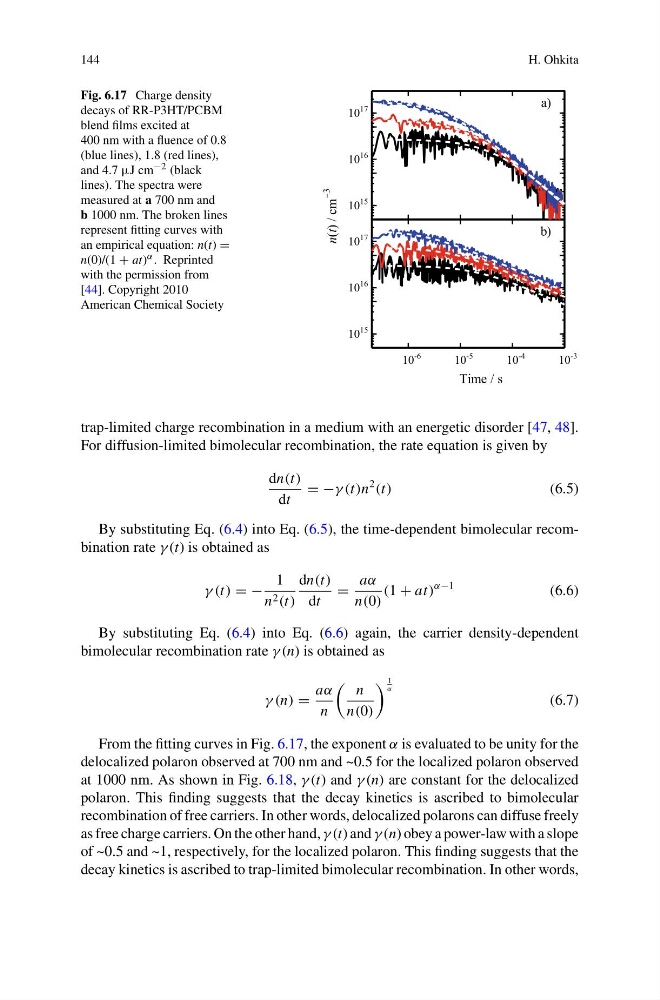
Fig. 6.17 Charge density
decays of RR-P3HT/PCBM
blend films excited at
400 nm with a fluence of 0.8
(blue lines), 1.8 (red lines),
and 4.7 μJ cm −2 (black
lines). The spectra were
measured at a 700 nm and
b 1000 nm. The broken lines
represent fitting curves with
an empirical equation: n(t) =
n(0)/(1 + at) α . Reprinted
with the permission from
[44]. Copyright 2010
American Chemical Society
10
-6
10
-5
10
-4
10
-3
10
15
10
16
10
17
b)
Time / s
10
15
10
16
10
17
n(t) / cm
–3
a)
trap-limited charge recombination in a medium with an energetic disorder [47, 48].
For diffusion-limited bimolecular recombination, the rate equation is given by
dn(t)
dt
= −γ (t)n
2
(t)
(6.5)
By substituting Eq. (6.4) into Eq. (6.5), the time-dependent bimolecular recombination rate γ (t) is obtained as
γ (t) = −
1
n 2 (t)
dn(t)
dt
=
aα
n(0)
(1 + at)
α−1
(6.6)
By substituting Eq. (6.4) into Eq. (6.6) again, the carrier density-dependent
bimolecular recombination rate γ (n) is obtained as
γ (n) =
aα
n
n
n(0)
1
α
(6.7)
From the fitting curves in Fig. 6.17, the exponent α is evaluated to be unity for the
delocalized polaron observed at 700 nm and ~0.5 for the localized polaron observed
at 1000 nm. As shown in Fig. 6.18, γ (t) and γ (n) are constant for the delocalized
polaron. This finding suggests that the decay kinetics is ascribed to bimolecular
recombination of free carriers. In other words, delocalized polarons can diffuse freely
as free charge carriers. On the other hand, γ (t) and γ (n) obey a power-law with a slope
of ~0.5 and ~1, respectively, for the localized polaron. This finding suggests that the
decay kinetics is ascribed to trap-limited bimolecular recombination. In other words,
H. Ohkita
Fig. 6.17 Charge density
decays of RR-P3HT/PCBM
blend films excited at
400 nm with a fluence of 0.8
(blue lines), 1.8 (red lines),
and 4.7 μJ cm −2 (black
lines). The spectra were
measured at a 700 nm and
b 1000 nm. The broken lines
represent fitting curves with
an empirical equation: n(t) =
n(0)/(1 + at) α . Reprinted
with the permission from
[44]. Copyright 2010
American Chemical Society
10
-6
10
-5
10
-4
10
-3
10
15
10
16
10
17
b)
Time / s
10
15
10
16
10
17
n(t) / cm
–3
a)
trap-limited charge recombination in a medium with an energetic disorder [47, 48].
For diffusion-limited bimolecular recombination, the rate equation is given by
dn(t)
dt
= −γ (t)n
2
(t)
(6.5)
By substituting Eq. (6.4) into Eq. (6.5), the time-dependent bimolecular recombination rate γ (t) is obtained as
γ (t) = −
1
n 2 (t)
dn(t)
dt
=
aα
n(0)
(1 + at)
α−1
(6.6)
By substituting Eq. (6.4) into Eq. (6.6) again, the carrier density-dependent
bimolecular recombination rate γ (n) is obtained as
γ (n) =
aα
n
n
n(0)
1
α
(6.7)
From the fitting curves in Fig. 6.17, the exponent α is evaluated to be unity for the
delocalized polaron observed at 700 nm and ~0.5 for the localized polaron observed
at 1000 nm. As shown in Fig. 6.18, γ (t) and γ (n) are constant for the delocalized
polaron. This finding suggests that the decay kinetics is ascribed to bimolecular
recombination of free carriers. In other words, delocalized polarons can diffuse freely
as free charge carriers. On the other hand, γ (t) and γ (n) obey a power-law with a slope
of ~0.5 and ~1, respectively, for the localized polaron. This finding suggests that the
decay kinetics is ascribed to trap-limited bimolecular recombination. In other words,