

142
H. Ohkita
50 ps, which is much faster than the geminate recombination of polymer polarons and
dye anions observed for RR-P3HT/SiPc6 blend films. Instead, PCBM anions increase
with the same time constant, suggesting a charge shift from SiPc6 to PCBM. This
finding suggests that SiPc6 dye molecules contact with PCBM as well as P3HT in
RR-P3HT/PCBM/SiPc6 ternary blend films. In other words, SiPc6 dye molecules
are located at the P3HT/PCBM interface in the ternary blend films. As described in
[13], only a small part of polymer polarons decay during the charge shift, suggesting
that a majority of dye molecules are located at the interface and a small minor part
of them are isolated in P3HT domains. Interestingly, no decay of polymer polarons
is observed at all during the charge shift for RR-P3HT/PCBM/SiPc6 ternary blend
films fabricated by solvent annealing. In this case, almost all the dye molecules are
spontaneously located at the P3HT/PCBM interface in the ternary blend films. As
discussed in [11], this is partly because dye molecules are expelled from polymer
crystalline or PCBM aggregated domains to disordered mixed domains, and partly
because dye molecules have an intermediate surface energy between RR-P3HT and
PCBM. In other words, dye locations can be controlled by careful design of dye
molecules as demonstrated in [43].
6.5 Charge Recombination Dynamics
This section describes the bimolecular recombination dynamics of dissociated charge
carriers on a timescale of microseconds in polymer/fullerene blend films. Here, our
attention is focused on bimolecular recombination dynamics in RR-P3HT/PCBM
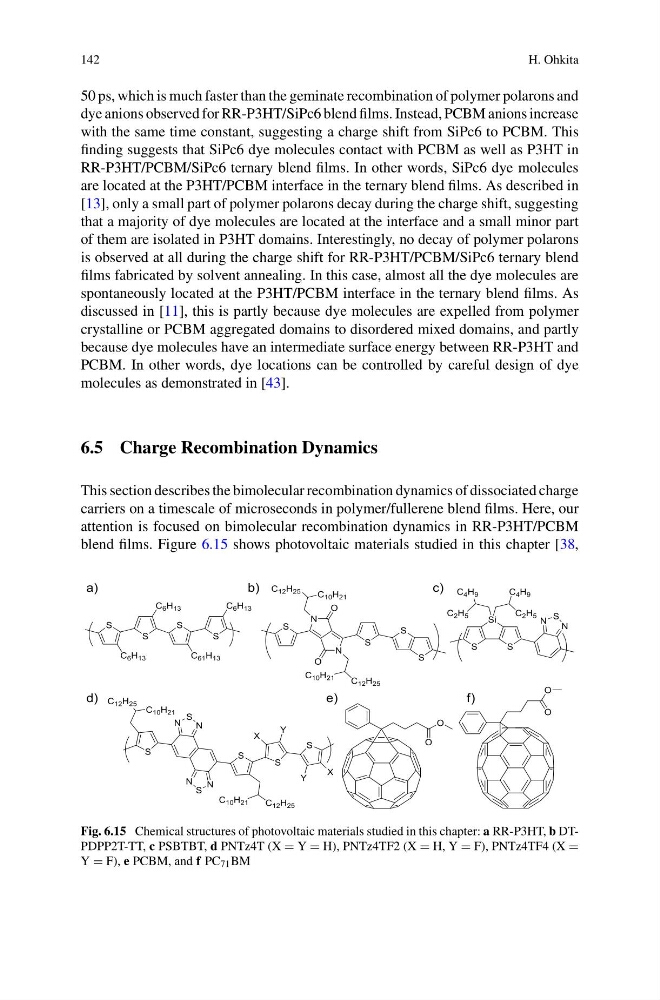
blend films. Figure 6.15 shows photovoltaic materials studied in this chapter [38,
Fig. 6.15 Chemical structures of photovoltaic materials studied in this chapter: a RR-P3HT, b DTPDPP2T-TT, c PSBTBT, d PNTz4T (X = Y = H), PNTz4TF2 (X = H, Y = F), PNTz4TF4 (X =
Y = F), e PCBM, and f PC 71 BM
H. Ohkita
50 ps, which is much faster than the geminate recombination of polymer polarons and
dye anions observed for RR-P3HT/SiPc6 blend films. Instead, PCBM anions increase
with the same time constant, suggesting a charge shift from SiPc6 to PCBM. This
finding suggests that SiPc6 dye molecules contact with PCBM as well as P3HT in
RR-P3HT/PCBM/SiPc6 ternary blend films. In other words, SiPc6 dye molecules
are located at the P3HT/PCBM interface in the ternary blend films. As described in
[13], only a small part of polymer polarons decay during the charge shift, suggesting
that a majority of dye molecules are located at the interface and a small minor part
of them are isolated in P3HT domains. Interestingly, no decay of polymer polarons
is observed at all during the charge shift for RR-P3HT/PCBM/SiPc6 ternary blend
films fabricated by solvent annealing. In this case, almost all the dye molecules are
spontaneously located at the P3HT/PCBM interface in the ternary blend films. As
discussed in [11], this is partly because dye molecules are expelled from polymer
crystalline or PCBM aggregated domains to disordered mixed domains, and partly
because dye molecules have an intermediate surface energy between RR-P3HT and
PCBM. In other words, dye locations can be controlled by careful design of dye
molecules as demonstrated in [43].
6.5 Charge Recombination Dynamics
This section describes the bimolecular recombination dynamics of dissociated charge
carriers on a timescale of microseconds in polymer/fullerene blend films. Here, our
attention is focused on bimolecular recombination dynamics in RR-P3HT/PCBM
blend films. Figure 6.15 shows photovoltaic materials studied in this chapter [38,
Fig. 6.15 Chemical structures of photovoltaic materials studied in this chapter: a RR-P3HT, b DTPDPP2T-TT, c PSBTBT, d PNTz4T (X = Y = H), PNTz4TF2 (X = H, Y = F), PNTz4TF4 (X =
Y = F), e PCBM, and f PC 71 BM