

6 Charge Carrier Dynamics in Polymer Solar Cells
141
is observed first, which is ascribed to SiPc6 singlet excitons because of the selective excitation at 680 nm. Subsequently, a broad absorption and a small but sharp
absorption bands are observed at around 850–1050 nm and at 940 nm, respectively.
As described in [13], the broad and sharp absorption bands are ascribed to polymer
polarons and dye anions, respectively. These two bands increase with a time constant
of 2 ps and then decay with a time constant of 2 ns. In summary, polymer polarons are
generated with a time constant of 2 ps in RR-P3HT/SiPc6 binary blends. As shown
in Fig. 6.13b, a large absorption and a small and broad absorption are observed at
855 and 1030 nm, respectively. As described in [13], the large and small absorption
bands are ascribed to SiPc6 anion and PCBM anion, respectively. These two bands
are observed even at 0 ps and then decay with time constants of 35 ps (40%) and 2 ns
(60%). In summary, polymer polarons are promptly generated within a laser pulse
width of 100 fs in PCBM/SiPc6 binary blends. In other words, charge generation
dynamics is dependent on the location of dye molecules in blend films.
For RR-P3HT/PCBM/SiPc6 ternary blend films excited at the dye absorption, as
shown in Fig. 6.13c, a flat absorption band due to SiPc6 singlet excitons is observed
first immediately after the laser excitation, and then a broad absorption band with a
small and sharp absorption peak, which is due to P3HT polarons and SiPc anions,
respectively, increase with a time constant of 2 ps. This charge generation dynamics
is the same as that observed for RR-P3HT/SiPc6 binary blends, suggesting that
SiPc6 dye molecules are basically located in P3HT domains. If SiPc6 dye molecules
were isolated in P3HT domains as is the case for RR-P3HT/SiPc6 binary blends,
polymer polarons and SiPc6 anions recombine geminately with a time constant of
2 ns. However, this is not the case. As shown in Fig. 6.13c, the absorption at 940 nm
does not decay at all. Instead, the absorption peak is shifted from 940 to 1000 nm with
time. The absorption at 1000 nm is ascribed to P3HT polarons and PCBM anions
observed for RR-P3HT/PCBM blends as described in Sect. 6.4.2. In other words,
this peak shift is indicative of charge shift (electron transfer) from SiPc6 anions to
PCBM.
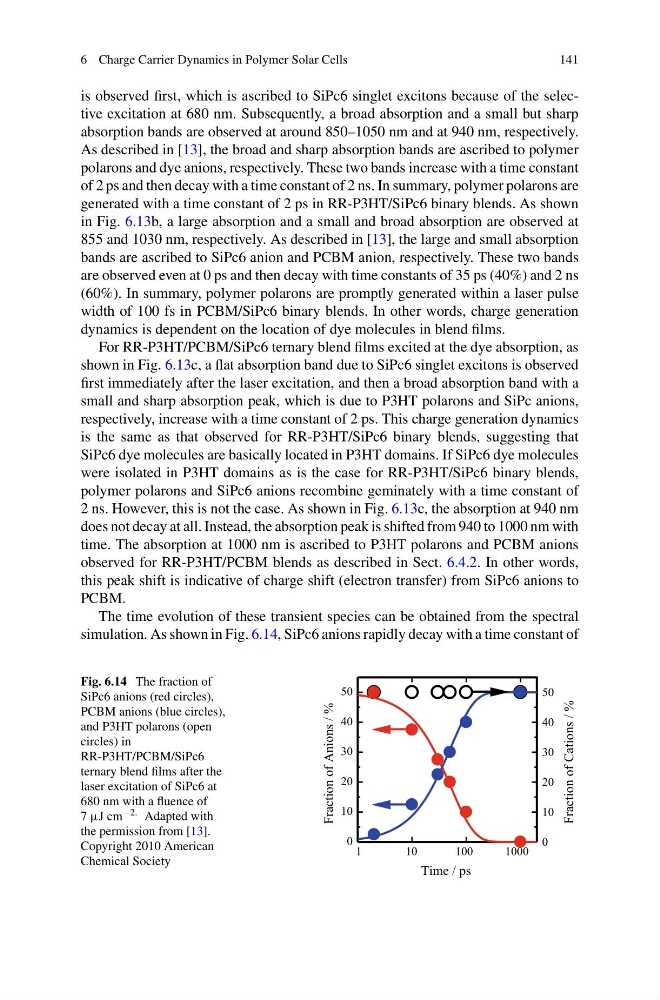
The time evolution of these transient species can be obtained from the spectral
simulation. As shown in Fig. 6.14, SiPc6 anions rapidly decay with a time constant of
Fig. 6.14 The fraction of
SiPc6 anions (red circles),
PCBM anions (blue circles),
and P3HT polarons (open
circles) in
RR-P3HT/PCBM/SiPc6
ternary blend films after the
laser excitation of SiPc6 at
680 nm with a fluence of
7 μJ cm −2. Adapted with
the permission from [13].
Copyright 2010 American
Chemical Society
1
10
100
1000
0
10
20
30
40
50
0
10
20
30
40
50
Time / ps
Fraction of Anions / %
Fraction of Cations / %
141
is observed first, which is ascribed to SiPc6 singlet excitons because of the selective excitation at 680 nm. Subsequently, a broad absorption and a small but sharp
absorption bands are observed at around 850–1050 nm and at 940 nm, respectively.
As described in [13], the broad and sharp absorption bands are ascribed to polymer
polarons and dye anions, respectively. These two bands increase with a time constant
of 2 ps and then decay with a time constant of 2 ns. In summary, polymer polarons are
generated with a time constant of 2 ps in RR-P3HT/SiPc6 binary blends. As shown
in Fig. 6.13b, a large absorption and a small and broad absorption are observed at
855 and 1030 nm, respectively. As described in [13], the large and small absorption
bands are ascribed to SiPc6 anion and PCBM anion, respectively. These two bands
are observed even at 0 ps and then decay with time constants of 35 ps (40%) and 2 ns
(60%). In summary, polymer polarons are promptly generated within a laser pulse
width of 100 fs in PCBM/SiPc6 binary blends. In other words, charge generation
dynamics is dependent on the location of dye molecules in blend films.
For RR-P3HT/PCBM/SiPc6 ternary blend films excited at the dye absorption, as
shown in Fig. 6.13c, a flat absorption band due to SiPc6 singlet excitons is observed
first immediately after the laser excitation, and then a broad absorption band with a
small and sharp absorption peak, which is due to P3HT polarons and SiPc anions,
respectively, increase with a time constant of 2 ps. This charge generation dynamics
is the same as that observed for RR-P3HT/SiPc6 binary blends, suggesting that
SiPc6 dye molecules are basically located in P3HT domains. If SiPc6 dye molecules
were isolated in P3HT domains as is the case for RR-P3HT/SiPc6 binary blends,
polymer polarons and SiPc6 anions recombine geminately with a time constant of
2 ns. However, this is not the case. As shown in Fig. 6.13c, the absorption at 940 nm
does not decay at all. Instead, the absorption peak is shifted from 940 to 1000 nm with
time. The absorption at 1000 nm is ascribed to P3HT polarons and PCBM anions
observed for RR-P3HT/PCBM blends as described in Sect. 6.4.2. In other words,
this peak shift is indicative of charge shift (electron transfer) from SiPc6 anions to
PCBM.
The time evolution of these transient species can be obtained from the spectral
simulation. As shown in Fig. 6.14, SiPc6 anions rapidly decay with a time constant of
Fig. 6.14 The fraction of
SiPc6 anions (red circles),
PCBM anions (blue circles),
and P3HT polarons (open
circles) in
RR-P3HT/PCBM/SiPc6
ternary blend films after the
laser excitation of SiPc6 at
680 nm with a fluence of
7 μJ cm −2. Adapted with
the permission from [13].
Copyright 2010 American
Chemical Society
1
10
100
1000
0
10
20
30
40
50
0
10
20
30
40
50
Time / ps
Fraction of Anions / %
Fraction of Cations / %