

140
H. Ohkita
depression is observed at around 680 nm only for the RR-P3HT/PCBM/SiPc6 ternary
blends. This depression band is ascribed to the GSB of SiPc6 dye molecules because
the wavelength is the same as that of the dye absorption. As described in [13], the
depression fraction increases with a time constant of 4 ps, which is in good agreement with the lifetime of polymer singlet excitons observed for the ternary blends.
Note that SiPc6 has negligible absorption at 400 nm and hence cannot be generated
directly by the laser excitation at 400 nm. Therefore, the rapid decay of polymer
singlet excitons (4 ps) is ascribed to an efficient energy transfer from polymer singlet
excitons to SiPc6 dye molecules. This is consistent with an effective spectral overlap
between P3HT emission and SiPc6 absorption bands. In summary, polymer singlet
excitons migrate to a donor/acceptor interface with a time constant of 25 ps followed
by charge generation in RR-P3HT/PCBM binary blend films upon the photoexcitation of the P3HT absorption band at 400 nm. On the other hand, polymer singlet
excitons are efficiently transferred to SiPc6 dye molecules by long-range energy
transfer with a time constant of 4 ps, and then polymer polarons are generated from
the dye singlet excitons with a time constant of 6 ps, which includes the energy
transfer time.
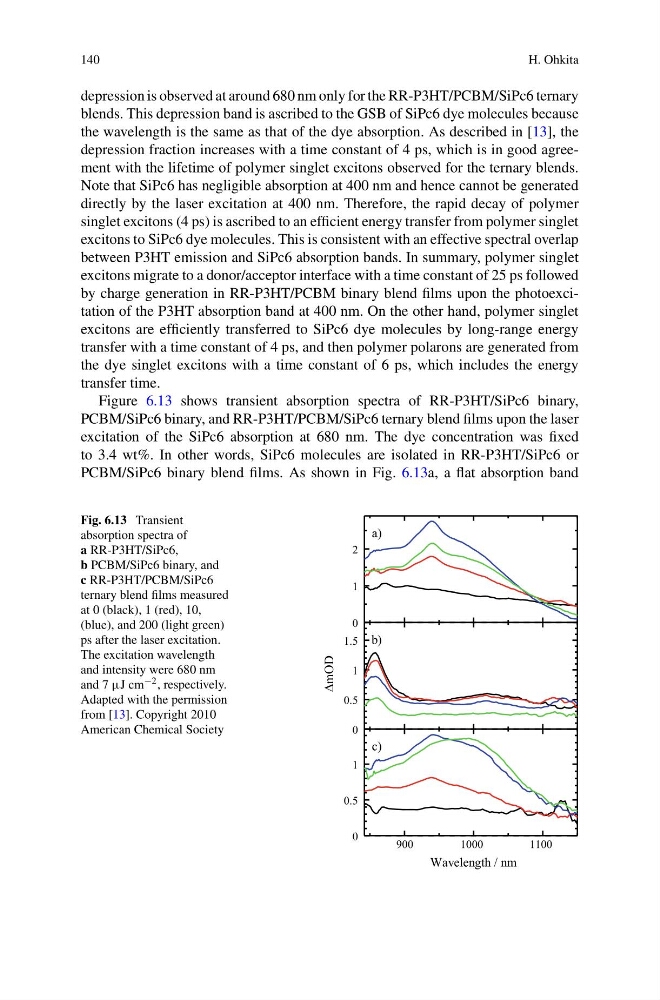
Figure 6.13 shows transient absorption spectra of RR-P3HT/SiPc6 binary,
PCBM/SiPc6 binary, and RR-P3HT/PCBM/SiPc6 ternary blend films upon the laser
excitation of the SiPc6 absorption at 680 nm. The dye concentration was fixed
to 3.4 wt%. In other words, SiPc6 molecules are isolated in RR-P3HT/SiPc6 or
PCBM/SiPc6 binary blend films. As shown in Fig. 6.13a, a flat absorption band
Fig. 6.13 Transient
absorption spectra of
a RR-P3HT/SiPc6,
b PCBM/SiPc6 binary, and
c RR-P3HT/PCBM/SiPc6
ternary blend films measured
at 0 (black), 1 (red), 10,
(blue), and 200 (light green)
ps after the laser excitation.
The excitation wavelength
and intensity were 680 nm
and 7 μJ cm −2 , respectively.
Adapted with the permission
from [13]. Copyright 2010
American Chemical Society
900
1000
1100
0
0.5
1
c)
Wavelength / nm
0
0.5
1
1.5 b)
ΔmOD
0
1
2
a)
H. Ohkita
depression is observed at around 680 nm only for the RR-P3HT/PCBM/SiPc6 ternary
blends. This depression band is ascribed to the GSB of SiPc6 dye molecules because
the wavelength is the same as that of the dye absorption. As described in [13], the
depression fraction increases with a time constant of 4 ps, which is in good agreement with the lifetime of polymer singlet excitons observed for the ternary blends.
Note that SiPc6 has negligible absorption at 400 nm and hence cannot be generated
directly by the laser excitation at 400 nm. Therefore, the rapid decay of polymer
singlet excitons (4 ps) is ascribed to an efficient energy transfer from polymer singlet
excitons to SiPc6 dye molecules. This is consistent with an effective spectral overlap
between P3HT emission and SiPc6 absorption bands. In summary, polymer singlet
excitons migrate to a donor/acceptor interface with a time constant of 25 ps followed
by charge generation in RR-P3HT/PCBM binary blend films upon the photoexcitation of the P3HT absorption band at 400 nm. On the other hand, polymer singlet
excitons are efficiently transferred to SiPc6 dye molecules by long-range energy
transfer with a time constant of 4 ps, and then polymer polarons are generated from
the dye singlet excitons with a time constant of 6 ps, which includes the energy
transfer time.
Figure 6.13 shows transient absorption spectra of RR-P3HT/SiPc6 binary,
PCBM/SiPc6 binary, and RR-P3HT/PCBM/SiPc6 ternary blend films upon the laser
excitation of the SiPc6 absorption at 680 nm. The dye concentration was fixed
to 3.4 wt%. In other words, SiPc6 molecules are isolated in RR-P3HT/SiPc6 or
PCBM/SiPc6 binary blend films. As shown in Fig. 6.13a, a flat absorption band
Fig. 6.13 Transient
absorption spectra of
a RR-P3HT/SiPc6,
b PCBM/SiPc6 binary, and
c RR-P3HT/PCBM/SiPc6
ternary blend films measured
at 0 (black), 1 (red), 10,
(blue), and 200 (light green)
ps after the laser excitation.
The excitation wavelength
and intensity were 680 nm
and 7 μJ cm −2 , respectively.
Adapted with the permission
from [13]. Copyright 2010
American Chemical Society
900
1000
1100
0
0.5
1
c)
Wavelength / nm
0
0.5
1
1.5 b)
ΔmOD
0
1
2
a)