

136
H. Ohkita
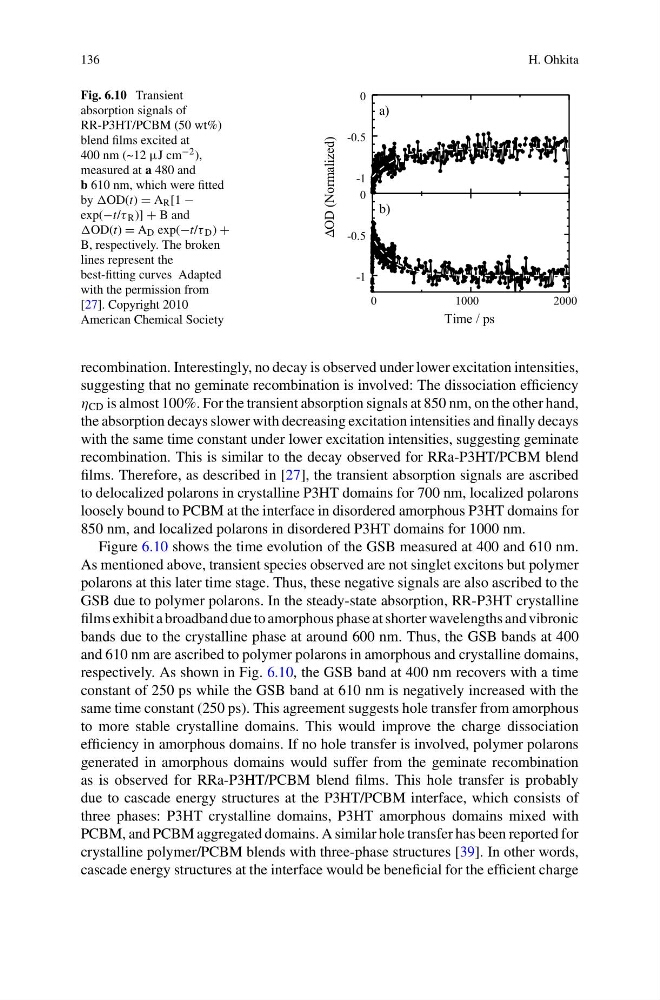
Fig. 6.10 Transient
absorption signals of
RR-P3HT/PCBM (50 wt%)
blend films excited at
400 nm (~12 μJ cm −2 ),
measured at a 480 and
b 610 nm, which were fitted
by OD(t) = A R [1 −
exp(−t/τ R )] + B and
OD(t) = A D exp(−t/τ D ) +
B, respectively. The broken
lines represent the
best-fitting curves Adapted
with the permission from
[27]. Copyright 2010
American Chemical Society
-1
-0.5
0
a)
ΔOD (Normalized)
0
1000
2000
-1
-0.5
0
Time / ps
b)
recombination. Interestingly, no decay is observed under lower excitation intensities,
suggesting that no geminate recombination is involved: The dissociation efficiency
η CD is almost 100%. For the transient absorption signals at 850 nm, on the other hand,
the absorption decays slower with decreasing excitation intensities and finally decays
with the same time constant under lower excitation intensities, suggesting geminate
recombination. This is similar to the decay observed for RRa-P3HT/PCBM blend
films. Therefore, as described in [27], the transient absorption signals are ascribed
to delocalized polarons in crystalline P3HT domains for 700 nm, localized polarons
loosely bound to PCBM at the interface in disordered amorphous P3HT domains for
850 nm, and localized polarons in disordered P3HT domains for 1000 nm.
Figure 6.10 shows the time evolution of the GSB measured at 400 and 610 nm.
As mentioned above, transient species observed are not singlet excitons but polymer
polarons at this later time stage. Thus, these negative signals are also ascribed to the
GSB due to polymer polarons. In the steady-state absorption, RR-P3HT crystalline
films exhibit a broadband due to amorphous phase at shorter wavelengths and vibronic
bands due to the crystalline phase at around 600 nm. Thus, the GSB bands at 400
and 610 nm are ascribed to polymer polarons in amorphous and crystalline domains,
respectively. As shown in Fig. 6.10, the GSB band at 400 nm recovers with a time
constant of 250 ps while the GSB band at 610 nm is negatively increased with the
same time constant (250 ps). This agreement suggests hole transfer from amorphous
to more stable crystalline domains. This would improve the charge dissociation
efficiency in amorphous domains. If no hole transfer is involved, polymer polarons
generated in amorphous domains would suffer from the geminate recombination
as is observed for RRa-P3HT/PCBM blend films. This hole transfer is probably
due to cascade energy structures at the P3HT/PCBM interface, which consists of
three phases: P3HT crystalline domains, P3HT amorphous domains mixed with
PCBM, and PCBM aggregated domains. A similar hole transfer has been reported for
crystalline polymer/PCBM blends with three-phase structures [39]. In other words,
cascade energy structures at the interface would be beneficial for the efficient charge
H. Ohkita
Fig. 6.10 Transient
absorption signals of
RR-P3HT/PCBM (50 wt%)
blend films excited at
400 nm (~12 μJ cm −2 ),
measured at a 480 and
b 610 nm, which were fitted
by OD(t) = A R [1 −
exp(−t/τ R )] + B and
OD(t) = A D exp(−t/τ D ) +
B, respectively. The broken
lines represent the
best-fitting curves Adapted
with the permission from
[27]. Copyright 2010
American Chemical Society
-1
-0.5
0
a)
ΔOD (Normalized)
0
1000
2000
-1
-0.5
0
Time / ps
b)
recombination. Interestingly, no decay is observed under lower excitation intensities,
suggesting that no geminate recombination is involved: The dissociation efficiency
η CD is almost 100%. For the transient absorption signals at 850 nm, on the other hand,
the absorption decays slower with decreasing excitation intensities and finally decays
with the same time constant under lower excitation intensities, suggesting geminate
recombination. This is similar to the decay observed for RRa-P3HT/PCBM blend
films. Therefore, as described in [27], the transient absorption signals are ascribed
to delocalized polarons in crystalline P3HT domains for 700 nm, localized polarons
loosely bound to PCBM at the interface in disordered amorphous P3HT domains for
850 nm, and localized polarons in disordered P3HT domains for 1000 nm.
Figure 6.10 shows the time evolution of the GSB measured at 400 and 610 nm.
As mentioned above, transient species observed are not singlet excitons but polymer
polarons at this later time stage. Thus, these negative signals are also ascribed to the
GSB due to polymer polarons. In the steady-state absorption, RR-P3HT crystalline
films exhibit a broadband due to amorphous phase at shorter wavelengths and vibronic
bands due to the crystalline phase at around 600 nm. Thus, the GSB bands at 400
and 610 nm are ascribed to polymer polarons in amorphous and crystalline domains,
respectively. As shown in Fig. 6.10, the GSB band at 400 nm recovers with a time
constant of 250 ps while the GSB band at 610 nm is negatively increased with the
same time constant (250 ps). This agreement suggests hole transfer from amorphous
to more stable crystalline domains. This would improve the charge dissociation
efficiency in amorphous domains. If no hole transfer is involved, polymer polarons
generated in amorphous domains would suffer from the geminate recombination
as is observed for RRa-P3HT/PCBM blend films. This hole transfer is probably
due to cascade energy structures at the P3HT/PCBM interface, which consists of
three phases: P3HT crystalline domains, P3HT amorphous domains mixed with
PCBM, and PCBM aggregated domains. A similar hole transfer has been reported for
crystalline polymer/PCBM blends with three-phase structures [39]. In other words,
cascade energy structures at the interface would be beneficial for the efficient charge