

6 Charge Carrier Dynamics in Polymer Solar Cells
135
fraction of PCBM: It is more quenched with increasing PCBM fraction. Instead,
new absorption bands are observed over 700 and 1100 nm, which are ascribed to
polymer polarons. In other words, polymer polarons are promptly generated even at
0 ps in the blend films. This is similar to that observed for RRa-P3HT/PCBM blends.
Thus, it would be ascribed to the prompt charge generation in amorphous P3HT
domains mixed with PCBM. Subsequently, the broadband of singlet excitons decays
and completely disappears at 100 ps. As described in [27], the singlet exciton signals
decay with different time constants, which shorten with increasing PCBM fraction
and extend after thermal annealing at 140 °C for 30 min. In other words, the decay
time is dependent upon P3HT domain size in the blend films. Indeed, the decay time
of singlet excitons is dependent upon polymer crystallinity: It was reported to be as
short as 0.8 ps for less crystalline PSBTBT and PCBM and as long as 100 ps for highly
crystalline PNOz4T and PC 71 BM blend films. As such, it is ascribed to the delayed
charge generation following the exciton diffusion in large crystalline domains. In
summary, there are two pathways for the charge generation in crystalline polymer
solar cells: one is prompt charge generation at amorphous polymer domains mixed
with PCBM or at an interface of crystalline polymer domains and PCBM where no
exciton diffusion is needed to generate charge carriers and the other is delayed charge
generation following exciton diffusion in large crystalline polymer domains.
At a later time stage after several tens of picoseconds, as shown in Fig. 6.8, singlet
excitons disappear and instead polymer polarons are observed from 700 to 1100 nm.
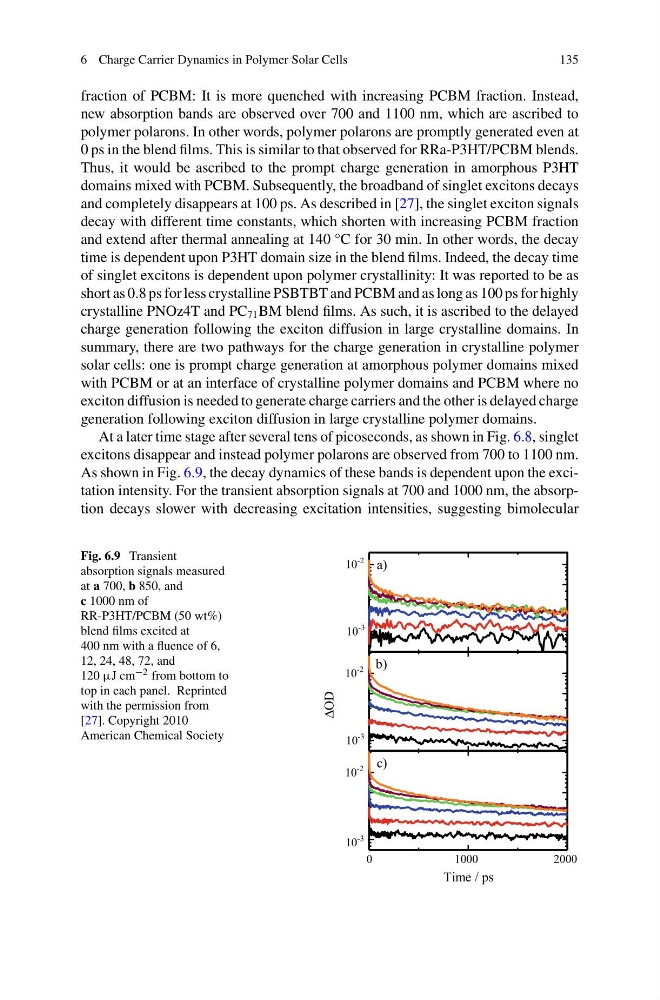
As shown in Fig. 6.9, the decay dynamics of these bands is dependent upon the excitation intensity. For the transient absorption signals at 700 and 1000 nm, the absorption decays slower with decreasing excitation intensities, suggesting bimolecular
Fig. 6.9 Transient
absorption signals measured
at a 700, b 850, and
c 1000 nm of
RR-P3HT/PCBM (50 wt%)
blend films excited at
400 nm with a fluence of 6,
12, 24, 48, 72, and
120 μJ cm −2 from bottom to
top in each panel. Reprinted
with the permission from
[27]. Copyright 2010
American Chemical Society
0
1000
2000
10
-3
10
-2
c)
Time / ps
10
-3
10
-2 b)
ΔOD
10
-3
10
-2
a)
135
fraction of PCBM: It is more quenched with increasing PCBM fraction. Instead,
new absorption bands are observed over 700 and 1100 nm, which are ascribed to
polymer polarons. In other words, polymer polarons are promptly generated even at
0 ps in the blend films. This is similar to that observed for RRa-P3HT/PCBM blends.
Thus, it would be ascribed to the prompt charge generation in amorphous P3HT
domains mixed with PCBM. Subsequently, the broadband of singlet excitons decays
and completely disappears at 100 ps. As described in [27], the singlet exciton signals
decay with different time constants, which shorten with increasing PCBM fraction
and extend after thermal annealing at 140 °C for 30 min. In other words, the decay
time is dependent upon P3HT domain size in the blend films. Indeed, the decay time
of singlet excitons is dependent upon polymer crystallinity: It was reported to be as
short as 0.8 ps for less crystalline PSBTBT and PCBM and as long as 100 ps for highly
crystalline PNOz4T and PC 71 BM blend films. As such, it is ascribed to the delayed
charge generation following the exciton diffusion in large crystalline domains. In
summary, there are two pathways for the charge generation in crystalline polymer
solar cells: one is prompt charge generation at amorphous polymer domains mixed
with PCBM or at an interface of crystalline polymer domains and PCBM where no
exciton diffusion is needed to generate charge carriers and the other is delayed charge
generation following exciton diffusion in large crystalline polymer domains.
At a later time stage after several tens of picoseconds, as shown in Fig. 6.8, singlet
excitons disappear and instead polymer polarons are observed from 700 to 1100 nm.
As shown in Fig. 6.9, the decay dynamics of these bands is dependent upon the excitation intensity. For the transient absorption signals at 700 and 1000 nm, the absorption decays slower with decreasing excitation intensities, suggesting bimolecular
Fig. 6.9 Transient
absorption signals measured
at a 700, b 850, and
c 1000 nm of
RR-P3HT/PCBM (50 wt%)
blend films excited at
400 nm with a fluence of 6,
12, 24, 48, 72, and
120 μJ cm −2 from bottom to
top in each panel. Reprinted
with the permission from
[27]. Copyright 2010
American Chemical Society
0
1000
2000
10
-3
10
-2
c)
Time / ps
10
-3
10
-2 b)
ΔOD
10
-3
10
-2
a)