

132
H. Ohkita
6.4.1 Amorphous Polymer Solar Cells
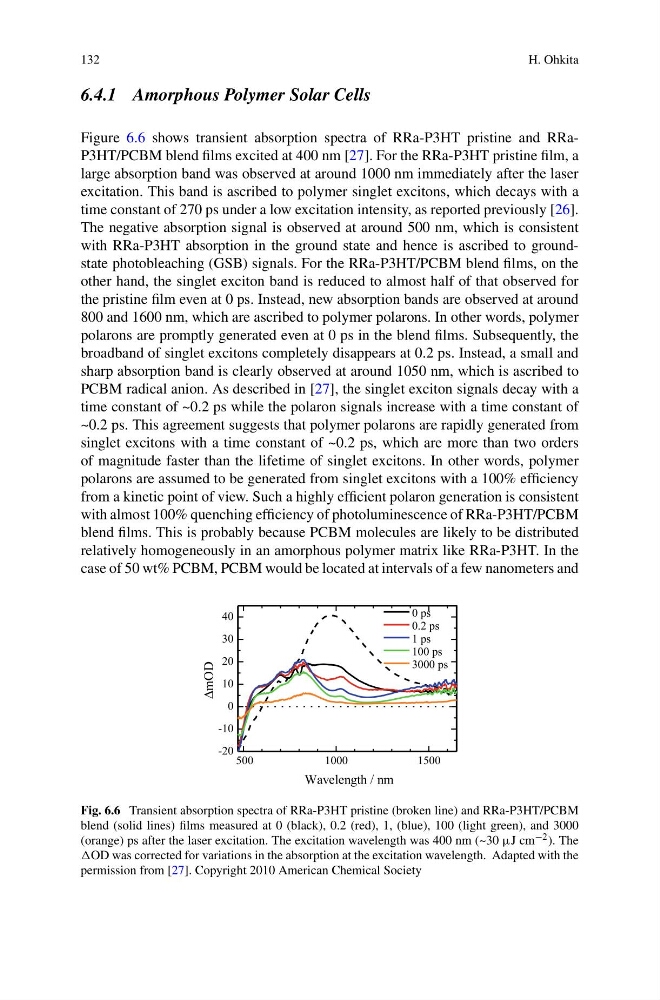
Figure 6.6 shows transient absorption spectra of RRa-P3HT pristine and RRaP3HT/PCBM blend films excited at 400 nm [27]. For the RRa-P3HT pristine film, a
large absorption band was observed at around 1000 nm immediately after the laser
excitation. This band is ascribed to polymer singlet excitons, which decays with a
time constant of 270 ps under a low excitation intensity, as reported previously [26].
The negative absorption signal is observed at around 500 nm, which is consistent
with RRa-P3HT absorption in the ground state and hence is ascribed to groundstate photobleaching (GSB) signals. For the RRa-P3HT/PCBM blend films, on the
other hand, the singlet exciton band is reduced to almost half of that observed for
the pristine film even at 0 ps. Instead, new absorption bands are observed at around
800 and 1600 nm, which are ascribed to polymer polarons. In other words, polymer
polarons are promptly generated even at 0 ps in the blend films. Subsequently, the
broadband of singlet excitons completely disappears at 0.2 ps. Instead, a small and
sharp absorption band is clearly observed at around 1050 nm, which is ascribed to
PCBM radical anion. As described in [27], the singlet exciton signals decay with a
time constant of ~0.2 ps while the polaron signals increase with a time constant of
~0.2 ps. This agreement suggests that polymer polarons are rapidly generated from
singlet excitons with a time constant of ~0.2 ps, which are more than two orders
of magnitude faster than the lifetime of singlet excitons. In other words, polymer
polarons are assumed to be generated from singlet excitons with a 100% efficiency
from a kinetic point of view. Such a highly efficient polaron generation is consistent
with almost 100% quenching efficiency of photoluminescence of RRa-P3HT/PCBM
blend films. This is probably because PCBM molecules are likely to be distributed
relatively homogeneously in an amorphous polymer matrix like RRa-P3HT. In the
case of 50 wt% PCBM, PCBM would be located at intervals of a few nanometers and
500
1000
1500
-20
-10
0
10
20
30
40
ΔmOD
0 ps
0.2 ps
1 ps
100 ps
3000 ps
Wavelength / nm
Fig. 6.6 Transient absorption spectra of RRa-P3HT pristine (broken line) and RRa-P3HT/PCBM
blend (solid lines) films measured at 0 (black), 0.2 (red), 1, (blue), 100 (light green), and 3000
(orange) ps after the laser excitation. The excitation wavelength was 400 nm (~30 μJ cm −2 ). The
OD was corrected for variations in the absorption at the excitation wavelength. Adapted with the
permission from [27]. Copyright 2010 American Chemical Society
H. Ohkita
6.4.1 Amorphous Polymer Solar Cells
Figure 6.6 shows transient absorption spectra of RRa-P3HT pristine and RRaP3HT/PCBM blend films excited at 400 nm [27]. For the RRa-P3HT pristine film, a
large absorption band was observed at around 1000 nm immediately after the laser
excitation. This band is ascribed to polymer singlet excitons, which decays with a
time constant of 270 ps under a low excitation intensity, as reported previously [26].
The negative absorption signal is observed at around 500 nm, which is consistent
with RRa-P3HT absorption in the ground state and hence is ascribed to groundstate photobleaching (GSB) signals. For the RRa-P3HT/PCBM blend films, on the
other hand, the singlet exciton band is reduced to almost half of that observed for
the pristine film even at 0 ps. Instead, new absorption bands are observed at around
800 and 1600 nm, which are ascribed to polymer polarons. In other words, polymer
polarons are promptly generated even at 0 ps in the blend films. Subsequently, the
broadband of singlet excitons completely disappears at 0.2 ps. Instead, a small and
sharp absorption band is clearly observed at around 1050 nm, which is ascribed to
PCBM radical anion. As described in [27], the singlet exciton signals decay with a
time constant of ~0.2 ps while the polaron signals increase with a time constant of
~0.2 ps. This agreement suggests that polymer polarons are rapidly generated from
singlet excitons with a time constant of ~0.2 ps, which are more than two orders
of magnitude faster than the lifetime of singlet excitons. In other words, polymer
polarons are assumed to be generated from singlet excitons with a 100% efficiency
from a kinetic point of view. Such a highly efficient polaron generation is consistent
with almost 100% quenching efficiency of photoluminescence of RRa-P3HT/PCBM
blend films. This is probably because PCBM molecules are likely to be distributed
relatively homogeneously in an amorphous polymer matrix like RRa-P3HT. In the
case of 50 wt% PCBM, PCBM would be located at intervals of a few nanometers and
500
1000
1500
-20
-10
0
10
20
30
40
ΔmOD
0 ps
0.2 ps
1 ps
100 ps
3000 ps
Wavelength / nm
Fig. 6.6 Transient absorption spectra of RRa-P3HT pristine (broken line) and RRa-P3HT/PCBM
blend (solid lines) films measured at 0 (black), 0.2 (red), 1, (blue), 100 (light green), and 3000
(orange) ps after the laser excitation. The excitation wavelength was 400 nm (~30 μJ cm −2 ). The
OD was corrected for variations in the absorption at the excitation wavelength. Adapted with the
permission from [27]. Copyright 2010 American Chemical Society