

6 Charge Carrier Dynamics in Polymer Solar Cells
131
6.4 Charge Generation Dynamics
This section describes the charge generation dynamics in various polymer/PCBM
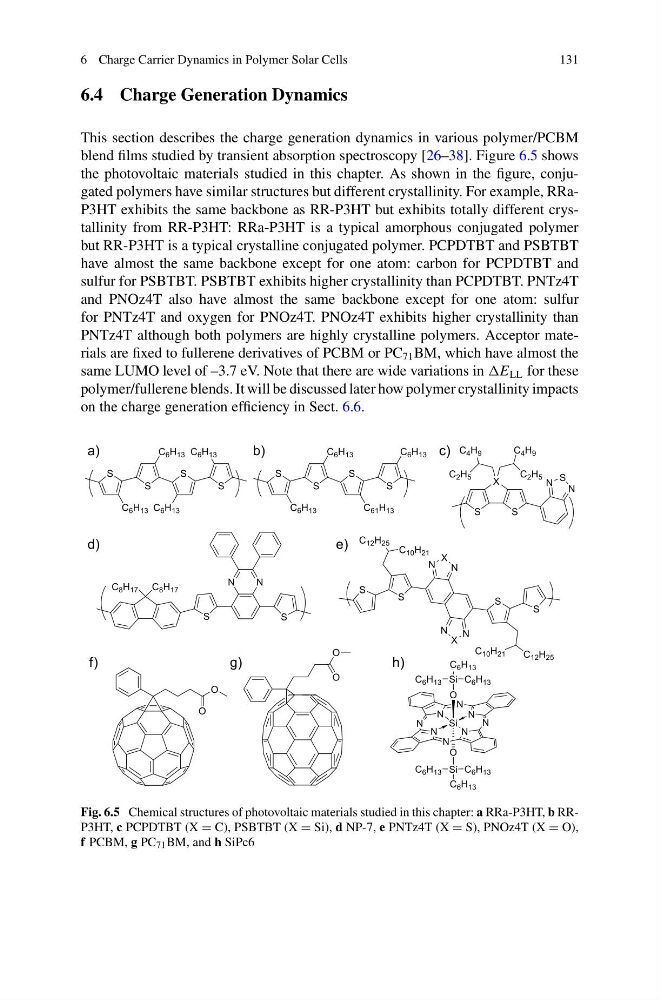
blend films studied by transient absorption spectroscopy [26–38]. Figure 6.5 shows
the photovoltaic materials studied in this chapter. As shown in the figure, conjugated polymers have similar structures but different crystallinity. For example, RRaP3HT exhibits the same backbone as RR-P3HT but exhibits totally different crystallinity from RR-P3HT: RRa-P3HT is a typical amorphous conjugated polymer
but RR-P3HT is a typical crystalline conjugated polymer. PCPDTBT and PSBTBT
have almost the same backbone except for one atom: carbon for PCPDTBT and
sulfur for PSBTBT. PSBTBT exhibits higher crystallinity than PCPDTBT. PNTz4T
and PNOz4T also have almost the same backbone except for one atom: sulfur
for PNTz4T and oxygen for PNOz4T. PNOz4T exhibits higher crystallinity than
PNTz4T although both polymers are highly crystalline polymers. Acceptor materials are fixed to fullerene derivatives of PCBM or PC 71 BM, which have almost the
same LUMO level of –3.7 eV. Note that there are wide variations in E LL for these
polymer/fullerene blends. It will be discussed later how polymer crystallinity impacts
on the charge generation efficiency in Sect. 6.6.
Fig. 6.5 Chemical structures of photovoltaic materials studied in this chapter: a RRa-P3HT, b RRP3HT, c PCPDTBT (X = C), PSBTBT (X = Si), d NP-7, e PNTz4T (X = S), PNOz4T (X = O),
f PCBM, g PC 71 BM, and h SiPc6
131
6.4 Charge Generation Dynamics
This section describes the charge generation dynamics in various polymer/PCBM
blend films studied by transient absorption spectroscopy [26–38]. Figure 6.5 shows
the photovoltaic materials studied in this chapter. As shown in the figure, conjugated polymers have similar structures but different crystallinity. For example, RRaP3HT exhibits the same backbone as RR-P3HT but exhibits totally different crystallinity from RR-P3HT: RRa-P3HT is a typical amorphous conjugated polymer
but RR-P3HT is a typical crystalline conjugated polymer. PCPDTBT and PSBTBT
have almost the same backbone except for one atom: carbon for PCPDTBT and
sulfur for PSBTBT. PSBTBT exhibits higher crystallinity than PCPDTBT. PNTz4T
and PNOz4T also have almost the same backbone except for one atom: sulfur
for PNTz4T and oxygen for PNOz4T. PNOz4T exhibits higher crystallinity than
PNTz4T although both polymers are highly crystalline polymers. Acceptor materials are fixed to fullerene derivatives of PCBM or PC 71 BM, which have almost the
same LUMO level of –3.7 eV. Note that there are wide variations in E LL for these
polymer/fullerene blends. It will be discussed later how polymer crystallinity impacts
on the charge generation efficiency in Sect. 6.6.
Fig. 6.5 Chemical structures of photovoltaic materials studied in this chapter: a RRa-P3HT, b RRP3HT, c PCPDTBT (X = C), PSBTBT (X = Si), d NP-7, e PNTz4T (X = S), PNOz4T (X = O),
f PCBM, g PC 71 BM, and h SiPc6