

130
H. Ohkita
recombine with the majority charges steadily generated by the white light illumination. In other words, the decay of the minority charges follows pseudo-first-order
kinetics and hence is given by an exponential function. Thus, the lifetime of the
minority charges τ n is evaluated as a time constant of the exponential decay. Similarly, the lifetimes τ n for different V OC s can be obtained by changing illumination
intensities. The following relationship between τ n and V OC is given by
τ n = τ n 0 exp
−
eV OC
νk B T
(6.1)
where τ n and ν are obtained from an intersection and a slope in Logarithmic plots
of τ n against V OC , respectively.
In TPC measurements, polymer solar cells are operated at the short-circuit under
white light (simulated solar) illumination and then are excited by the same small
perturbation pulsed laser light as TPV. Under the short-circuit condition, transient
photocurrent decay is ascribed to charge collection to electrodes. As described previously, the total charge carrier density n can be evaluated from TPC analyses [23, 24].
The following relationship between n and V OC is given by
n = n 0 exp
eV OC
mk B T
(6.2)
where n 0 and m are obtained from an intersection and a slope in Logarithmic plots
of n against V OC , respectively. Finally, the lifetime of the total charge carriers τ n is
given by τ n = (1 + λ)τ n = δτ n where λ = m/ν and δ = 1 + λ. Here, δ is the
empirical reaction order that describes how the recombination rate scales with all
charge carrier density in a device including both free and trapped charges [25]. By
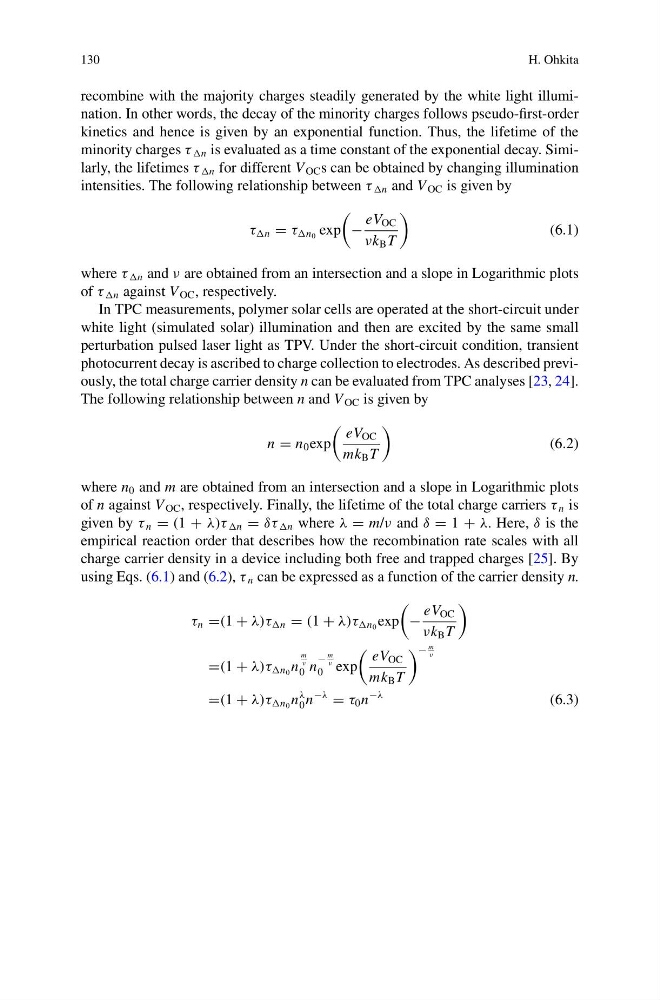
using Eqs. (6.1) and (6.2), τ n can be expressed as a function of the carrier density n.
τ n =(1 + λ)τ n = (1 + λ)τ n 0 exp
−
eV OC
νk B T
=(1 + λ)τ n 0 n
m
ν
0 n
−
m
ν
0 exp
eV OC
mk B T
−
m
ν
=(1 + λ)τ n 0 n
λ
0 n
−λ
= τ 0 n
−λ
(6.3)
H. Ohkita
recombine with the majority charges steadily generated by the white light illumination. In other words, the decay of the minority charges follows pseudo-first-order
kinetics and hence is given by an exponential function. Thus, the lifetime of the
minority charges τ n is evaluated as a time constant of the exponential decay. Similarly, the lifetimes τ n for different V OC s can be obtained by changing illumination
intensities. The following relationship between τ n and V OC is given by
τ n = τ n 0 exp
−
eV OC
νk B T
(6.1)
where τ n and ν are obtained from an intersection and a slope in Logarithmic plots
of τ n against V OC , respectively.
In TPC measurements, polymer solar cells are operated at the short-circuit under
white light (simulated solar) illumination and then are excited by the same small
perturbation pulsed laser light as TPV. Under the short-circuit condition, transient
photocurrent decay is ascribed to charge collection to electrodes. As described previously, the total charge carrier density n can be evaluated from TPC analyses [23, 24].
The following relationship between n and V OC is given by
n = n 0 exp
eV OC
mk B T
(6.2)
where n 0 and m are obtained from an intersection and a slope in Logarithmic plots
of n against V OC , respectively. Finally, the lifetime of the total charge carriers τ n is
given by τ n = (1 + λ)τ n = δτ n where λ = m/ν and δ = 1 + λ. Here, δ is the
empirical reaction order that describes how the recombination rate scales with all
charge carrier density in a device including both free and trapped charges [25]. By
using Eqs. (6.1) and (6.2), τ n can be expressed as a function of the carrier density n.
τ n =(1 + λ)τ n = (1 + λ)τ n 0 exp
−
eV OC
νk B T
=(1 + λ)τ n 0 n
m
ν
0 n
−
m
ν
0 exp
eV OC
mk B T
−
m
ν
=(1 + λ)τ n 0 n
λ
0 n
−λ
= τ 0 n
−λ
(6.3)