

5 Polymer Solar Cells: Development of π-Conjugated Polymers …
111
a
F2-F0
–3.28
–5.14
1.46
F2-F2
–3.35
–5.30
1.53
F0-F0
–3.12
–5.09
E g
1.56
F0-F2
–5.27
–3.18
1.60
Energy (eV)
HOMO
LUMO
F0-F4
–5.46
–3.30
1.62
b
c
S
S
N
S
N
N S
N
S
S
S
S
N
S
N
N S
N
HOMO
LUMO
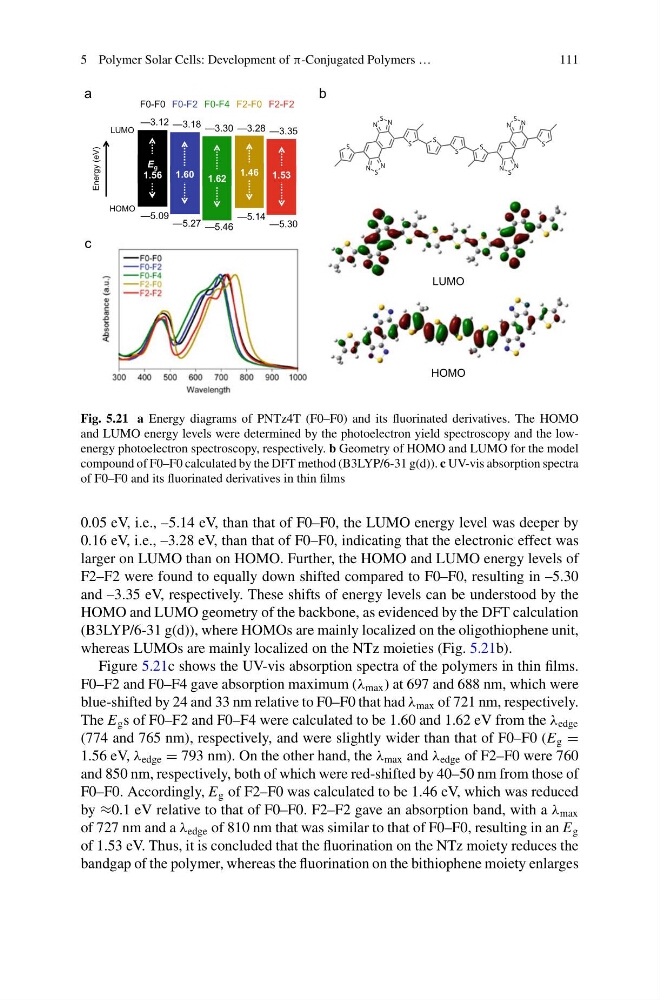
Fig. 5.21 a Energy diagrams of PNTz4T (F0–F0) and its fluorinated derivatives. The HOMO
and LUMO energy levels were determined by the photoelectron yield spectroscopy and the lowenergy photoelectron spectroscopy, respectively. b Geometry of HOMO and LUMO for the model
compound of F0–F0 calculated by the DFT method (B3LYP/6-31 g(d)). c UV-vis absorption spectra
of F0–F0 and its fluorinated derivatives in thin films
0.05 eV, i.e., –5.14 eV, than that of F0–F0, the LUMO energy level was deeper by
0.16 eV, i.e., –3.28 eV, than that of F0–F0, indicating that the electronic effect was
larger on LUMO than on HOMO. Further, the HOMO and LUMO energy levels of
F2–F2 were found to equally down shifted compared to F0–F0, resulting in –5.30
and –3.35 eV, respectively. These shifts of energy levels can be understood by the
HOMO and LUMO geometry of the backbone, as evidenced by the DFT calculation
(B3LYP/6-31 g(d)), where HOMOs are mainly localized on the oligothiophene unit,
whereas LUMOs are mainly localized on the NTz moieties (Fig. 5.21b).
Figure 5.21c shows the UV-vis absorption spectra of the polymers in thin films.
F0–F2 and F0–F4 gave absorption maximum (λ max ) at 697 and 688 nm, which were
blue-shifted by 24 and 33 nm relative to F0–F0 that had λ max of 721 nm, respectively.
The E g s of F0–F2 and F0–F4 were calculated to be 1.60 and 1.62 eV from the λ edge
(774 and 765 nm), respectively, and were slightly wider than that of F0–F0 (E g =
1.56 eV, λ edge = 793 nm). On the other hand, the λ max and λ edge of F2–F0 were 760
and 850 nm, respectively, both of which were red-shifted by 40–50 nm from those of
F0–F0. Accordingly, E g of F2–F0 was calculated to be 1.46 eV, which was reduced
by ≈0.1 eV relative to that of F0–F0. F2–F2 gave an absorption band, with a λ max
of 727 nm and a λ edge of 810 nm that was similar to that of F0–F0, resulting in an E g
of 1.53 eV. Thus, it is concluded that the fluorination on the NTz moiety reduces the
bandgap of the polymer, whereas the fluorination on the bithiophene moiety enlarges
111
a
F2-F0
–3.28
–5.14
1.46
F2-F2
–3.35
–5.30
1.53
F0-F0
–3.12
–5.09
E g
1.56
F0-F2
–5.27
–3.18
1.60
Energy (eV)
HOMO
LUMO
F0-F4
–5.46
–3.30
1.62
b
c
S
S
N
S
N
N S
N
S
S
S
S
N
S
N
N S
N
HOMO
LUMO
Fig. 5.21 a Energy diagrams of PNTz4T (F0–F0) and its fluorinated derivatives. The HOMO
and LUMO energy levels were determined by the photoelectron yield spectroscopy and the lowenergy photoelectron spectroscopy, respectively. b Geometry of HOMO and LUMO for the model
compound of F0–F0 calculated by the DFT method (B3LYP/6-31 g(d)). c UV-vis absorption spectra
of F0–F0 and its fluorinated derivatives in thin films
0.05 eV, i.e., –5.14 eV, than that of F0–F0, the LUMO energy level was deeper by
0.16 eV, i.e., –3.28 eV, than that of F0–F0, indicating that the electronic effect was
larger on LUMO than on HOMO. Further, the HOMO and LUMO energy levels of
F2–F2 were found to equally down shifted compared to F0–F0, resulting in –5.30
and –3.35 eV, respectively. These shifts of energy levels can be understood by the
HOMO and LUMO geometry of the backbone, as evidenced by the DFT calculation
(B3LYP/6-31 g(d)), where HOMOs are mainly localized on the oligothiophene unit,
whereas LUMOs are mainly localized on the NTz moieties (Fig. 5.21b).
Figure 5.21c shows the UV-vis absorption spectra of the polymers in thin films.
F0–F2 and F0–F4 gave absorption maximum (λ max ) at 697 and 688 nm, which were
blue-shifted by 24 and 33 nm relative to F0–F0 that had λ max of 721 nm, respectively.
The E g s of F0–F2 and F0–F4 were calculated to be 1.60 and 1.62 eV from the λ edge
(774 and 765 nm), respectively, and were slightly wider than that of F0–F0 (E g =
1.56 eV, λ edge = 793 nm). On the other hand, the λ max and λ edge of F2–F0 were 760
and 850 nm, respectively, both of which were red-shifted by 40–50 nm from those of
F0–F0. Accordingly, E g of F2–F0 was calculated to be 1.46 eV, which was reduced
by ≈0.1 eV relative to that of F0–F0. F2–F2 gave an absorption band, with a λ max
of 727 nm and a λ edge of 810 nm that was similar to that of F0–F0, resulting in an E g
of 1.53 eV. Thus, it is concluded that the fluorination on the NTz moiety reduces the
bandgap of the polymer, whereas the fluorination on the bithiophene moiety enlarges