

110
I. Osaka
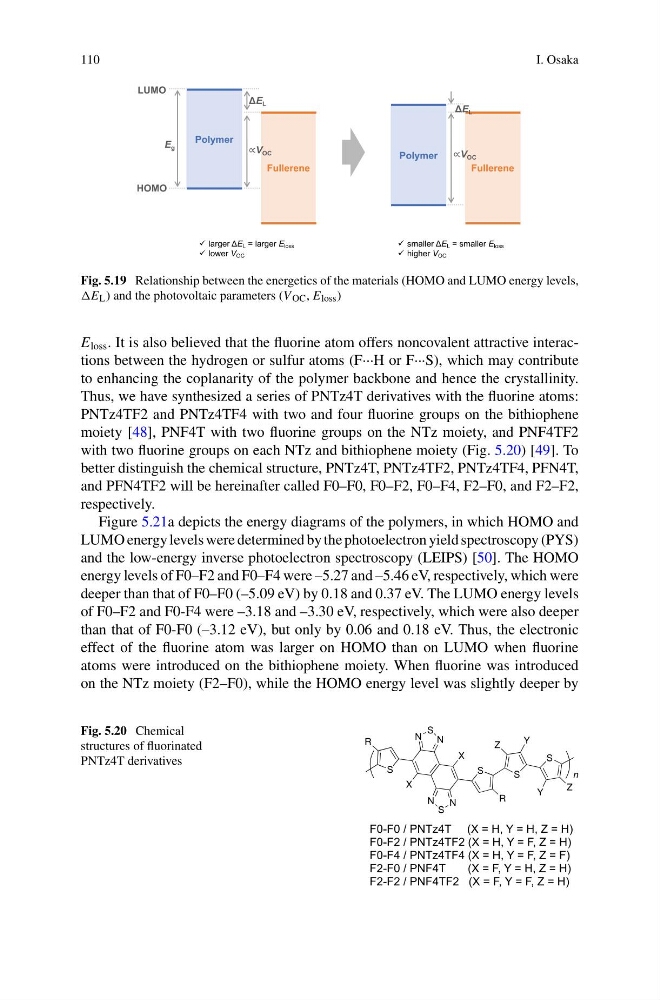
Fig. 5.19 Relationship between the energetics of the materials (HOMO and LUMO energy levels,
L ) and the photovoltaic parameters (V OC , E loss )
E loss . It is also believed that the fluorine atom offers noncovalent attractive interactions between the hydrogen or sulfur atoms (F···H or F···S), which may contribute
to enhancing the coplanarity of the polymer backbone and hence the crystallinity.
Thus, we have synthesized a series of PNTz4T derivatives with the fluorine atoms:
PNTz4TF2 and PNTz4TF4 with two and four fluorine groups on the bithiophene
moiety [48], PNF4T with two fluorine groups on the NTz moiety, and PNF4TF2
with two fluorine groups on each NTz and bithiophene moiety (Fig. 5.20) [49]. To
better distinguish the chemical structure, PNTz4T, PNTz4TF2, PNTz4TF4, PFN4T,
and PFN4TF2 will be hereinafter called F0–F0, F0–F2, F0–F4, F2–F0, and F2–F2,
respectively.
Figure 5.21a depicts the energy diagrams of the polymers, in which HOMO and
LUMO energy levels were determined by the photoelectron yield spectroscopy (PYS)
and the low-energy inverse photoelectron spectroscopy (LEIPS) [50]. The HOMO
energy levels of F0–F2 and F0–F4 were –5.27 and –5.46 eV, respectively, which were
deeper than that of F0–F0 (–5.09 eV) by 0.18 and 0.37 eV. The LUMO energy levels
of F0–F2 and F0-F4 were –3.18 and –3.30 eV, respectively, which were also deeper
than that of F0-F0 (–3.12 eV), but only by 0.06 and 0.18 eV. Thus, the electronic
effect of the fluorine atom was larger on HOMO than on LUMO when fluorine
atoms were introduced on the bithiophene moiety. When fluorine was introduced
on the NTz moiety (F2–F0), while the HOMO energy level was slightly deeper by
Fig. 5.20 Chemical
structures of fluorinated
PNTz4T derivatives
I. Osaka
Fig. 5.19 Relationship between the energetics of the materials (HOMO and LUMO energy levels,
L ) and the photovoltaic parameters (V OC , E loss )
E loss . It is also believed that the fluorine atom offers noncovalent attractive interactions between the hydrogen or sulfur atoms (F···H or F···S), which may contribute
to enhancing the coplanarity of the polymer backbone and hence the crystallinity.
Thus, we have synthesized a series of PNTz4T derivatives with the fluorine atoms:
PNTz4TF2 and PNTz4TF4 with two and four fluorine groups on the bithiophene
moiety [48], PNF4T with two fluorine groups on the NTz moiety, and PNF4TF2
with two fluorine groups on each NTz and bithiophene moiety (Fig. 5.20) [49]. To
better distinguish the chemical structure, PNTz4T, PNTz4TF2, PNTz4TF4, PFN4T,
and PFN4TF2 will be hereinafter called F0–F0, F0–F2, F0–F4, F2–F0, and F2–F2,
respectively.
Figure 5.21a depicts the energy diagrams of the polymers, in which HOMO and
LUMO energy levels were determined by the photoelectron yield spectroscopy (PYS)
and the low-energy inverse photoelectron spectroscopy (LEIPS) [50]. The HOMO
energy levels of F0–F2 and F0–F4 were –5.27 and –5.46 eV, respectively, which were
deeper than that of F0–F0 (–5.09 eV) by 0.18 and 0.37 eV. The LUMO energy levels
of F0–F2 and F0-F4 were –3.18 and –3.30 eV, respectively, which were also deeper
than that of F0-F0 (–3.12 eV), but only by 0.06 and 0.18 eV. Thus, the electronic
effect of the fluorine atom was larger on HOMO than on LUMO when fluorine
atoms were introduced on the bithiophene moiety. When fluorine was introduced
on the NTz moiety (F2–F0), while the HOMO energy level was slightly deeper by
Fig. 5.20 Chemical
structures of fluorinated
PNTz4T derivatives