

5 Polymer Solar Cells: Development of π-Conjugated Polymers …
109
-25
-20
-15
-10
-5
0
5
-0.2
0
0.2
0.4
0.6
0.8
1
Conventional (PC 61 BM)
Conventional (PC 71 BM)
Inverted (PC 61 BM)
Inverted (PC 71 BM)
Current density (mA
cm
– 2
)
Voltage (V)
0
20
40
60
80
100
300 400 500 600 700 800 900
Conventional (PC 61 BM)
Conventional (PC 71 BM)
Inverted (PC 61 BM)
Inverted (PC 71 BM)
EQE (%)
Wavelength (nm)
a
b
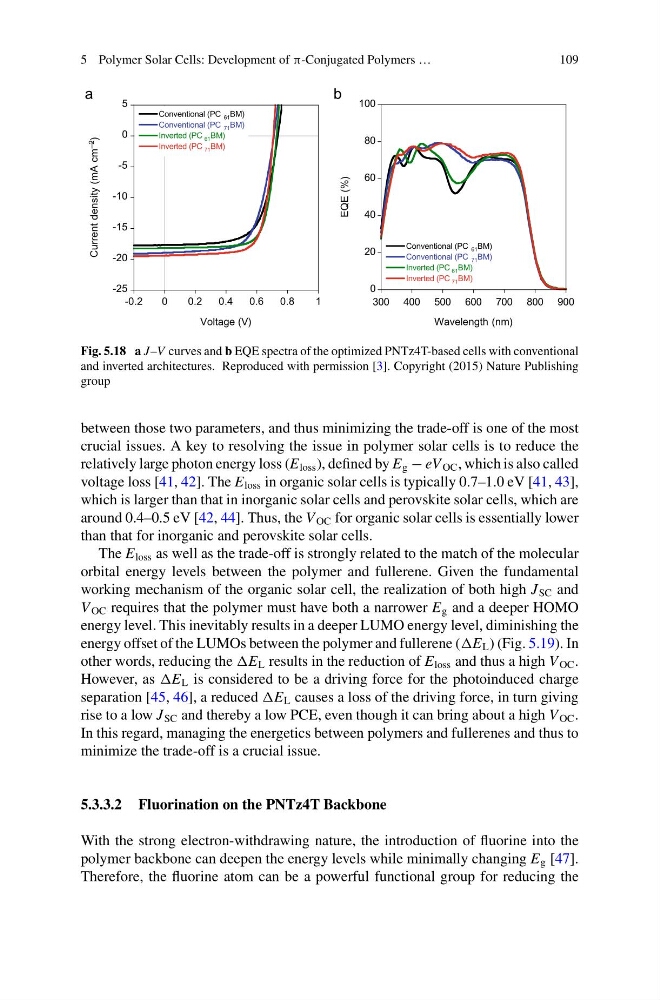
Fig. 5.18 a J–V curves and b EQE spectra of the optimized PNTz4T-based cells with conventional
and inverted architectures. Reproduced with permission [3]. Copyright (2015) Nature Publishing
group
between those two parameters, and thus minimizing the trade-off is one of the most
crucial issues. A key to resolving the issue in polymer solar cells is to reduce the
relatively large photon energy loss (E loss ), defined by E g − eV OC , which is also called
voltage loss [41, 42]. The E loss in organic solar cells is typically 0.7–1.0 eV [41, 43],
which is larger than that in inorganic solar cells and perovskite solar cells, which are
around 0.4–0.5 eV [42, 44]. Thus, the V OC for organic solar cells is essentially lower
than that for inorganic and perovskite solar cells.
The E loss as well as the trade-off is strongly related to the match of the molecular
orbital energy levels between the polymer and fullerene. Given the fundamental
working mechanism of the organic solar cell, the realization of both high J SC and
V OC requires that the polymer must have both a narrower E g and a deeper HOMO
energy level. This inevitably results in a deeper LUMO energy level, diminishing the
energy offset of the LUMOs between the polymer and fullerene ( L ) (Fig. 5.19). In
other words, reducing the L results in the reduction of E loss and thus a high V OC .
However, as L is considered to be a driving force for the photoinduced charge
separation [45, 46], a reduced L causes a loss of the driving force, in turn giving
rise to a low J SC and thereby a low PCE, even though it can bring about a high V OC .
In this regard, managing the energetics between polymers and fullerenes and thus to
minimize the trade-off is a crucial issue.
5.3.3.2 Fluorination on the PNTz4T Backbone
With the strong electron-withdrawing nature, the introduction of fluorine into the
polymer backbone can deepen the energy levels while minimally changing E g [47].
Therefore, the fluorine atom can be a powerful functional group for reducing the
109
-25
-20
-15
-10
-5
0
5
-0.2
0
0.2
0.4
0.6
0.8
1
Conventional (PC 61 BM)
Conventional (PC 71 BM)
Inverted (PC 61 BM)
Inverted (PC 71 BM)
Current density (mA
cm
– 2
)
Voltage (V)
0
20
40
60
80
100
300 400 500 600 700 800 900
Conventional (PC 61 BM)
Conventional (PC 71 BM)
Inverted (PC 61 BM)
Inverted (PC 71 BM)
EQE (%)
Wavelength (nm)
a
b
Fig. 5.18 a J–V curves and b EQE spectra of the optimized PNTz4T-based cells with conventional
and inverted architectures. Reproduced with permission [3]. Copyright (2015) Nature Publishing
group
between those two parameters, and thus minimizing the trade-off is one of the most
crucial issues. A key to resolving the issue in polymer solar cells is to reduce the
relatively large photon energy loss (E loss ), defined by E g − eV OC , which is also called
voltage loss [41, 42]. The E loss in organic solar cells is typically 0.7–1.0 eV [41, 43],
which is larger than that in inorganic solar cells and perovskite solar cells, which are
around 0.4–0.5 eV [42, 44]. Thus, the V OC for organic solar cells is essentially lower
than that for inorganic and perovskite solar cells.
The E loss as well as the trade-off is strongly related to the match of the molecular
orbital energy levels between the polymer and fullerene. Given the fundamental
working mechanism of the organic solar cell, the realization of both high J SC and
V OC requires that the polymer must have both a narrower E g and a deeper HOMO
energy level. This inevitably results in a deeper LUMO energy level, diminishing the
energy offset of the LUMOs between the polymer and fullerene ( L ) (Fig. 5.19). In
other words, reducing the L results in the reduction of E loss and thus a high V OC .
However, as L is considered to be a driving force for the photoinduced charge
separation [45, 46], a reduced L causes a loss of the driving force, in turn giving
rise to a low J SC and thereby a low PCE, even though it can bring about a high V OC .
In this regard, managing the energetics between polymers and fullerenes and thus to
minimize the trade-off is a crucial issue.
5.3.3.2 Fluorination on the PNTz4T Backbone
With the strong electron-withdrawing nature, the introduction of fluorine into the
polymer backbone can deepen the energy levels while minimally changing E g [47].
Therefore, the fluorine atom can be a powerful functional group for reducing the