

108
I. Osaka
b
PNTz4T
PBTz4T
a
NTz2T
BTz2T
Top
view
Side
view
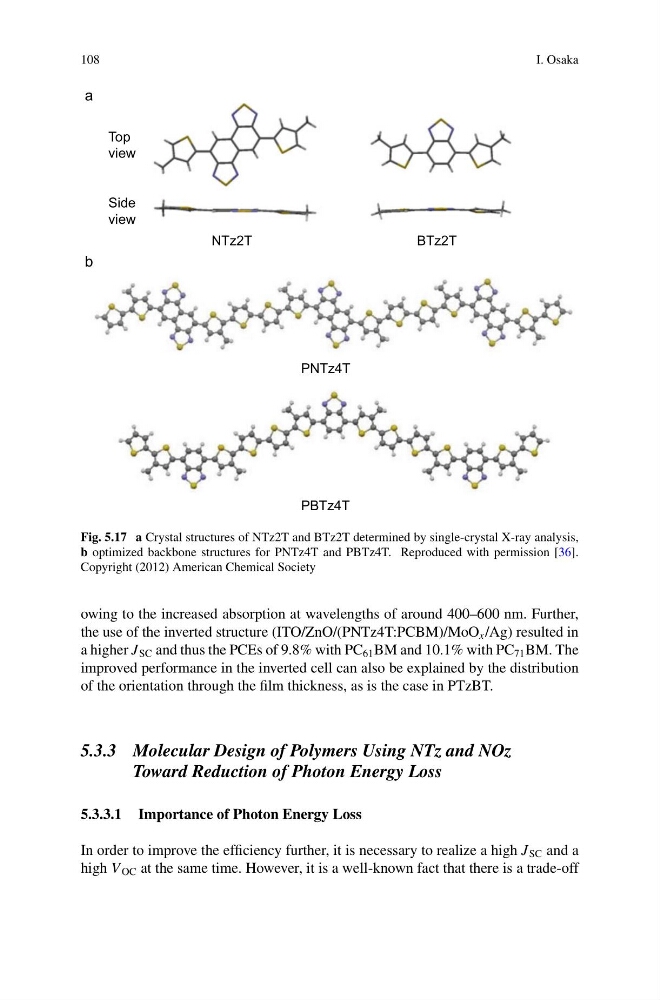
Fig. 5.17 a Crystal structures of NTz2T and BTz2T determined by single-crystal X-ray analysis,
b optimized backbone structures for PNTz4T and PBTz4T. Reproduced with permission [36].
Copyright (2012) American Chemical Society
owing to the increased absorption at wavelengths of around 400–600 nm. Further,
the use of the inverted structure (ITO/ZnO/(PNTz4T:PCBM)/MoO x /Ag) resulted in
a higher J SC and thus the PCEs of 9.8% with PC 61 BM and 10.1% with PC 71 BM. The
improved performance in the inverted cell can also be explained by the distribution
of the orientation through the film thickness, as is the case in PTzBT.
5.3.3 Molecular Design of Polymers Using NTz and NOz
Toward Reduction of Photon Energy Loss
5.3.3.1 Importance of Photon Energy Loss
In order to improve the efficiency further, it is necessary to realize a high J SC and a
high V OC at the same time. However, it is a well-known fact that there is a trade-off
I. Osaka
b
PNTz4T
PBTz4T
a
NTz2T
BTz2T
Top
view
Side
view
Fig. 5.17 a Crystal structures of NTz2T and BTz2T determined by single-crystal X-ray analysis,
b optimized backbone structures for PNTz4T and PBTz4T. Reproduced with permission [36].
Copyright (2012) American Chemical Society
owing to the increased absorption at wavelengths of around 400–600 nm. Further,
the use of the inverted structure (ITO/ZnO/(PNTz4T:PCBM)/MoO x /Ag) resulted in
a higher J SC and thus the PCEs of 9.8% with PC 61 BM and 10.1% with PC 71 BM. The
improved performance in the inverted cell can also be explained by the distribution
of the orientation through the film thickness, as is the case in PTzBT.
5.3.3 Molecular Design of Polymers Using NTz and NOz
Toward Reduction of Photon Energy Loss
5.3.3.1 Importance of Photon Energy Loss
In order to improve the efficiency further, it is necessary to realize a high J SC and a
high V OC at the same time. However, it is a well-known fact that there is a trade-off