

1 Basic Principles of Modern Organic Solar Cells
3
inadequate semiconductor for solar cells because of its indirect transition. This offers
a strong motivation to develop the next-generation solar cells.
1.1.3 Motivation for Organic Solar Cell
The original motivation for organic solar cells was to obtain man-made solar energy
conversion systems using organic compounds as an alternative to photosynthesis in
plants. However, currently, the following motivations accelerate the development of
organic solar cells.
(i) Construction of Novel Physics on Organic Semiconductors
The novel physics on organic semiconductors emerged as a result of long-term
research that lasted for more than a half century; researchers anticipated a vast
and fruitful uncultivated field of organic semiconductors. The organic solar cell
is one such spin-off.
(ii) Steady Efficiency Increase
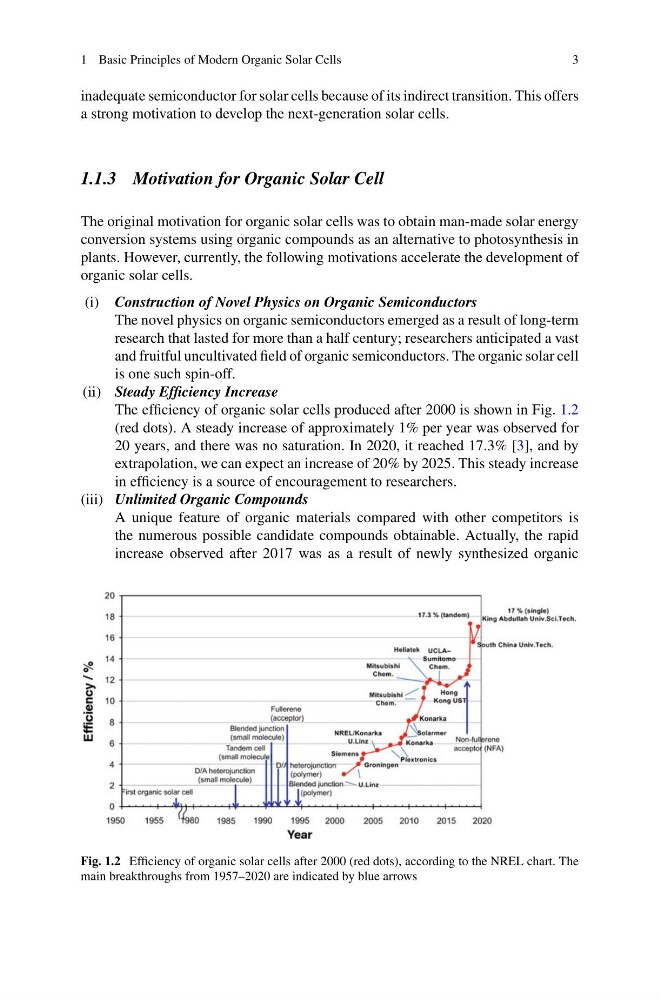
The efficiency of organic solar cells produced after 2000 is shown in Fig. 1.2
(red dots). A steady increase of approximately 1% per year was observed for
20 years, and there was no saturation. In 2020, it reached 17.3% [3], and by
extrapolation, we can expect an increase of 20% by 2025. This steady increase
in efficiency is a source of encouragement to researchers.
(iii) Unlimited Organic Compounds
A unique feature of organic materials compared with other competitors is
the numerous possible candidate compounds obtainable. Actually, the rapid
increase observed after 2017 was as a result of newly synthesized organic
Fig. 1.2 Efficiency of organic solar cells after 2000 (red dots), according to the NREL chart. The
main breakthroughs from 1957–2020 are indicated by blue arrows
3
inadequate semiconductor for solar cells because of its indirect transition. This offers
a strong motivation to develop the next-generation solar cells.
1.1.3 Motivation for Organic Solar Cell
The original motivation for organic solar cells was to obtain man-made solar energy
conversion systems using organic compounds as an alternative to photosynthesis in
plants. However, currently, the following motivations accelerate the development of
organic solar cells.
(i) Construction of Novel Physics on Organic Semiconductors
The novel physics on organic semiconductors emerged as a result of long-term
research that lasted for more than a half century; researchers anticipated a vast
and fruitful uncultivated field of organic semiconductors. The organic solar cell
is one such spin-off.
(ii) Steady Efficiency Increase
The efficiency of organic solar cells produced after 2000 is shown in Fig. 1.2
(red dots). A steady increase of approximately 1% per year was observed for
20 years, and there was no saturation. In 2020, it reached 17.3% [3], and by
extrapolation, we can expect an increase of 20% by 2025. This steady increase
in efficiency is a source of encouragement to researchers.
(iii) Unlimited Organic Compounds
A unique feature of organic materials compared with other competitors is
the numerous possible candidate compounds obtainable. Actually, the rapid
increase observed after 2017 was as a result of newly synthesized organic
Fig. 1.2 Efficiency of organic solar cells after 2000 (red dots), according to the NREL chart. The
main breakthroughs from 1957–2020 are indicated by blue arrows