

4
M. Hiramoto
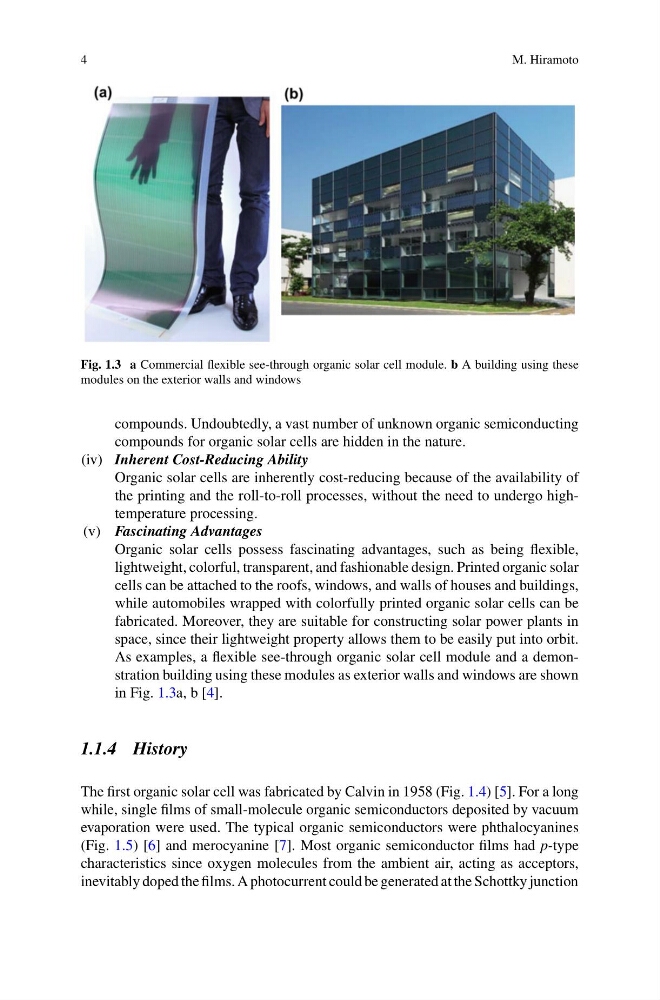
Fig. 1.3 a Commercial flexible see-through organic solar cell module. b A building using these
modules on the exterior walls and windows
compounds. Undoubtedly, a vast number of unknown organic semiconducting
compounds for organic solar cells are hidden in the nature.
(iv) Inherent Cost-Reducing Ability
Organic solar cells are inherently cost-reducing because of the availability of
the printing and the roll-to-roll processes, without the need to undergo hightemperature processing.
(v) Fascinating Advantages
Organic solar cells possess fascinating advantages, such as being flexible,
lightweight, colorful, transparent, and fashionable design. Printed organic solar
cells can be attached to the roofs, windows, and walls of houses and buildings,
while automobiles wrapped with colorfully printed organic solar cells can be
fabricated. Moreover, they are suitable for constructing solar power plants in
space, since their lightweight property allows them to be easily put into orbit.
As examples, a flexible see-through organic solar cell module and a demonstration building using these modules as exterior walls and windows are shown
in Fig. 1.3a, b [4].
1.1.4 History
The first organic solar cell was fabricated by Calvin in 1958 (Fig. 1.4) [5]. For a long
while, single films of small-molecule organic semiconductors deposited by vacuum
evaporation were used. The typical organic semiconductors were phthalocyanines
(Fig. 1.5) [6] and merocyanine [7]. Most organic semiconductor films had p-type
characteristics since oxygen molecules from the ambient air, acting as acceptors,
inevitably doped the films. A photocurrent could be generated at the Schottky junction
M. Hiramoto
Fig. 1.3 a Commercial flexible see-through organic solar cell module. b A building using these
modules on the exterior walls and windows
compounds. Undoubtedly, a vast number of unknown organic semiconducting
compounds for organic solar cells are hidden in the nature.
(iv) Inherent Cost-Reducing Ability
Organic solar cells are inherently cost-reducing because of the availability of
the printing and the roll-to-roll processes, without the need to undergo hightemperature processing.
(v) Fascinating Advantages
Organic solar cells possess fascinating advantages, such as being flexible,
lightweight, colorful, transparent, and fashionable design. Printed organic solar
cells can be attached to the roofs, windows, and walls of houses and buildings,
while automobiles wrapped with colorfully printed organic solar cells can be
fabricated. Moreover, they are suitable for constructing solar power plants in
space, since their lightweight property allows them to be easily put into orbit.
As examples, a flexible see-through organic solar cell module and a demonstration building using these modules as exterior walls and windows are shown
in Fig. 1.3a, b [4].
1.1.4 History
The first organic solar cell was fabricated by Calvin in 1958 (Fig. 1.4) [5]. For a long
while, single films of small-molecule organic semiconductors deposited by vacuum
evaporation were used. The typical organic semiconductors were phthalocyanines
(Fig. 1.5) [6] and merocyanine [7]. Most organic semiconductor films had p-type
characteristics since oxygen molecules from the ambient air, acting as acceptors,
inevitably doped the films. A photocurrent could be generated at the Schottky junction