

2
M. Hiramoto
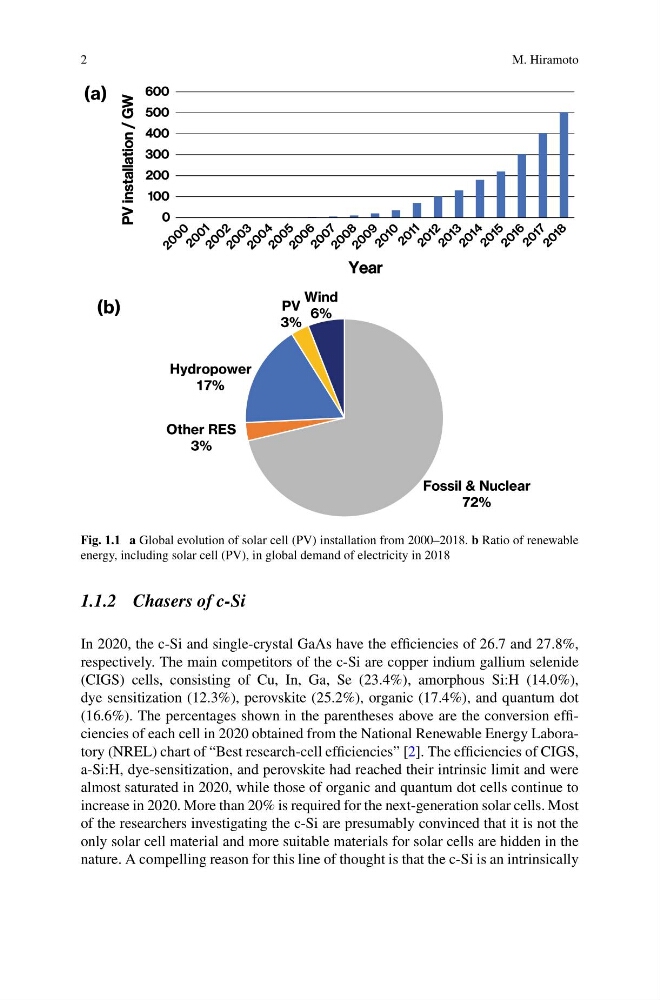
Fig. 1.1 a Global evolution of solar cell (PV) installation from 2000–2018. b Ratio of renewable
energy, including solar cell (PV), in global demand of electricity in 2018
1.1.2 Chasers of c-Si
In 2020, the c-Si and single-crystal GaAs have the efficiencies of 26.7 and 27.8%,
respectively. The main competitors of the c-Si are copper indium gallium selenide
(CIGS) cells, consisting of Cu, In, Ga, Se (23.4%), amorphous Si:H (14.0%),
dye sensitization (12.3%), perovskite (25.2%), organic (17.4%), and quantum dot
(16.6%). The percentages shown in the parentheses above are the conversion efficiencies of each cell in 2020 obtained from the National Renewable Energy Laboratory (NREL) chart of “Best research-cell efficiencies” [2]. The efficiencies of CIGS,
a-Si:H, dye-sensitization, and perovskite had reached their intrinsic limit and were
almost saturated in 2020, while those of organic and quantum dot cells continue to
increase in 2020. More than 20% is required for the next-generation solar cells. Most
of the researchers investigating the c-Si are presumably convinced that it is not the
only solar cell material and more suitable materials for solar cells are hidden in the
nature. A compelling reason for this line of thought is that the c-Si is an intrinsically
M. Hiramoto
Fig. 1.1 a Global evolution of solar cell (PV) installation from 2000–2018. b Ratio of renewable
energy, including solar cell (PV), in global demand of electricity in 2018
1.1.2 Chasers of c-Si
In 2020, the c-Si and single-crystal GaAs have the efficiencies of 26.7 and 27.8%,
respectively. The main competitors of the c-Si are copper indium gallium selenide
(CIGS) cells, consisting of Cu, In, Ga, Se (23.4%), amorphous Si:H (14.0%),
dye sensitization (12.3%), perovskite (25.2%), organic (17.4%), and quantum dot
(16.6%). The percentages shown in the parentheses above are the conversion efficiencies of each cell in 2020 obtained from the National Renewable Energy Laboratory (NREL) chart of “Best research-cell efficiencies” [2]. The efficiencies of CIGS,
a-Si:H, dye-sensitization, and perovskite had reached their intrinsic limit and were
almost saturated in 2020, while those of organic and quantum dot cells continue to
increase in 2020. More than 20% is required for the next-generation solar cells. Most
of the researchers investigating the c-Si are presumably convinced that it is not the
only solar cell material and more suitable materials for solar cells are hidden in the
nature. A compelling reason for this line of thought is that the c-Si is an intrinsically