

8 BETWEEN THE RHETORIC AND THE REALITY: RENEWABLE ENERGY …
191
concern with skyrocketing costs, the government replaced the FIT with
an RPS in 2012. According to Yoon and Sim, this shift not only benefitted large-scale producers disproportionately, but also made it harder
to promote renewable energy diffusion. The FIT was very costly, yet it
enabled small-scale energy producers to get finance easily because profitability was guaranteed for 20 years. Under RPS, the minimum quantity
of total energy generation is allocated from renewable sources. In such
a system, large-scale producers are in a better position to take advantage
of the wholesale electricity price and renewable energy certificate sales,
whereas it is difficult for small-scale producers to even secure the sales of
renewable energy certificates (REC).
Economic Dimension. In addition to the political and historical conditions discussed previously, one would not be able to explain the low level
of renewable energy adoption in South Korea without understanding the
preferences of South Korean consumers. As is well-known, one of the
biggest drawbacks is the high cost, which emanates from unstable supply
as well as relatively immature markets and technologies. How willing
consumers are to pay for various forms of renewable energy has been
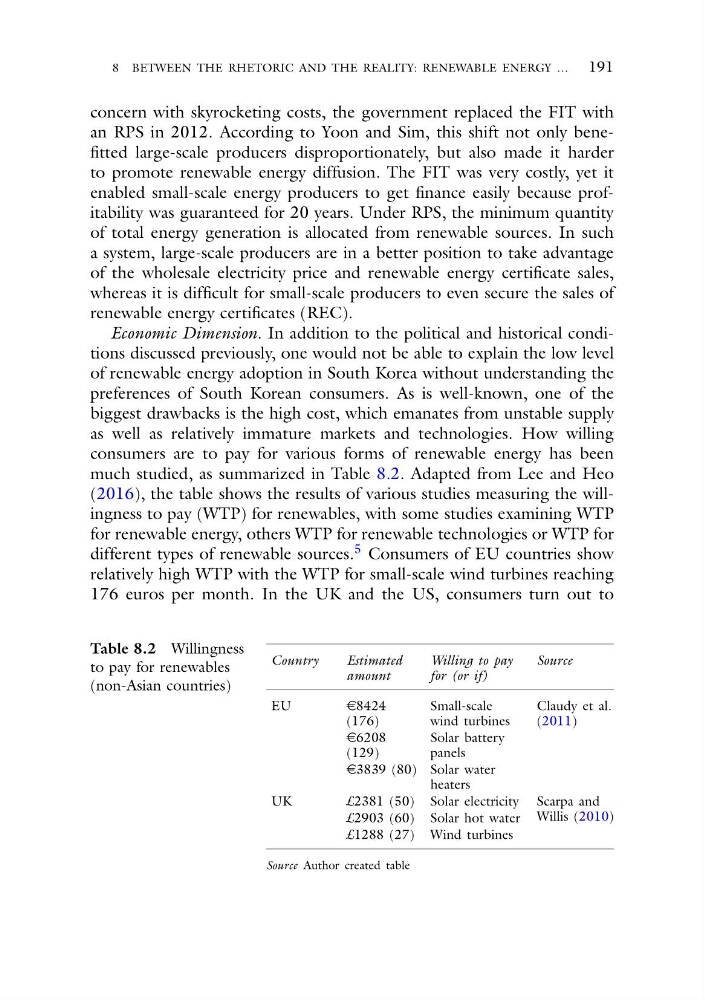
much studied, as summarized in Table 8.2. Adapted from Lee and Heo
(2016), the table shows the results of various studies measuring the willingness to pay (WTP) for renewables, with some studies examining WTP
for renewable energy, others WTP for renewable technologies or WTP for
different types of renewable sources. 5 Consumers of EU countries show
relatively high WTP with the WTP for small-scale wind turbines reaching
176 euros per month. In the UK and the US, consumers turn out to
Table 8.2 Willingness
to pay for renewables
(non-Asian countries)
Country
Estimated
amount
Willing to pay
for (or if)
Source
EU
e8424
(176)
Small-scale
wind turbines
Claudy et al.
(2011)
e6208
(129)
Solar battery
panels
e3839 (80) Solar water
heaters
UK
£2381 (50) Solar electricity Scarpa and
Willis (2010)
£2903 (60) Solar hot water
£1288 (27) Wind turbines
Source Author created table
191
concern with skyrocketing costs, the government replaced the FIT with
an RPS in 2012. According to Yoon and Sim, this shift not only benefitted large-scale producers disproportionately, but also made it harder
to promote renewable energy diffusion. The FIT was very costly, yet it
enabled small-scale energy producers to get finance easily because profitability was guaranteed for 20 years. Under RPS, the minimum quantity
of total energy generation is allocated from renewable sources. In such
a system, large-scale producers are in a better position to take advantage
of the wholesale electricity price and renewable energy certificate sales,
whereas it is difficult for small-scale producers to even secure the sales of
renewable energy certificates (REC).
Economic Dimension. In addition to the political and historical conditions discussed previously, one would not be able to explain the low level
of renewable energy adoption in South Korea without understanding the
preferences of South Korean consumers. As is well-known, one of the
biggest drawbacks is the high cost, which emanates from unstable supply
as well as relatively immature markets and technologies. How willing
consumers are to pay for various forms of renewable energy has been
much studied, as summarized in Table 8.2. Adapted from Lee and Heo
(2016), the table shows the results of various studies measuring the willingness to pay (WTP) for renewables, with some studies examining WTP
for renewable energy, others WTP for renewable technologies or WTP for
different types of renewable sources. 5 Consumers of EU countries show
relatively high WTP with the WTP for small-scale wind turbines reaching
176 euros per month. In the UK and the US, consumers turn out to
Table 8.2 Willingness
to pay for renewables
(non-Asian countries)
Country
Estimated
amount
Willing to pay
for (or if)
Source
EU
e8424
(176)
Small-scale
wind turbines
Claudy et al.
(2011)
e6208
(129)
Solar battery
panels
e3839 (80) Solar water
heaters
UK
£2381 (50) Solar electricity Scarpa and
Willis (2010)
£2903 (60) Solar hot water
£1288 (27) Wind turbines
Source Author created table