

192 S. Y. KIM AND I. SUN
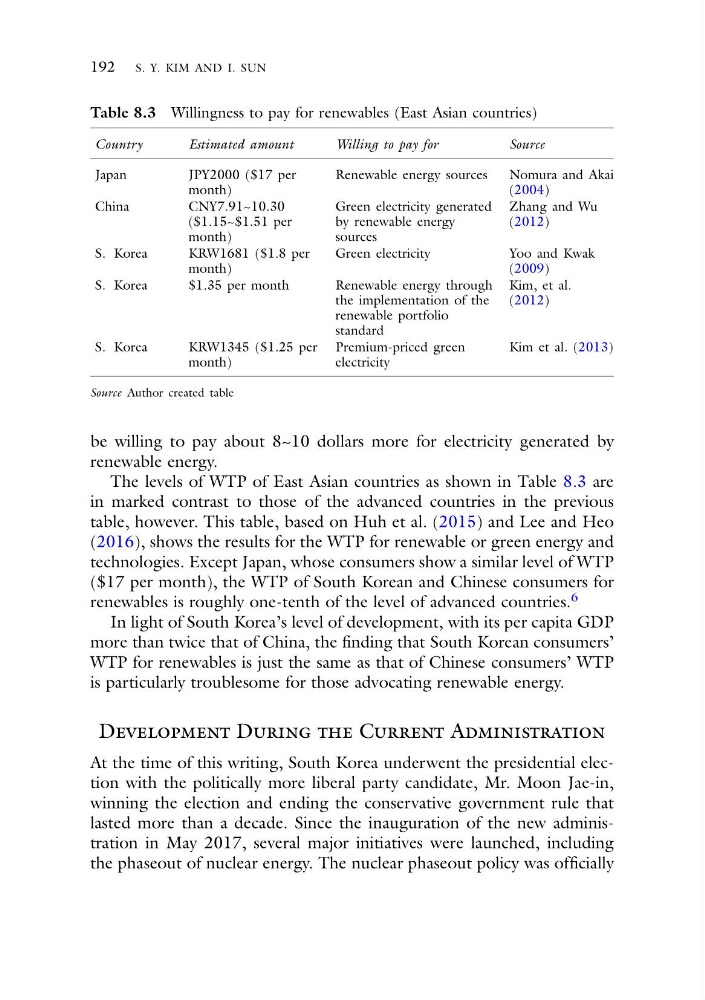
Table 8.3 Willingness to pay for renewables (East Asian countries)
Country
Estimated amount
Willing to pay for
Source
Japan
JPY2000 ($17 per
month)
Renewable energy sources
Nomura and Akai
(2004)
China
CNY7.91~10.30
($1.15~$1.51 per
month)
Green electricity generated
by renewable energy
sources
Zhang and Wu
(2012)
S. Korea
KRW1681 ($1.8 per
month)
Green electricity
Yoo and Kwak
(2009)
S. Korea
$1.35 per month
Renewable energy through
the implementation of the
renewable portfolio
standard
Kim, et al.
(2012)
S. Korea
KRW1345 ($1.25 per
month)
Premium-priced green
electricity
Kim et al. (2013)
Source Author created table
be willing to pay about 8~10 dollars more for electricity generated by
renewable energy.
The levels of WTP of East Asian countries as shown in Table 8.3 are
in marked contrast to those of the advanced countries in the previous
table, however. This table, based on Huh et al. (2015) and Lee and Heo
(2016), shows the results for the WTP for renewable or green energy and
technologies. Except Japan, whose consumers show a similar level of WTP
($17 per month), the WTP of South Korean and Chinese consumers for
renewables is roughly one-tenth of the level of advanced countries. 6
In light of South Korea’s level of development, with its per capita GDP
more than twice that of China, the finding that South Korean consumers’
WTP for renewables is just the same as that of Chinese consumers’ WTP
is particularly troublesome for those advocating renewable energy.
Development During the Current Administration
At the time of this writing, South Korea underwent the presidential election with the politically more liberal party candidate, Mr. Moon Jae-in,
winning the election and ending the conservative government rule that
lasted more than a decade. Since the inauguration of the new administration in May 2017, several major initiatives were launched, including
the phaseout of nuclear energy. The nuclear phaseout policy was officially
Table 8.3 Willingness to pay for renewables (East Asian countries)
Country
Estimated amount
Willing to pay for
Source
Japan
JPY2000 ($17 per
month)
Renewable energy sources
Nomura and Akai
(2004)
China
CNY7.91~10.30
($1.15~$1.51 per
month)
Green electricity generated
by renewable energy
sources
Zhang and Wu
(2012)
S. Korea
KRW1681 ($1.8 per
month)
Green electricity
Yoo and Kwak
(2009)
S. Korea
$1.35 per month
Renewable energy through
the implementation of the
renewable portfolio
standard
Kim, et al.
(2012)
S. Korea
KRW1345 ($1.25 per
month)
Premium-priced green
electricity
Kim et al. (2013)
Source Author created table
be willing to pay about 8~10 dollars more for electricity generated by
renewable energy.
The levels of WTP of East Asian countries as shown in Table 8.3 are
in marked contrast to those of the advanced countries in the previous
table, however. This table, based on Huh et al. (2015) and Lee and Heo
(2016), shows the results for the WTP for renewable or green energy and
technologies. Except Japan, whose consumers show a similar level of WTP
($17 per month), the WTP of South Korean and Chinese consumers for
renewables is roughly one-tenth of the level of advanced countries. 6
In light of South Korea’s level of development, with its per capita GDP
more than twice that of China, the finding that South Korean consumers’
WTP for renewables is just the same as that of Chinese consumers’ WTP
is particularly troublesome for those advocating renewable energy.
Development During the Current Administration
At the time of this writing, South Korea underwent the presidential election with the politically more liberal party candidate, Mr. Moon Jae-in,
winning the election and ending the conservative government rule that
lasted more than a decade. Since the inauguration of the new administration in May 2017, several major initiatives were launched, including
the phaseout of nuclear energy. The nuclear phaseout policy was officially