

60
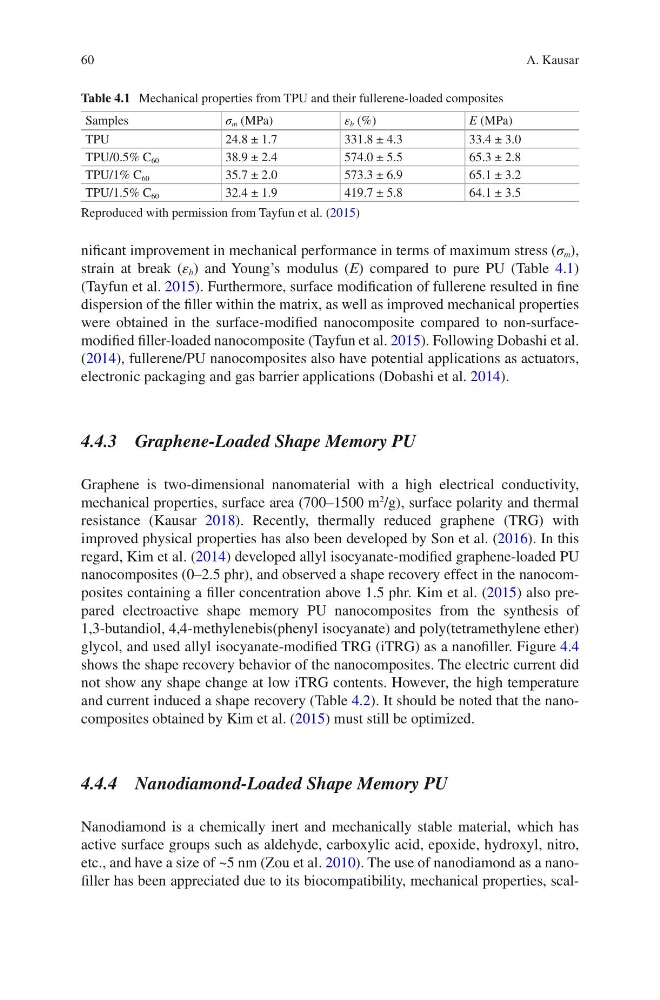
nificant improvement in mechanical performance in terms of maximum stress (σ m ),
strain at break (ε b ) and Young’s modulus (E) compared to pure PU (Table 4.1)
(Tayfun et al. 2015). Furthermore, surface modification of fullerene resulted in fine
dispersion of the filler within the matrix, as well as improved mechanical properties
were obtained in the surface-modified nanocomposite compared to non-surfacemodified filler-loaded nanocomposite (Tayfun et al. 2015). Following Dobashi et al.
(2014), fullerene/PU nanocomposites also have potential applications as actuators,
electronic packaging and gas barrier applications (Dobashi et al. 2014).
4.4.3 Graphene-Loaded Shape Memory PU
Graphene is two-dimensional nanomaterial with a high electrical conductivity,
mechanical properties, surface area (700–1500 m
2
/g), surface polarity and thermal
resistance (Kausar 2018). Recently, thermally reduced graphene (TRG) with
improved physical properties has also been developed by Son et al. (2016). In this
regard, Kim et al. (2014) developed allyl isocyanate-modified graphene-loaded PU
nanocomposites (0–2.5 phr), and observed a shape recovery effect in the nanocomposites containing a filler concentration above 1.5 phr. Kim et al. (2015) also prepared electroactive shape memory PU nanocomposites from the synthesis of
1,3-butandiol, 4,4-methylenebis(phenyl isocyanate) and poly(tetramethylene ether)
glycol, and used allyl isocyanate-modified TRG (iTRG) as a nanofiller. Figure 4.4
shows the shape recovery behavior of the nanocomposites. The electric current did
not show any shape change at low iTRG contents. However, the high temperature
and current induced a shape recovery (Table 4.2). It should be noted that the nanocomposites obtained by Kim et al. (2015) must still be optimized.
4.4.4 Nanodiamond-Loaded Shape Memory PU
Nanodiamond is a chemically inert and mechanically stable material, which has
active surface groups such as aldehyde, carboxylic acid, epoxide, hydroxyl, nitro,
etc., and have a size of ~5 nm (Zou et al. 2010). The use of nanodiamond as a nanofiller has been appreciated due to its biocompatibility, mechanical properties, scalTable 4.1 Mechanical properties from TPU and their fullerene-loaded composites
Samples
σ m (MPa)
ε b (%)
E (MPa)
TPU
24.8 ± 1.7
331.8 ± 4.3
33.4 ± 3.0
TPU/0.5% C 60
38.9 ± 2.4
574.0 ± 5.5
65.3 ± 2.8
TPU/1% C 60
35.7 ± 2.0
573.3 ± 6.9
65.1 ± 3.2
TPU/1.5% C 60
32.4 ± 1.9
419.7 ± 5.8
64.1 ± 3.5
Reproduced with permission from Tayfun et al. (2015)
A. Kausar
nificant improvement in mechanical performance in terms of maximum stress (σ m ),
strain at break (ε b ) and Young’s modulus (E) compared to pure PU (Table 4.1)
(Tayfun et al. 2015). Furthermore, surface modification of fullerene resulted in fine
dispersion of the filler within the matrix, as well as improved mechanical properties
were obtained in the surface-modified nanocomposite compared to non-surfacemodified filler-loaded nanocomposite (Tayfun et al. 2015). Following Dobashi et al.
(2014), fullerene/PU nanocomposites also have potential applications as actuators,
electronic packaging and gas barrier applications (Dobashi et al. 2014).
4.4.3 Graphene-Loaded Shape Memory PU
Graphene is two-dimensional nanomaterial with a high electrical conductivity,
mechanical properties, surface area (700–1500 m
2
/g), surface polarity and thermal
resistance (Kausar 2018). Recently, thermally reduced graphene (TRG) with
improved physical properties has also been developed by Son et al. (2016). In this
regard, Kim et al. (2014) developed allyl isocyanate-modified graphene-loaded PU
nanocomposites (0–2.5 phr), and observed a shape recovery effect in the nanocomposites containing a filler concentration above 1.5 phr. Kim et al. (2015) also prepared electroactive shape memory PU nanocomposites from the synthesis of
1,3-butandiol, 4,4-methylenebis(phenyl isocyanate) and poly(tetramethylene ether)
glycol, and used allyl isocyanate-modified TRG (iTRG) as a nanofiller. Figure 4.4
shows the shape recovery behavior of the nanocomposites. The electric current did
not show any shape change at low iTRG contents. However, the high temperature
and current induced a shape recovery (Table 4.2). It should be noted that the nanocomposites obtained by Kim et al. (2015) must still be optimized.
4.4.4 Nanodiamond-Loaded Shape Memory PU
Nanodiamond is a chemically inert and mechanically stable material, which has
active surface groups such as aldehyde, carboxylic acid, epoxide, hydroxyl, nitro,
etc., and have a size of ~5 nm (Zou et al. 2010). The use of nanodiamond as a nanofiller has been appreciated due to its biocompatibility, mechanical properties, scalTable 4.1 Mechanical properties from TPU and their fullerene-loaded composites
Samples
σ m (MPa)
ε b (%)
E (MPa)
TPU
24.8 ± 1.7
331.8 ± 4.3
33.4 ± 3.0
TPU/0.5% C 60
38.9 ± 2.4
574.0 ± 5.5
65.3 ± 2.8
TPU/1% C 60
35.7 ± 2.0
573.3 ± 6.9
65.1 ± 3.2
TPU/1.5% C 60
32.4 ± 1.9
419.7 ± 5.8
64.1 ± 3.5
Reproduced with permission from Tayfun et al. (2015)
A. Kausar