

59
mixing, thus obtaining improved electrical conductivity and shape memory properties for nanocomposites compared to pure PU. Furthermore, the T g values of the
functional metal NP-loaded CNT/PU nanocomposites were higher than the pristine
CNT/PU nanocomposites. This possibly caused by an increased interaction between
nanofiller (CNT) and PU. Chen et al. (2015) also designed CNT-loaded TPU nanocomposites, varying the nanofiller (CNT) content from 0.5 to 5 wt.%, as a result,
nanocomposites with better electrical and mechanical properties than pure TPU
were obtained. This possibly due to the formation of the percolation network, which
allowed to increase the conductivity properties of composite materials containing
more than 2 wt.% of CNT. Furthermore, the strain sensitivity and shape memory
properties of the nanocomposite were also improved using 5 wt.% of CNT. Figure 4.3
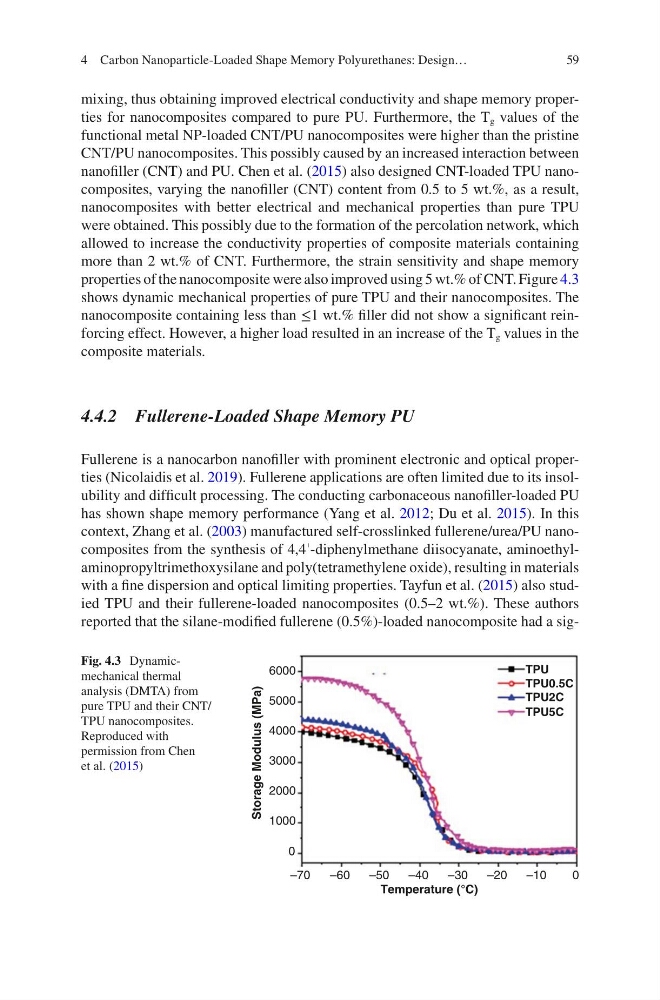
shows dynamic mechanical properties of pure TPU and their nanocomposites. The
nanocomposite containing less than ≤1 wt.% filler did not show a significant reinforcing effect. However, a higher load resulted in an increase of the T g values in the
composite materials.
4.4.2 Fullerene-Loaded Shape Memory PU
Fullerene is a nanocarbon nanofiller with prominent electronic and optical properties (Nicolaidis et al. 2019). Fullerene applications are often limited due to its insolubility and difficult processing. The conducting carbonaceous nanofiller-loaded PU
has shown shape memory performance (Yang et al. 2012; Du et al. 2015). In this
context, Zhang et al. (2003) manufactured self-crosslinked fullerene/urea/PU nanocomposites from the synthesis of 4,4ˈ-diphenylmethane diisocyanate, aminoethylaminopropyltrimethoxysilane and poly(tetramethylene oxide), resulting in materials
with a fine dispersion and optical limiting properties. Tayfun et al. (2015) also studied TPU and their fullerene-loaded nanocomposites (0.5–2 wt.%). These authors
reported that the silane-modified fullerene (0.5%)-loaded nanocomposite had a sig6000
TPU
TPU0.5C
TPU2C
TPU5C
5000
4000
3000
2000
1000
0
–70
–60
–50
Storage Modulus (MPa)
–40
Temperature (°C)
–30
–20
–10
0
Fig. 4.3 Dynamicmechanical thermal
analysis (DMTA) from
pure TPU and their CNT/
TPU nanocomposites.
Reproduced with
permission from Chen
et al. (2015)
4 Carbon Nanoparticle-Loaded Shape Memory Polyurethanes: Design…
mixing, thus obtaining improved electrical conductivity and shape memory properties for nanocomposites compared to pure PU. Furthermore, the T g values of the
functional metal NP-loaded CNT/PU nanocomposites were higher than the pristine
CNT/PU nanocomposites. This possibly caused by an increased interaction between
nanofiller (CNT) and PU. Chen et al. (2015) also designed CNT-loaded TPU nanocomposites, varying the nanofiller (CNT) content from 0.5 to 5 wt.%, as a result,
nanocomposites with better electrical and mechanical properties than pure TPU
were obtained. This possibly due to the formation of the percolation network, which
allowed to increase the conductivity properties of composite materials containing
more than 2 wt.% of CNT. Furthermore, the strain sensitivity and shape memory
properties of the nanocomposite were also improved using 5 wt.% of CNT. Figure 4.3
shows dynamic mechanical properties of pure TPU and their nanocomposites. The
nanocomposite containing less than ≤1 wt.% filler did not show a significant reinforcing effect. However, a higher load resulted in an increase of the T g values in the
composite materials.
4.4.2 Fullerene-Loaded Shape Memory PU
Fullerene is a nanocarbon nanofiller with prominent electronic and optical properties (Nicolaidis et al. 2019). Fullerene applications are often limited due to its insolubility and difficult processing. The conducting carbonaceous nanofiller-loaded PU
has shown shape memory performance (Yang et al. 2012; Du et al. 2015). In this
context, Zhang et al. (2003) manufactured self-crosslinked fullerene/urea/PU nanocomposites from the synthesis of 4,4ˈ-diphenylmethane diisocyanate, aminoethylaminopropyltrimethoxysilane and poly(tetramethylene oxide), resulting in materials
with a fine dispersion and optical limiting properties. Tayfun et al. (2015) also studied TPU and their fullerene-loaded nanocomposites (0.5–2 wt.%). These authors
reported that the silane-modified fullerene (0.5%)-loaded nanocomposite had a sig6000
TPU
TPU0.5C
TPU2C
TPU5C
5000
4000
3000
2000
1000
0
–70
–60
–50
Storage Modulus (MPa)
–40
Temperature (°C)
–30
–20
–10
0
Fig. 4.3 Dynamicmechanical thermal
analysis (DMTA) from
pure TPU and their CNT/
TPU nanocomposites.
Reproduced with
permission from Chen
et al. (2015)
4 Carbon Nanoparticle-Loaded Shape Memory Polyurethanes: Design…