

58
a high thermal transition temperature, while the soft segments have a low thermal
transition temperature, which can act as switching segments. In general, the performance of the shape memory depends on the thermal transition of the soft segments.
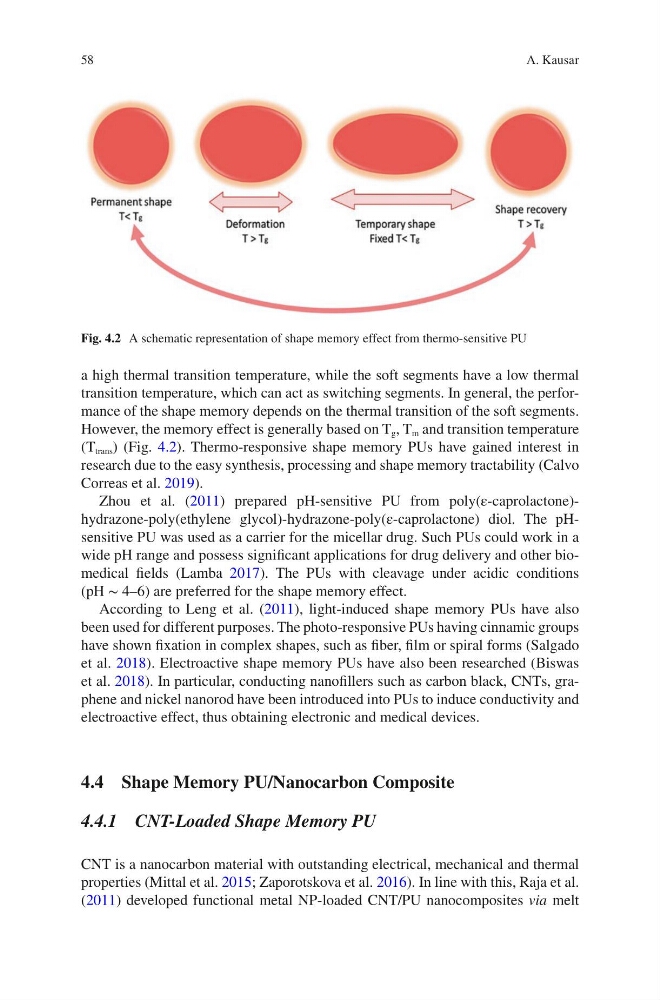
However, the memory effect is generally based on T g , T m and transition temperature
(T trans ) (Fig. 4.2). Thermo-responsive shape memory PUs have gained interest in
research due to the easy synthesis, processing and shape memory tractability (Calvo
Correas et al. 2019).
Zhou et al. (2011) prepared pH-sensitive PU from poly(ε-caprolactone)hydrazone-poly(ethylene glycol)-hydrazone-poly(ε-caprolactone) diol. The pHsensitive PU was used as a carrier for the micellar drug. Such PUs could work in a
wide pH range and possess significant applications for drug delivery and other biomedical fields (Lamba 2017). The PUs with cleavage under acidic conditions
(pH ∼ 4–6) are preferred for the shape memory effect.
According to Leng et al. (2011), light-induced shape memory PUs have also
been used for different purposes. The photo-responsive PUs having cinnamic groups
have shown fixation in complex shapes, such as fiber, film or spiral forms (Salgado
et al. 2018). Electroactive shape memory PUs have also been researched (Biswas
et al. 2018). In particular, conducting nanofillers such as carbon black, CNTs, graphene and nickel nanorod have been introduced into PUs to induce conductivity and
electroactive effect, thus obtaining electronic and medical devices.
4.4 Shape Memory PU/Nanocarbon Composite
4.4.1 CNT-Loaded Shape Memory PU
CNT is a nanocarbon material with outstanding electrical, mechanical and thermal
properties (Mittal et al. 2015; Zaporotskova et al. 2016). In line with this, Raja et al.
(2011) developed functional metal NP-loaded CNT/PU nanocomposites via melt
Fig. 4.2 A schematic representation of shape memory effect from thermo-sensitive PU
A. Kausar
a high thermal transition temperature, while the soft segments have a low thermal
transition temperature, which can act as switching segments. In general, the performance of the shape memory depends on the thermal transition of the soft segments.
However, the memory effect is generally based on T g , T m and transition temperature
(T trans ) (Fig. 4.2). Thermo-responsive shape memory PUs have gained interest in
research due to the easy synthesis, processing and shape memory tractability (Calvo
Correas et al. 2019).
Zhou et al. (2011) prepared pH-sensitive PU from poly(ε-caprolactone)hydrazone-poly(ethylene glycol)-hydrazone-poly(ε-caprolactone) diol. The pHsensitive PU was used as a carrier for the micellar drug. Such PUs could work in a
wide pH range and possess significant applications for drug delivery and other biomedical fields (Lamba 2017). The PUs with cleavage under acidic conditions
(pH ∼ 4–6) are preferred for the shape memory effect.
According to Leng et al. (2011), light-induced shape memory PUs have also
been used for different purposes. The photo-responsive PUs having cinnamic groups
have shown fixation in complex shapes, such as fiber, film or spiral forms (Salgado
et al. 2018). Electroactive shape memory PUs have also been researched (Biswas
et al. 2018). In particular, conducting nanofillers such as carbon black, CNTs, graphene and nickel nanorod have been introduced into PUs to induce conductivity and
electroactive effect, thus obtaining electronic and medical devices.
4.4 Shape Memory PU/Nanocarbon Composite
4.4.1 CNT-Loaded Shape Memory PU
CNT is a nanocarbon material with outstanding electrical, mechanical and thermal
properties (Mittal et al. 2015; Zaporotskova et al. 2016). In line with this, Raja et al.
(2011) developed functional metal NP-loaded CNT/PU nanocomposites via melt
Fig. 4.2 A schematic representation of shape memory effect from thermo-sensitive PU
A. Kausar