

35
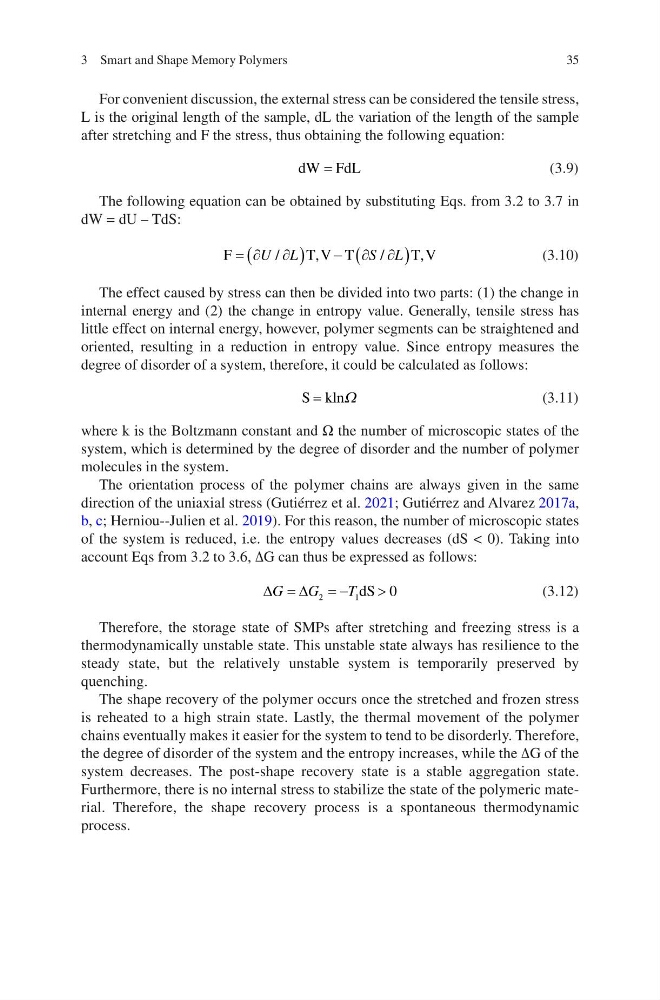
For convenient discussion, the external stress can be considered the tensile stress,
L is the original length of the sample, dL the variation of the length of the sample
after stretching and F the stress, thus obtaining the following equation:
dW FdL
=
(3.9)
The following equation can be obtained by substituting Eqs. from 3.2 to 3.7 in
dW = dU – TdS:
F
TV T
T V
= ¶ 
(
) - ¶ 
(
)
U L
S L
/
,
/
,
(3.10)
The effect caused by stress can then be divided into two parts: (1) the change in
internal energy and (2) the change in entropy value. Generally, tensile stress has
little effect on internal energy, however, polymer segments can be straightened and
oriented, resulting in a reduction in entropy value. Since entropy measures the
degree of disorder of a system, therefore, it could be calculated as follows:
S kln
=
W
(3.11)
where k is the Boltzmann constant and Ω the number of microscopic states of the
system, which is determined by the degree of disorder and the number of polymer
molecules in the system.
The orientation process of the polymer chains are always given in the same
direction of the uniaxial stress (Gutiérrez et al. 2021; Gutiérrez and Alvarez 2017a,
b, c; Herniou--Julien et al. 2019). For this reason, the number of microscopic states
of the system is reduced, i.e. the entropy values decreases (dS < 0). Taking into
account Eqs from 3.2 to 3.6, ΔG can thus be expressed as follows:
DG
G
T
=
=>
D 2
1
0
dS
(3.12)
Therefore, the storage state of SMPs after stretching and freezing stress is a
thermodynamically unstable state. This unstable state always has resilience to the
steady state, but the relatively unstable system is temporarily preserved by
quenching.
The shape recovery of the polymer occurs once the stretched and frozen stress
is reheated to a high strain state. Lastly, the thermal movement of the polymer
chains eventually makes it easier for the system to tend to be disorderly. Therefore,
the degree of disorder of the system and the entropy increases, while the ΔG of the
system decreases. The post-shape recovery state is a stable aggregation state.
Furthermore, there is no internal stress to stabilize the state of the polymeric material. Therefore, the shape recovery process is a spontaneous thermodynamic
process.
3 Smart and Shape Memory Polymers
For convenient discussion, the external stress can be considered the tensile stress,
L is the original length of the sample, dL the variation of the length of the sample
after stretching and F the stress, thus obtaining the following equation:
dW FdL
=
(3.9)
The following equation can be obtained by substituting Eqs. from 3.2 to 3.7 in
dW = dU – TdS:
F
TV T
T V
= ¶ 
(
) - ¶ 
(
)
U L
S L
/
,
/
,
(3.10)
The effect caused by stress can then be divided into two parts: (1) the change in
internal energy and (2) the change in entropy value. Generally, tensile stress has
little effect on internal energy, however, polymer segments can be straightened and
oriented, resulting in a reduction in entropy value. Since entropy measures the
degree of disorder of a system, therefore, it could be calculated as follows:
S kln
=
W
(3.11)
where k is the Boltzmann constant and Ω the number of microscopic states of the
system, which is determined by the degree of disorder and the number of polymer
molecules in the system.
The orientation process of the polymer chains are always given in the same
direction of the uniaxial stress (Gutiérrez et al. 2021; Gutiérrez and Alvarez 2017a,
b, c; Herniou--Julien et al. 2019). For this reason, the number of microscopic states
of the system is reduced, i.e. the entropy values decreases (dS < 0). Taking into
account Eqs from 3.2 to 3.6, ΔG can thus be expressed as follows:
DG
G
T
=
=>
D 2
1
0
dS
(3.12)
Therefore, the storage state of SMPs after stretching and freezing stress is a
thermodynamically unstable state. This unstable state always has resilience to the
steady state, but the relatively unstable system is temporarily preserved by
quenching.
The shape recovery of the polymer occurs once the stretched and frozen stress
is reheated to a high strain state. Lastly, the thermal movement of the polymer
chains eventually makes it easier for the system to tend to be disorderly. Therefore,
the degree of disorder of the system and the entropy increases, while the ΔG of the
system decreases. The post-shape recovery state is a stable aggregation state.
Furthermore, there is no internal stress to stabilize the state of the polymeric material. Therefore, the shape recovery process is a spontaneous thermodynamic
process.
3 Smart and Shape Memory Polymers