

34
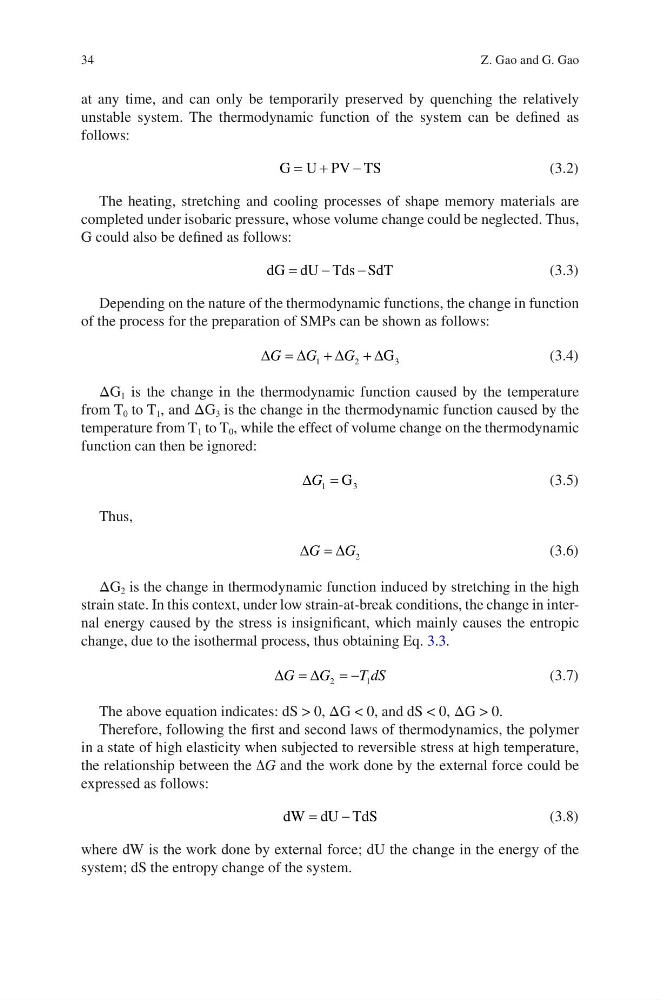
at any time, and can only be temporarily preserved by quenching the relatively
unstable system. The thermodynamic function of the system can be defined as
follows:
G U PV TS
= +
-
(3.2)
The heating, stretching and cooling processes of shape memory materials are
completed under isobaric pressure, whose volume change could be neglected. Thus,
G could also be defined as follows:
dG dU Tds SdT
=
-
-
(3.3)
Depending on the nature of the thermodynamic functions, the change in function
of the process for the preparation of SMPs can be shown as follows:
D
D
D
D
G
G
G
=
+
+
1
2
3
G
(3.4)
ΔG 1 is the change in the thermodynamic function caused by the temperature
from T 0 to T 1 , and ΔG 3 is the change in the thermodynamic function caused by the
temperature from T 1 to T 0 , while the effect of volume change on the thermodynamic
function can then be ignored:
DG 1
3
= G
(3.5)
Thus,
D
D
G
G
=
2
(3.6)
ΔG 2 is the change in thermodynamic function induced by stretching in the high
strain state. In this context, under low strain-at-break conditions, the change in internal energy caused by the stress is insignificant, which mainly causes the entropic
change, due to the isothermal process, thus obtaining Eq. 3.3.
DG
G
T dS
=
=D 2
1
(3.7)
The above equation indicates: dS > 0, ΔG < 0, and dS < 0, ΔG > 0.
Therefore, following the first and second laws of thermodynamics, the polymer
in a state of high elasticity when subjected to reversible stress at high temperature,
the relationship between the ΔG and the work done by the external force could be
expressed as follows:
dW dU TdS
=
-
(3.8)
where dW is the work done by external force; dU the change in the energy of the
system; dS the entropy change of the system.
Z. Gao and G. Gao
at any time, and can only be temporarily preserved by quenching the relatively
unstable system. The thermodynamic function of the system can be defined as
follows:
G U PV TS
= +
-
(3.2)
The heating, stretching and cooling processes of shape memory materials are
completed under isobaric pressure, whose volume change could be neglected. Thus,
G could also be defined as follows:
dG dU Tds SdT
=
-
-
(3.3)
Depending on the nature of the thermodynamic functions, the change in function
of the process for the preparation of SMPs can be shown as follows:
D
D
D
D
G
G
G
=
+
+
1
2
3
G
(3.4)
ΔG 1 is the change in the thermodynamic function caused by the temperature
from T 0 to T 1 , and ΔG 3 is the change in the thermodynamic function caused by the
temperature from T 1 to T 0 , while the effect of volume change on the thermodynamic
function can then be ignored:
DG 1
3
= G
(3.5)
Thus,
D
D
G
G
=
2
(3.6)
ΔG 2 is the change in thermodynamic function induced by stretching in the high
strain state. In this context, under low strain-at-break conditions, the change in internal energy caused by the stress is insignificant, which mainly causes the entropic
change, due to the isothermal process, thus obtaining Eq. 3.3.
DG
G
T dS
=
=D 2
1
(3.7)
The above equation indicates: dS > 0, ΔG < 0, and dS < 0, ΔG > 0.
Therefore, following the first and second laws of thermodynamics, the polymer
in a state of high elasticity when subjected to reversible stress at high temperature,
the relationship between the ΔG and the work done by the external force could be
expressed as follows:
dW dU TdS
=
-
(3.8)
where dW is the work done by external force; dU the change in the energy of the
system; dS the entropy change of the system.
Z. Gao and G. Gao