

33
1. The structure of polymeric materials must contain crystalline and amorphous
zones in an appropriate ratio, simultaneously;
2. High elasticity in a broad temperature range above T g or T m . The glassy state is
also presented in broad temperature range to ensure freezing stress without
releasing under storage.
3. The mechanical strength (also known as stress, σ) of SMP materials is good
enough to implement deformation.
Based on the rubber elasticity theory, the size of the heat shrinkability of shape
memory material could be characterized by the elastic modulus (also known as
Young’s modulus, E) of the material as follows:
Memory characteristics
Vk gT
E = 3
2
a
(3.1)
where T is the absolute temperature (above T m ), g the entanglement factor, k
Boltzmann constant, a the dialation factor (average length of the chains during orientation/ average length of the chains when not are oriented), V the number of
chains per unit volume (V = ρN/Mc(1-2Mc/Mn) ρ-density; Mn-number average
molecular weight; Mc- molecular weight between crosslinked bonds). Based on the
above equation, the following conclusion can be given: the property of shape memory increases with the degree of crosslinking. Mw and density also have a positive
effect on the shape memory property.
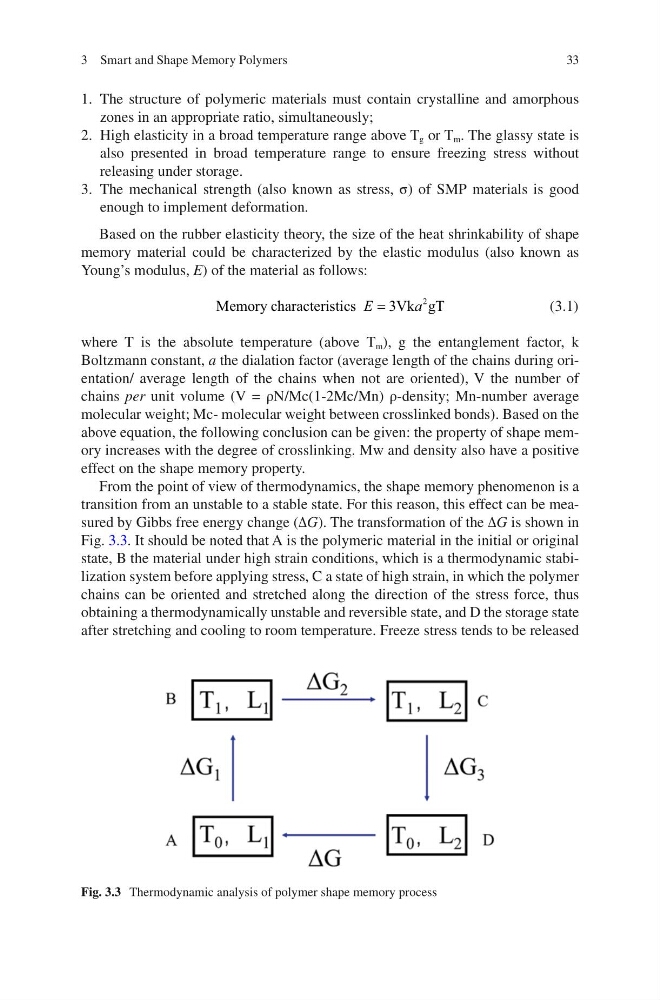
From the point of view of thermodynamics, the shape memory phenomenon is a
transition from an unstable to a stable state. For this reason, this effect can be measured by Gibbs free energy change (ΔG). The transformation of the ΔG is shown in
Fig. 3.3. It should be noted that A is the polymeric material in the initial or original
state, B the material under high strain conditions, which is a thermodynamic stabilization system before applying stress, C a state of high strain, in which the polymer
chains can be oriented and stretched along the direction of the stress force, thus
obtaining a thermodynamically unstable and reversible state, and D the storage state
after stretching and cooling to room temperature. Freeze stress tends to be released
Fig. 3.3 Thermodynamic analysis of polymer shape memory process
3 Smart and Shape Memory Polymers
1. The structure of polymeric materials must contain crystalline and amorphous
zones in an appropriate ratio, simultaneously;
2. High elasticity in a broad temperature range above T g or T m . The glassy state is
also presented in broad temperature range to ensure freezing stress without
releasing under storage.
3. The mechanical strength (also known as stress, σ) of SMP materials is good
enough to implement deformation.
Based on the rubber elasticity theory, the size of the heat shrinkability of shape
memory material could be characterized by the elastic modulus (also known as
Young’s modulus, E) of the material as follows:
Memory characteristics
Vk gT
E = 3
2
a
(3.1)
where T is the absolute temperature (above T m ), g the entanglement factor, k
Boltzmann constant, a the dialation factor (average length of the chains during orientation/ average length of the chains when not are oriented), V the number of
chains per unit volume (V = ρN/Mc(1-2Mc/Mn) ρ-density; Mn-number average
molecular weight; Mc- molecular weight between crosslinked bonds). Based on the
above equation, the following conclusion can be given: the property of shape memory increases with the degree of crosslinking. Mw and density also have a positive
effect on the shape memory property.
From the point of view of thermodynamics, the shape memory phenomenon is a
transition from an unstable to a stable state. For this reason, this effect can be measured by Gibbs free energy change (ΔG). The transformation of the ΔG is shown in
Fig. 3.3. It should be noted that A is the polymeric material in the initial or original
state, B the material under high strain conditions, which is a thermodynamic stabilization system before applying stress, C a state of high strain, in which the polymer
chains can be oriented and stretched along the direction of the stress force, thus
obtaining a thermodynamically unstable and reversible state, and D the storage state
after stretching and cooling to room temperature. Freeze stress tends to be released
Fig. 3.3 Thermodynamic analysis of polymer shape memory process
3 Smart and Shape Memory Polymers