

32
capable of melting even by heating above T m . In this context, the crosslinked polymer materials exhibit performance of elastomer in a broad temperature range
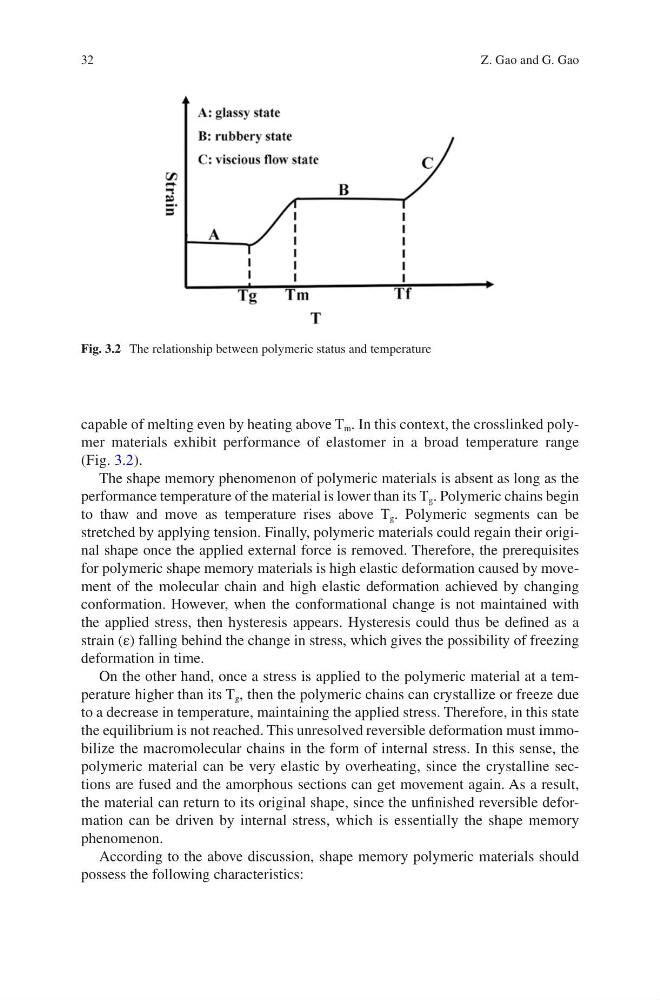
(Fig. 3.2).
The shape memory phenomenon of polymeric materials is absent as long as the
performance temperature of the material is lower than its T g . Polymeric chains begin
to thaw and move as temperature rises above T g . Polymeric segments can be
stretched by applying tension. Finally, polymeric materials could regain their original shape once the applied external force is removed. Therefore, the prerequisites
for polymeric shape memory materials is high elastic deformation caused by movement of the molecular chain and high elastic deformation achieved by changing
conformation. However, when the conformational change is not maintained with
the applied stress, then hysteresis appears. Hysteresis could thus be defined as a
strain (ε) falling behind the change in stress, which gives the possibility of freezing
deformation in time.
On the other hand, once a stress is applied to the polymeric material at a temperature higher than its T g , then the polymeric chains can crystallize or freeze due
to a decrease in temperature, maintaining the applied stress. Therefore, in this state
the equilibrium is not reached. This unresolved reversible deformation must immobilize the macromolecular chains in the form of internal stress. In this sense, the
polymeric material can be very elastic by overheating, since the crystalline sections are fused and the amorphous sections can get movement again. As a result,
the material can return to its original shape, since the unfinished reversible deformation can be driven by internal stress, which is essentially the shape memory
phenomenon.
According to the above discussion, shape memory polymeric materials should
possess the following characteristics:
Fig. 3.2 The relationship between polymeric status and temperature
Z. Gao and G. Gao
capable of melting even by heating above T m . In this context, the crosslinked polymer materials exhibit performance of elastomer in a broad temperature range
(Fig. 3.2).
The shape memory phenomenon of polymeric materials is absent as long as the
performance temperature of the material is lower than its T g . Polymeric chains begin
to thaw and move as temperature rises above T g . Polymeric segments can be
stretched by applying tension. Finally, polymeric materials could regain their original shape once the applied external force is removed. Therefore, the prerequisites
for polymeric shape memory materials is high elastic deformation caused by movement of the molecular chain and high elastic deformation achieved by changing
conformation. However, when the conformational change is not maintained with
the applied stress, then hysteresis appears. Hysteresis could thus be defined as a
strain (ε) falling behind the change in stress, which gives the possibility of freezing
deformation in time.
On the other hand, once a stress is applied to the polymeric material at a temperature higher than its T g , then the polymeric chains can crystallize or freeze due
to a decrease in temperature, maintaining the applied stress. Therefore, in this state
the equilibrium is not reached. This unresolved reversible deformation must immobilize the macromolecular chains in the form of internal stress. In this sense, the
polymeric material can be very elastic by overheating, since the crystalline sections are fused and the amorphous sections can get movement again. As a result,
the material can return to its original shape, since the unfinished reversible deformation can be driven by internal stress, which is essentially the shape memory
phenomenon.
According to the above discussion, shape memory polymeric materials should
possess the following characteristics:
Fig. 3.2 The relationship between polymeric status and temperature
Z. Gao and G. Gao