

31
(NASA) proved the shape memory performance of radiation-crosslinked PE after
realizing the potential application of SMPs in aerospace field in 1970s. And different kinds of polymers with shape memory property have been explored in recent
years such as polynorbornene, trans-polyisoprene, styrene-butadiene copolymer,
PU polyester and polymer gels. The SMPs induced with various stimulus have also
been explored, including temperature, light, electricity, magnetism and chemical
solvent.
As a kind of smart polymers, SMPs possess remarkable application potential
in many fields, such as car, electronics, chemical, packaging, toys and daily
necessities. Specific application would be introduced in the follow-up of this
chapter.
3.2 Mechanism of SMPs
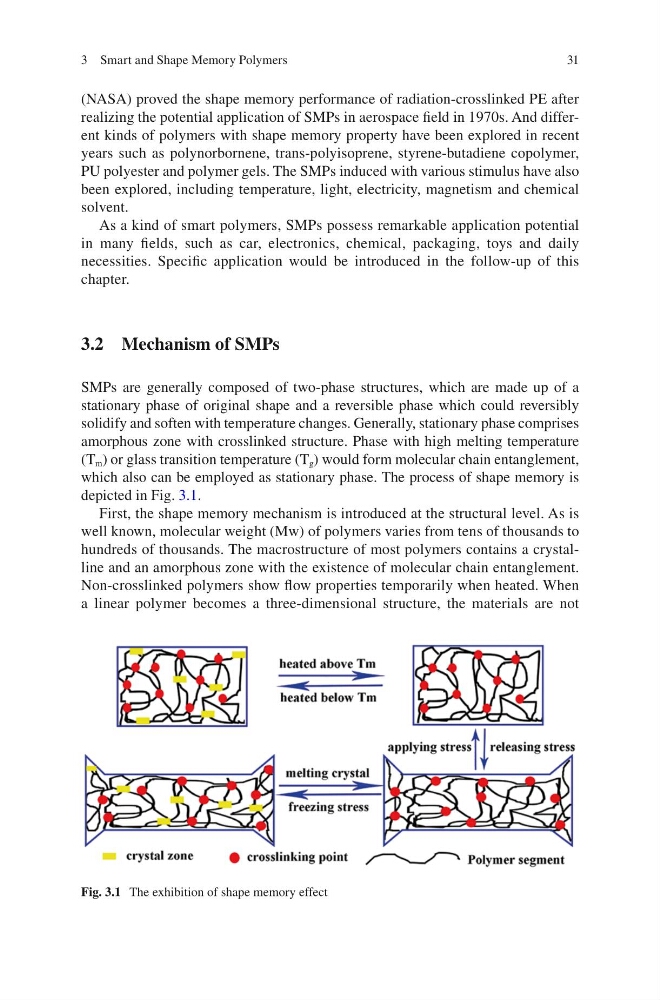
SMPs are generally composed of two-phase structures, which are made up of a
stationary phase of original shape and a reversible phase which could reversibly
solidify and soften with temperature changes. Generally, stationary phase comprises
amorphous zone with crosslinked structure. Phase with high melting temperature
(T m ) or glass transition temperature (T g ) would form molecular chain entanglement,
which also can be employed as stationary phase. The process of shape memory is
depicted in Fig. 3.1.
First, the shape memory mechanism is introduced at the structural level. As is
well known, molecular weight (Mw) of polymers varies from tens of thousands to
hundreds of thousands. The macrostructure of most polymers contains a crystalline and an amorphous zone with the existence of molecular chain entanglement.
Non-crosslinked polymers show flow properties temporarily when heated. When
a linear polymer becomes a three-dimensional structure, the materials are not
Fig. 3.1 The exhibition of shape memory effect
3 Smart and Shape Memory Polymers
(NASA) proved the shape memory performance of radiation-crosslinked PE after
realizing the potential application of SMPs in aerospace field in 1970s. And different kinds of polymers with shape memory property have been explored in recent
years such as polynorbornene, trans-polyisoprene, styrene-butadiene copolymer,
PU polyester and polymer gels. The SMPs induced with various stimulus have also
been explored, including temperature, light, electricity, magnetism and chemical
solvent.
As a kind of smart polymers, SMPs possess remarkable application potential
in many fields, such as car, electronics, chemical, packaging, toys and daily
necessities. Specific application would be introduced in the follow-up of this
chapter.
3.2 Mechanism of SMPs
SMPs are generally composed of two-phase structures, which are made up of a
stationary phase of original shape and a reversible phase which could reversibly
solidify and soften with temperature changes. Generally, stationary phase comprises
amorphous zone with crosslinked structure. Phase with high melting temperature
(T m ) or glass transition temperature (T g ) would form molecular chain entanglement,
which also can be employed as stationary phase. The process of shape memory is
depicted in Fig. 3.1.
First, the shape memory mechanism is introduced at the structural level. As is
well known, molecular weight (Mw) of polymers varies from tens of thousands to
hundreds of thousands. The macrostructure of most polymers contains a crystalline and an amorphous zone with the existence of molecular chain entanglement.
Non-crosslinked polymers show flow properties temporarily when heated. When
a linear polymer becomes a three-dimensional structure, the materials are not
Fig. 3.1 The exhibition of shape memory effect
3 Smart and Shape Memory Polymers