

36
3.3 Factors Affecting SMPs
3.3.1 Effect of Stress and Speed
It is well known that an internal stress is generated in polymeric materials once an
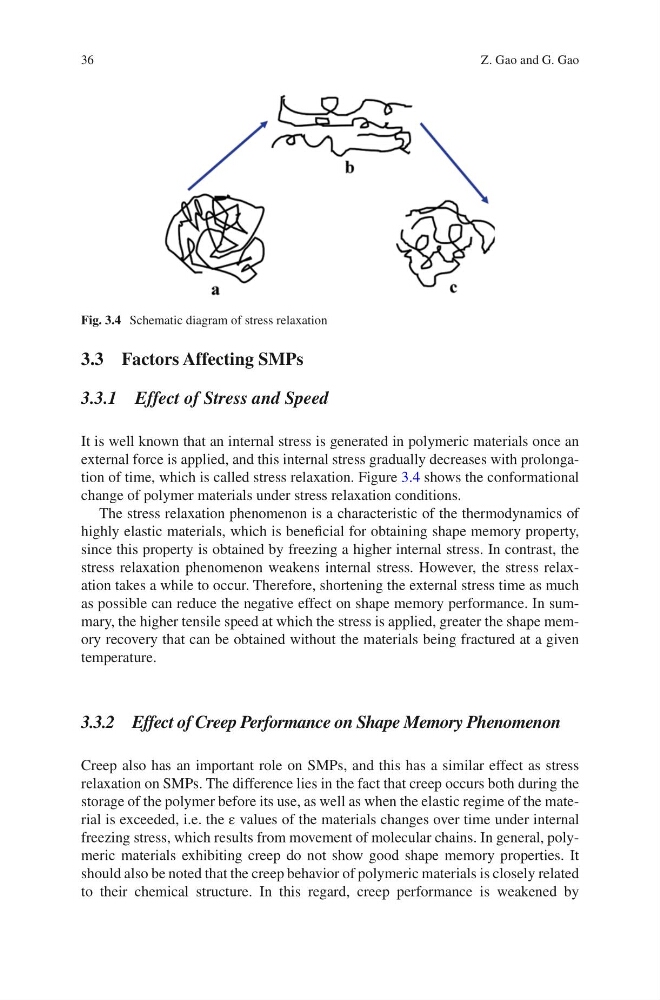
external force is applied, and this internal stress gradually decreases with prolongation of time, which is called stress relaxation. Figure 3.4 shows the conformational
change of polymer materials under stress relaxation conditions.
The stress relaxation phenomenon is a characteristic of the thermodynamics of
highly elastic materials, which is beneficial for obtaining shape memory property,
since this property is obtained by freezing a higher internal stress. In contrast, the
stress relaxation phenomenon weakens internal stress. However, the stress relaxation takes a while to occur. Therefore, shortening the external stress time as much
as possible can reduce the negative effect on shape memory performance. In summary, the higher tensile speed at which the stress is applied, greater the shape memory recovery that can be obtained without the materials being fractured at a given
temperature.
3.3.2 Effect of Creep Performance on Shape Memory Phenomenon
Creep also has an important role on SMPs, and this has a similar effect as stress
relaxation on SMPs. The difference lies in the fact that creep occurs both during the
storage of the polymer before its use, as well as when the elastic regime of the material is exceeded, i.e. the ε values of the materials changes over time under internal
freezing stress, which results from movement of molecular chains. In general, polymeric materials exhibiting creep do not show good shape memory properties. It
should also be noted that the creep behavior of polymeric materials is closely related
to their chemical structure. In this regard, creep performance is weakened by
Fig. 3.4 Schematic diagram of stress relaxation
Z. Gao and G. Gao
3.3 Factors Affecting SMPs
3.3.1 Effect of Stress and Speed
It is well known that an internal stress is generated in polymeric materials once an
external force is applied, and this internal stress gradually decreases with prolongation of time, which is called stress relaxation. Figure 3.4 shows the conformational
change of polymer materials under stress relaxation conditions.
The stress relaxation phenomenon is a characteristic of the thermodynamics of
highly elastic materials, which is beneficial for obtaining shape memory property,
since this property is obtained by freezing a higher internal stress. In contrast, the
stress relaxation phenomenon weakens internal stress. However, the stress relaxation takes a while to occur. Therefore, shortening the external stress time as much
as possible can reduce the negative effect on shape memory performance. In summary, the higher tensile speed at which the stress is applied, greater the shape memory recovery that can be obtained without the materials being fractured at a given
temperature.
3.3.2 Effect of Creep Performance on Shape Memory Phenomenon
Creep also has an important role on SMPs, and this has a similar effect as stress
relaxation on SMPs. The difference lies in the fact that creep occurs both during the
storage of the polymer before its use, as well as when the elastic regime of the material is exceeded, i.e. the ε values of the materials changes over time under internal
freezing stress, which results from movement of molecular chains. In general, polymeric materials exhibiting creep do not show good shape memory properties. It
should also be noted that the creep behavior of polymeric materials is closely related
to their chemical structure. In this regard, creep performance is weakened by
Fig. 3.4 Schematic diagram of stress relaxation
Z. Gao and G. Gao