

188
the sake of comparison, 75 academic research papers on the issue of flame retardancy of the PLA were published in 2019 compared to 4 papers in 2008 (Vahabi
et al. 2018). Correspondingly, a series of strategies and different flame-retardant
systems have been proposed for improving flame retardancy of PLA (Bourbigot and
Fontaine 2010; Matko et al. 2005). However, there is a limited number of research
papers on the chemical modification of PLA in relation to flame retardancy issues.
In general, there are two ways to chemically modify the flame retardancy of PLA
(Wang and Wang 2017). The first form is the copolymerization of lactic acid with a
functional comonomer containing flame retardant elements. The second form is the
chemical modification of the PLA chains by reaction of functional flame retardant
and -OH groups from PLA end chains. Wang et al. (2011) and Yuan et al. (2011)
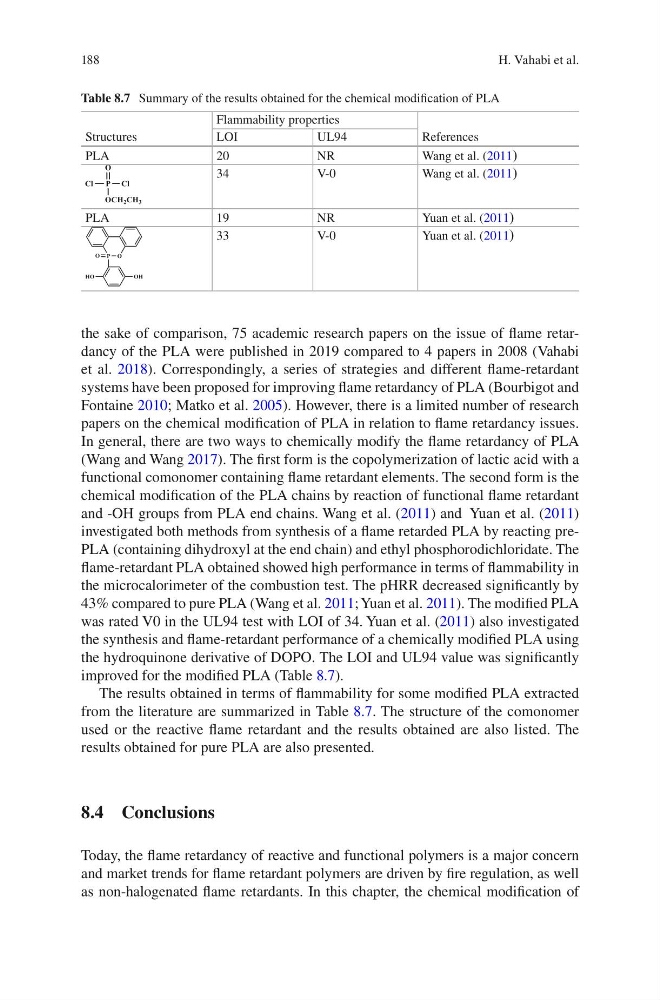
investigated both methods from synthesis of a flame retarded PLA by reacting prePLA (containing dihydroxyl at the end chain) and ethyl phosphorodichloridate. The
flame-retardant PLA obtained showed high performance in terms of flammability in
the microcalorimeter of the combustion test. The pHRR decreased significantly by
43% compared to pure PLA (Wang et al. 2011; Yuan et al. 2011). The modified PLA
was rated V0 in the UL94 test with LOI of 34. Yuan et al. (2011) also investigated
the synthesis and flame-retardant performance of a chemically modified PLA using
the hydroquinone derivative of DOPO. The LOI and UL94 value was significantly
improved for the modified PLA (Table 8.7).
The results obtained in terms of flammability for some modified PLA extracted
from the literature are summarized in Table 8.7. The structure of the comonomer
used or the reactive flame retardant and the results obtained are also listed. The
results obtained for pure PLA are also presented.
8.4 Conclusions
Today, the flame retardancy of reactive and functional polymers is a major concern
and market trends for flame retardant polymers are driven by fire regulation, as well
as non-halogenated flame retardants. In this chapter, the chemical modification of
Table 8.7 Summary of the results obtained for the chemical modification of PLA
Structures
Flammability properties
References
LOI
UL94
PLA
20
NR
Wang et al. (2011)
34
V-0
Wang et al. (2011)
PLA
19
NR
Yuan et al. (2011)
33
V-0
Yuan et al. (2011)
H. Vahabi et al.
the sake of comparison, 75 academic research papers on the issue of flame retardancy of the PLA were published in 2019 compared to 4 papers in 2008 (Vahabi
et al. 2018). Correspondingly, a series of strategies and different flame-retardant
systems have been proposed for improving flame retardancy of PLA (Bourbigot and
Fontaine 2010; Matko et al. 2005). However, there is a limited number of research
papers on the chemical modification of PLA in relation to flame retardancy issues.
In general, there are two ways to chemically modify the flame retardancy of PLA
(Wang and Wang 2017). The first form is the copolymerization of lactic acid with a
functional comonomer containing flame retardant elements. The second form is the
chemical modification of the PLA chains by reaction of functional flame retardant
and -OH groups from PLA end chains. Wang et al. (2011) and Yuan et al. (2011)
investigated both methods from synthesis of a flame retarded PLA by reacting prePLA (containing dihydroxyl at the end chain) and ethyl phosphorodichloridate. The
flame-retardant PLA obtained showed high performance in terms of flammability in
the microcalorimeter of the combustion test. The pHRR decreased significantly by
43% compared to pure PLA (Wang et al. 2011; Yuan et al. 2011). The modified PLA
was rated V0 in the UL94 test with LOI of 34. Yuan et al. (2011) also investigated
the synthesis and flame-retardant performance of a chemically modified PLA using
the hydroquinone derivative of DOPO. The LOI and UL94 value was significantly
improved for the modified PLA (Table 8.7).
The results obtained in terms of flammability for some modified PLA extracted
from the literature are summarized in Table 8.7. The structure of the comonomer
used or the reactive flame retardant and the results obtained are also listed. The
results obtained for pure PLA are also presented.
8.4 Conclusions
Today, the flame retardancy of reactive and functional polymers is a major concern
and market trends for flame retardant polymers are driven by fire regulation, as well
as non-halogenated flame retardants. In this chapter, the chemical modification of
Table 8.7 Summary of the results obtained for the chemical modification of PLA
Structures
Flammability properties
References
LOI
UL94
PLA
20
NR
Wang et al. (2011)
34
V-0
Wang et al. (2011)
PLA
19
NR
Yuan et al. (2011)
33
V-0
Yuan et al. (2011)
H. Vahabi et al.