

187
8.3.3 Poly(Lactic Acid) (PLA)
PLA has attracted great attention among the biobased polymers compared to other
candidates due to its exceptional properties, such as biodegradability, ease of processing, good transparency and high rigidity (Auras et al. 2011; Khosravi et al.
2020). There is a clue that PLA plays the role of the most commercially developed
biobased polymer today. By this year 2020, the production of PLA is expected to
reach 1031 kilotons PLA 2016–2022). However, the future development of PLA
and its replacement in some durable applications with petroleum-based polymers
depends on the extent in which its properties can be improved. The flame retardancy
of PLA is a critical feature that limits its development for engineering applications.
Therefore, a large number of research papers have been devoted to this topic. For
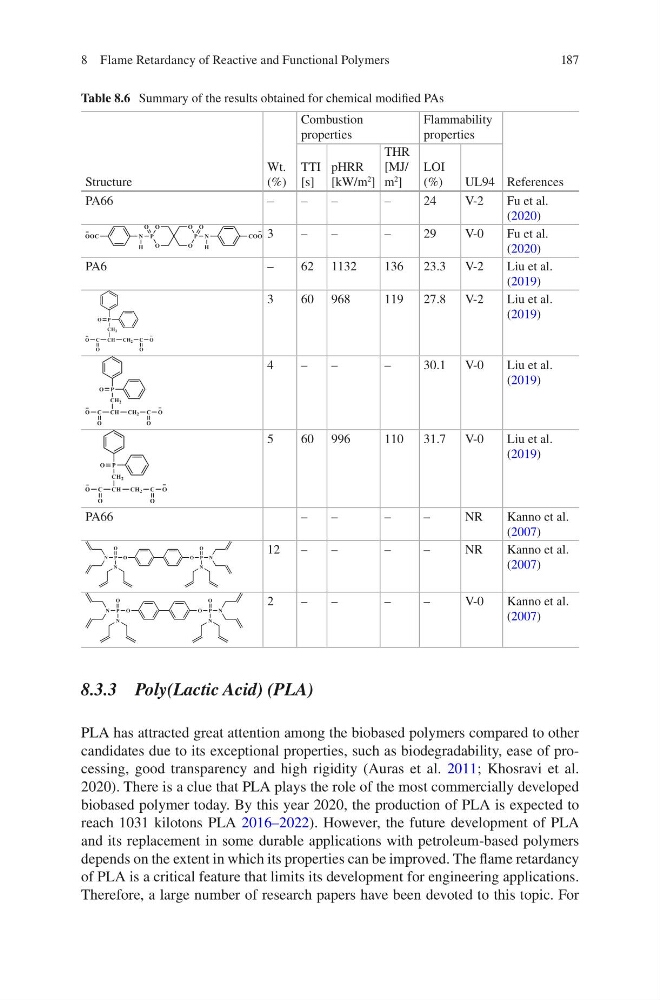
Table 8.6 Summary of the results obtained for chemical modified PAs
Structure
Wt.
(%)
Combustion
properties
Flammability
properties
References
TTI
[s]
pHRR
[kW/m
2 ]
THR
[MJ/
m
2
]
LOI
(%)
UL94
PA66
–
–
–
–
24
V-2
Fu et al.
(2020)
3
–
–
–
29
V-0
Fu et al.
(2020)
PA6
–
62 1132
136
23.3
V-2
Liu et al.
(2019)
3
60 968
119
27.8
V-2
Liu et al.
(2019)
4
–
–
–
30.1
V-0
Liu et al.
(2019)
5
60 996
110
31.7
V-0
Liu et al.
(2019)
PA66
–
–
–
–
NR
Kanno et al.
(2007)
12
–
–
–
–
NR
Kanno et al.
(2007)
2
–
–
–
–
V-0
Kanno et al.
(2007)
8 Flame Retardancy of Reactive and Functional Polymers
8.3.3 Poly(Lactic Acid) (PLA)
PLA has attracted great attention among the biobased polymers compared to other
candidates due to its exceptional properties, such as biodegradability, ease of processing, good transparency and high rigidity (Auras et al. 2011; Khosravi et al.
2020). There is a clue that PLA plays the role of the most commercially developed
biobased polymer today. By this year 2020, the production of PLA is expected to
reach 1031 kilotons PLA 2016–2022). However, the future development of PLA
and its replacement in some durable applications with petroleum-based polymers
depends on the extent in which its properties can be improved. The flame retardancy
of PLA is a critical feature that limits its development for engineering applications.
Therefore, a large number of research papers have been devoted to this topic. For
Table 8.6 Summary of the results obtained for chemical modified PAs
Structure
Wt.
(%)
Combustion
properties
Flammability
properties
References
TTI
[s]
pHRR
[kW/m
2 ]
THR
[MJ/
m
2
]
LOI
(%)
UL94
PA66
–
–
–
–
24
V-2
Fu et al.
(2020)
3
–
–
–
29
V-0
Fu et al.
(2020)
PA6
–
62 1132
136
23.3
V-2
Liu et al.
(2019)
3
60 968
119
27.8
V-2
Liu et al.
(2019)
4
–
–
–
30.1
V-0
Liu et al.
(2019)
5
60 996
110
31.7
V-0
Liu et al.
(2019)
PA66
–
–
–
–
NR
Kanno et al.
(2007)
12
–
–
–
–
NR
Kanno et al.
(2007)
2
–
–
–
–
V-0
Kanno et al.
(2007)
8 Flame Retardancy of Reactive and Functional Polymers