

156
Another prominent characteristic of PEEK is its ability to be modified chemically, thus resulting in 3D printed materials with better mechanical properties: durability and wear resistance. In addition, several fillers can be incorporated such as
glass fibers, TiO 2 NPs, among others (Maekawa et al. 2015; Bassi et al. 2016).
7.5.2 PMMA
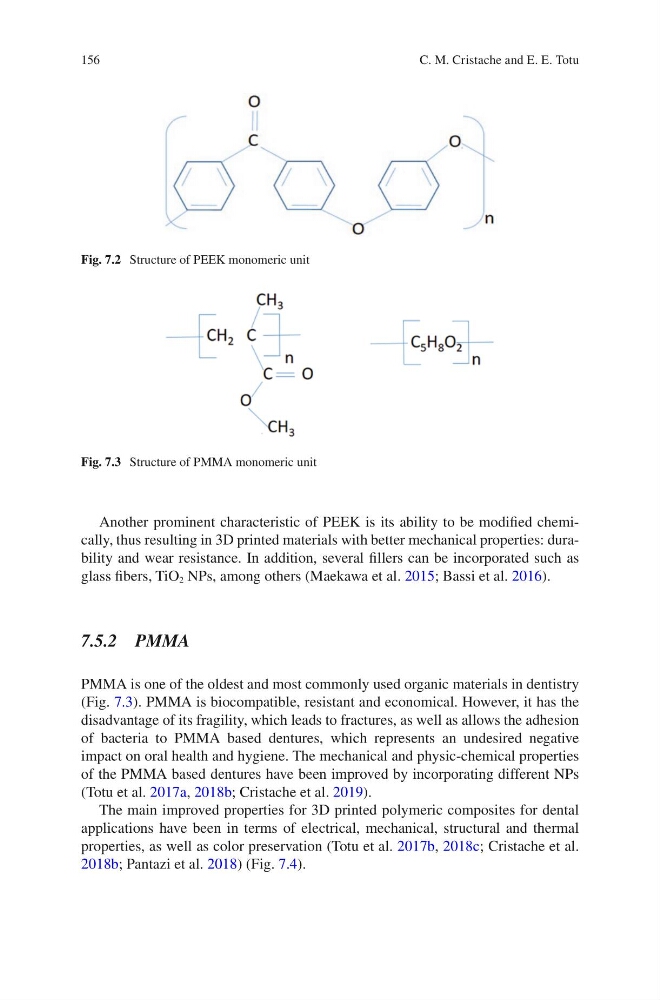
PMMA is one of the oldest and most commonly used organic materials in dentistry
(Fig. 7.3). PMMA is biocompatible, resistant and economical. However, it has the
disadvantage of its fragility, which leads to fractures, as well as allows the adhesion
of bacteria to PMMA based dentures, which represents an undesired negative
impact on oral health and hygiene. The mechanical and physic-chemical properties
of the PMMA based dentures have been improved by incorporating different NPs
(Totu et al. 2017a, 2018b; Cristache et al. 2019).
The main improved properties for 3D printed polymeric composites for dental
applications have been in terms of electrical, mechanical, structural and thermal
properties, as well as color preservation (Totu et al. 2017b, 2018c; Cristache et al.
2018b; Pantazi et al. 2018) (Fig. 7.4).
Fig. 7.2 Structure of PEEK monomeric unit
Fig. 7.3 Structure of PMMA monomeric unit
C. M. Cristache and E. E. Totu
Another prominent characteristic of PEEK is its ability to be modified chemically, thus resulting in 3D printed materials with better mechanical properties: durability and wear resistance. In addition, several fillers can be incorporated such as
glass fibers, TiO 2 NPs, among others (Maekawa et al. 2015; Bassi et al. 2016).
7.5.2 PMMA
PMMA is one of the oldest and most commonly used organic materials in dentistry
(Fig. 7.3). PMMA is biocompatible, resistant and economical. However, it has the
disadvantage of its fragility, which leads to fractures, as well as allows the adhesion
of bacteria to PMMA based dentures, which represents an undesired negative
impact on oral health and hygiene. The mechanical and physic-chemical properties
of the PMMA based dentures have been improved by incorporating different NPs
(Totu et al. 2017a, 2018b; Cristache et al. 2019).
The main improved properties for 3D printed polymeric composites for dental
applications have been in terms of electrical, mechanical, structural and thermal
properties, as well as color preservation (Totu et al. 2017b, 2018c; Cristache et al.
2018b; Pantazi et al. 2018) (Fig. 7.4).
Fig. 7.2 Structure of PEEK monomeric unit
Fig. 7.3 Structure of PMMA monomeric unit
C. M. Cristache and E. E. Totu