

155
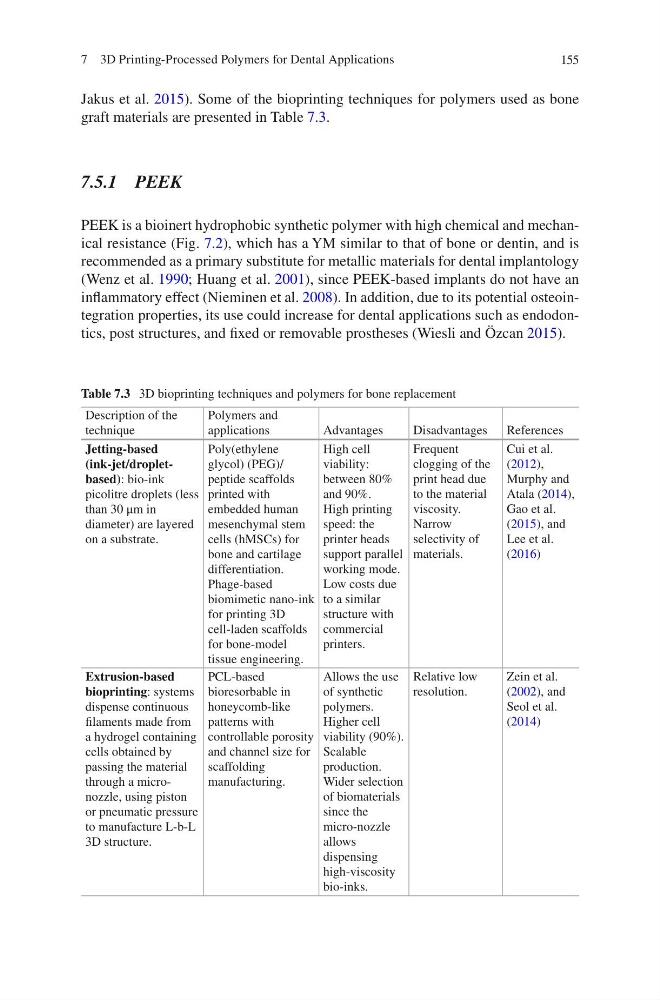
Jakus et al. 2015). Some of the bioprinting techniques for polymers used as bone
graft materials are presented in Table 7.3.
7.5.1 PEEK
PEEK is a bioinert hydrophobic synthetic polymer with high chemical and mechanical resistance (Fig. 7.2), which has a YM similar to that of bone or dentin, and is
recommended as a primary substitute for metallic materials for dental implantology
(Wenz et al. 1990; Huang et al. 2001), since PEEK-based implants do not have an
inflammatory effect (Nieminen et al. 2008). In addition, due to its potential osteointegration properties, its use could increase for dental applications such as endodontics, post structures, and fixed or removable prostheses (Wiesli and Özcan 2015).
Table 7.3 3D bioprinting techniques and polymers for bone replacement
Description of the
technique
Polymers and
applications
Advantages
Disadvantages
References
Jetting-based
(ink-jet/dropletbased): bio-ink
picolitre droplets (less
than 30 μm in
diameter) are layered
on a substrate.
Poly(ethylene
glycol) (PEG)/
peptide scaffolds
printed with
embedded human
mesenchymal stem
cells (hMSCs) for
bone and cartilage
differentiation.
Phage-based
biomimetic nano-ink
for printing 3D
cell-laden scaffolds
for bone-model
tissue engineering.
High cell
viability:
between 80%
and 90%.
High printing
speed: the
printer heads
support parallel
working mode.
Low costs due
to a similar
structure with
commercial
printers.
Frequent
clogging of the
print head due
to the material
viscosity.
Narrow
selectivity of
materials.
Cui et al.
(2012),
Murphy and
Atala (2014),
Gao et al.
(2015), and
Lee et al.
(2016)
Extrusion-based
bioprinting: systems
dispense continuous
filaments made from
a hydrogel containing
cells obtained by
passing the material
through a micronozzle, using piston
or pneumatic pressure
to manufacture L-b-L
3D structure.
PCL-based
bioresorbable in
honeycomb-like
patterns with
controllable porosity
and channel size for
scaffolding
manufacturing.
Allows the use
of synthetic
polymers.
Higher cell
viability (90%).
Scalable
production.
Wider selection
of biomaterials
since the
micro-nozzle
allows
dispensing
high-viscosity
bio-inks.
Relative low
resolution.
Zein et al.
(2002), and
Seol et al.
(2014)
7 3D Printing-Processed Polymers for Dental Applications
Jakus et al. 2015). Some of the bioprinting techniques for polymers used as bone
graft materials are presented in Table 7.3.
7.5.1 PEEK
PEEK is a bioinert hydrophobic synthetic polymer with high chemical and mechanical resistance (Fig. 7.2), which has a YM similar to that of bone or dentin, and is
recommended as a primary substitute for metallic materials for dental implantology
(Wenz et al. 1990; Huang et al. 2001), since PEEK-based implants do not have an
inflammatory effect (Nieminen et al. 2008). In addition, due to its potential osteointegration properties, its use could increase for dental applications such as endodontics, post structures, and fixed or removable prostheses (Wiesli and Özcan 2015).
Table 7.3 3D bioprinting techniques and polymers for bone replacement
Description of the
technique
Polymers and
applications
Advantages
Disadvantages
References
Jetting-based
(ink-jet/dropletbased): bio-ink
picolitre droplets (less
than 30 μm in
diameter) are layered
on a substrate.
Poly(ethylene
glycol) (PEG)/
peptide scaffolds
printed with
embedded human
mesenchymal stem
cells (hMSCs) for
bone and cartilage
differentiation.
Phage-based
biomimetic nano-ink
for printing 3D
cell-laden scaffolds
for bone-model
tissue engineering.
High cell
viability:
between 80%
and 90%.
High printing
speed: the
printer heads
support parallel
working mode.
Low costs due
to a similar
structure with
commercial
printers.
Frequent
clogging of the
print head due
to the material
viscosity.
Narrow
selectivity of
materials.
Cui et al.
(2012),
Murphy and
Atala (2014),
Gao et al.
(2015), and
Lee et al.
(2016)
Extrusion-based
bioprinting: systems
dispense continuous
filaments made from
a hydrogel containing
cells obtained by
passing the material
through a micronozzle, using piston
or pneumatic pressure
to manufacture L-b-L
3D structure.
PCL-based
bioresorbable in
honeycomb-like
patterns with
controllable porosity
and channel size for
scaffolding
manufacturing.
Allows the use
of synthetic
polymers.
Higher cell
viability (90%).
Scalable
production.
Wider selection
of biomaterials
since the
micro-nozzle
allows
dispensing
high-viscosity
bio-inks.
Relative low
resolution.
Zein et al.
(2002), and
Seol et al.
(2014)
7 3D Printing-Processed Polymers for Dental Applications