

157
7.6 Conclusions and Future Perspectives
Natural and synthetic polymers have a wide range of applications in modern dentistry, due to the improved properties they have obtained, as a result of the rapid
development of polymer science and technology. With this in mind, stimulusresponse polymers are also used to obtain printed materials (González-Henríquez
et al. 2019b). In particular, shape memory polymers have gained a lot for obtaining
four-dimensional (4D) printed materials. It should be noted that 4D printing is
defined by the Atlantic Council of the United States as additive manufacturing of
objects able to self-transform, in form or function, when exposed to a predetermined
stimulus, such as current, heat, osmotic pressure, ultraviolet light or other sources of
energy (Campbell et al. 2014). For this reason, the development of 3D- or 4D-printed
materials for dental applications will be booming in the following years, thus obtaining ‘smart’ polymeric materials as part of orthodontic appliances and implants
(Javaid and Haleem 2019). However, the widespread use of 3D printed polymers in
all fields of dentistry depends on further improvements in processing technologies,
as well as innovation in material composition.
Acknowledgments Authors would like to thank the Romanian National Authority for Scientific
Research and Innovation, CCCDI – UEFISCDI, for grant No. 30/2016 – PRIDENTPRO, (ERANET- MANUNET II) within PNCDI III and for grant No.39/2018 - HAMELDENT, COFUND MANUNET III, within PNCDI III.
Conflicts of Interest The authors declare no conflict of interest.
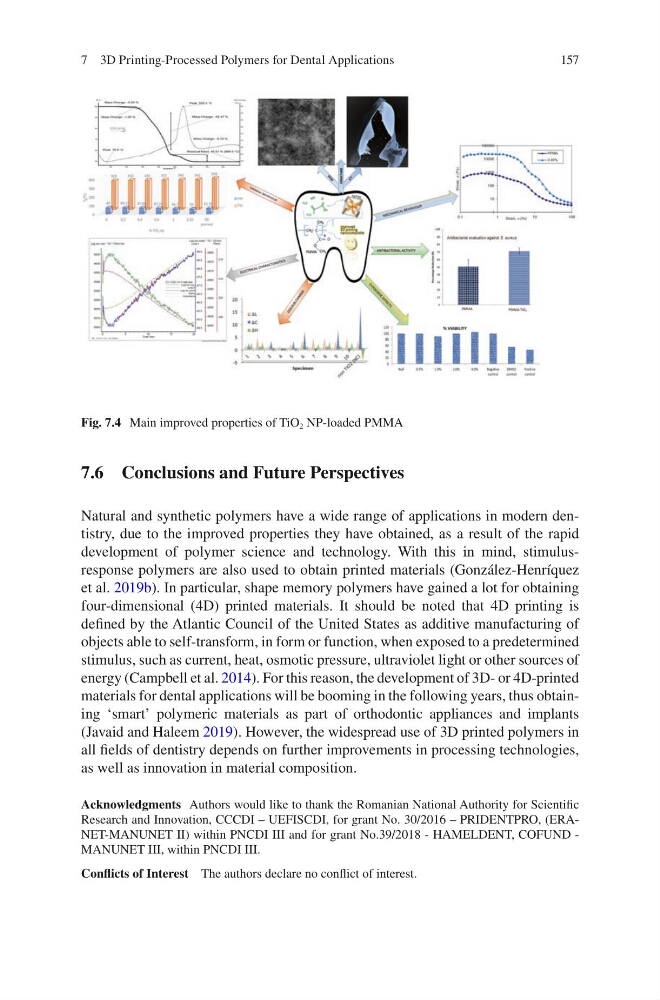
Fig. 7.4 Main improved properties of TiO 2 NP-loaded PMMA
7 3D Printing-Processed Polymers for Dental Applications
7.6 Conclusions and Future Perspectives
Natural and synthetic polymers have a wide range of applications in modern dentistry, due to the improved properties they have obtained, as a result of the rapid
development of polymer science and technology. With this in mind, stimulusresponse polymers are also used to obtain printed materials (González-Henríquez
et al. 2019b). In particular, shape memory polymers have gained a lot for obtaining
four-dimensional (4D) printed materials. It should be noted that 4D printing is
defined by the Atlantic Council of the United States as additive manufacturing of
objects able to self-transform, in form or function, when exposed to a predetermined
stimulus, such as current, heat, osmotic pressure, ultraviolet light or other sources of
energy (Campbell et al. 2014). For this reason, the development of 3D- or 4D-printed
materials for dental applications will be booming in the following years, thus obtaining ‘smart’ polymeric materials as part of orthodontic appliances and implants
(Javaid and Haleem 2019). However, the widespread use of 3D printed polymers in
all fields of dentistry depends on further improvements in processing technologies,
as well as innovation in material composition.
Acknowledgments Authors would like to thank the Romanian National Authority for Scientific
Research and Innovation, CCCDI – UEFISCDI, for grant No. 30/2016 – PRIDENTPRO, (ERANET- MANUNET II) within PNCDI III and for grant No.39/2018 - HAMELDENT, COFUND MANUNET III, within PNCDI III.
Conflicts of Interest The authors declare no conflict of interest.
Fig. 7.4 Main improved properties of TiO 2 NP-loaded PMMA
7 3D Printing-Processed Polymers for Dental Applications