

121
transfer. Unexpectedly, the exceptionally high g lum (0.32) was observed for these
polymers, which were attributed to the strong interchain interaction. Furthermore,
a chiral β-ketoiminate- based moiety was introduced into the polymer backbone to
produce polymers 9 and 10 in Scheme 6.1 (Jiang et al. 2014). These polymers demonstrated extreme improvement of Φ F up to 0.37. In addition, the massive improvement of g lum of 9 in Scheme 6.1 (0.349) and 10 in Scheme 6.1 (0.105) were also
observed which was assigned to the linear amplification of CPL in the conjugated
polymer structure.
6.3.2 Polymers Bearing Chiral Backbones
The incorporation of a chiral π-conjugated moiety into the main chain has been
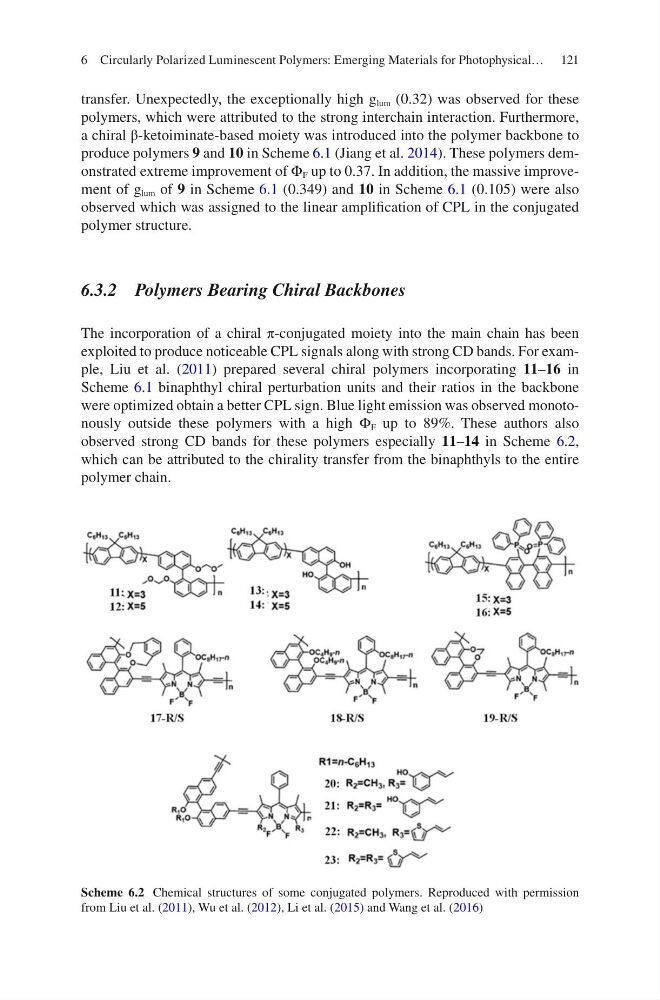
exploited to produce noticeable CPL signals along with strong CD bands. For example, Liu et al. (2011) prepared several chiral polymers incorporating 11–16 in
Scheme 6.1 binaphthyl chiral perturbation units and their ratios in the backbone
were optimized obtain a better CPL sign. Blue light emission was observed monotonously outside these polymers with a high Φ F up to 89%. These authors also
observed strong CD bands for these polymers especially 11–14 in Scheme 6.2,
which can be attributed to the chirality transfer from the binaphthyls to the entire
polymer chain.
Scheme 6.2 Chemical structures of some conjugated polymers. Reproduced with permission
from Liu et al. (2011), Wu et al. (2012), Li et al. (2015) and Wang et al. (2016)
6 Circularly Polarized Luminescent Polymers: Emerging Materials for Photophysical…
transfer. Unexpectedly, the exceptionally high g lum (0.32) was observed for these
polymers, which were attributed to the strong interchain interaction. Furthermore,
a chiral β-ketoiminate- based moiety was introduced into the polymer backbone to
produce polymers 9 and 10 in Scheme 6.1 (Jiang et al. 2014). These polymers demonstrated extreme improvement of Φ F up to 0.37. In addition, the massive improvement of g lum of 9 in Scheme 6.1 (0.349) and 10 in Scheme 6.1 (0.105) were also
observed which was assigned to the linear amplification of CPL in the conjugated
polymer structure.
6.3.2 Polymers Bearing Chiral Backbones
The incorporation of a chiral π-conjugated moiety into the main chain has been
exploited to produce noticeable CPL signals along with strong CD bands. For example, Liu et al. (2011) prepared several chiral polymers incorporating 11–16 in
Scheme 6.1 binaphthyl chiral perturbation units and their ratios in the backbone
were optimized obtain a better CPL sign. Blue light emission was observed monotonously outside these polymers with a high Φ F up to 89%. These authors also
observed strong CD bands for these polymers especially 11–14 in Scheme 6.2,
which can be attributed to the chirality transfer from the binaphthyls to the entire
polymer chain.
Scheme 6.2 Chemical structures of some conjugated polymers. Reproduced with permission
from Liu et al. (2011), Wu et al. (2012), Li et al. (2015) and Wang et al. (2016)
6 Circularly Polarized Luminescent Polymers: Emerging Materials for Photophysical…