

122
In another study, Wang et al. (2016) synthesized some conjugated polymers
(17–19 in Scheme 6.2) using binaphthyl and boron-dipyrromethene (BODIPY)
moieties. Interestingly, directive CPL signals were observed by altering the dihedral
angles of binaphthyl moiety, as a result, the g lum of these polymers was progressively
amplified from 0.001 to 0.002 decreased dihedral angles. Similarly, modification of
the BODIPY structure was also performed to produce polymers like 20–23 (Scheme
6.2). The polymers having structurally similar chiral perturbation units showed
intense luminescence along with stronger CPL signals in the near-infrared region,
which was believed to be due to the transfer of chirality from the chiral groups to the
main polymer backbone (Wu et al. 2012; Li et al. 2015).
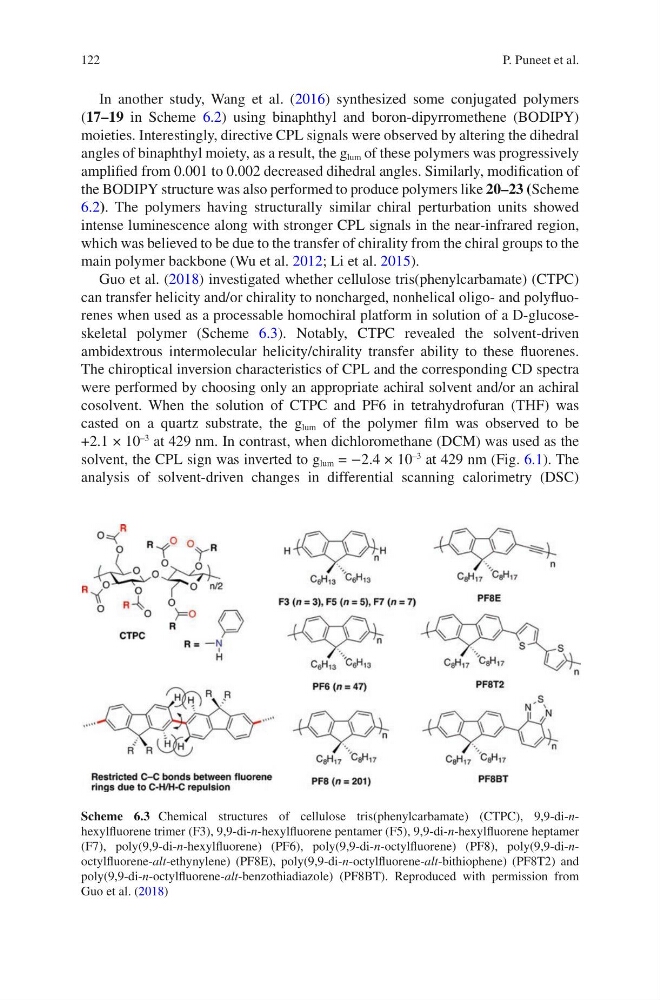
Guo et al. (2018) investigated whether cellulose tris(phenylcarbamate) (CTPC)
can transfer helicity and/or chirality to noncharged, nonhelical oligo- and polyfluorenes when used as a processable homochiral platform in solution of a D-glucoseskeletal polymer (Scheme 6.3). Notably, CTPC revealed the solvent-driven
ambidextrous intermolecular helicity/chirality transfer ability to these fluorenes.
The chiroptical inversion characteristics of CPL and the corresponding CD spectra
were performed by choosing only an appropriate achiral solvent and/or an achiral
cosolvent. When the solution of CTPC and PF6 in tetrahydrofuran (THF) was
casted on a quartz substrate, the g lum of the polymer film was observed to be
+2.1 × 10
–3
at 429 nm. In contrast, when dichloromethane (DCM) was used as the
solvent, the CPL sign was inverted to g lum = −2.4 × 10
–3
at 429 nm (Fig. 6.1). The
analysis of solvent-driven changes in differential scanning calorimetry (DSC)
Scheme 6.3 Chemical structures of cellulose tris(phenylcarbamate) (CTPC), 9,9-di-nhexylfluorene trimer (F3), 9,9-di-n-hexylfluorene pentamer (F5), 9,9-di-n-hexylfluorene heptamer
(F7), poly(9,9-di-n-hexylfluorene) (PF6), poly(9,9-di-n-octylfluorene) (PF8), poly(9,9-di-noctylfluorene-alt-ethynylene) (PF8E), poly(9,9-di-n-octylfluorene-alt-bithiophene) (PF8T2) and
poly(9,9-di-n-octylfluorene-alt-benzothiadiazole) (PF8BT). Reproduced with permission from
Guo et al. (2018)
P. Puneet et al.
In another study, Wang et al. (2016) synthesized some conjugated polymers
(17–19 in Scheme 6.2) using binaphthyl and boron-dipyrromethene (BODIPY)
moieties. Interestingly, directive CPL signals were observed by altering the dihedral
angles of binaphthyl moiety, as a result, the g lum of these polymers was progressively
amplified from 0.001 to 0.002 decreased dihedral angles. Similarly, modification of
the BODIPY structure was also performed to produce polymers like 20–23 (Scheme
6.2). The polymers having structurally similar chiral perturbation units showed
intense luminescence along with stronger CPL signals in the near-infrared region,
which was believed to be due to the transfer of chirality from the chiral groups to the
main polymer backbone (Wu et al. 2012; Li et al. 2015).
Guo et al. (2018) investigated whether cellulose tris(phenylcarbamate) (CTPC)
can transfer helicity and/or chirality to noncharged, nonhelical oligo- and polyfluorenes when used as a processable homochiral platform in solution of a D-glucoseskeletal polymer (Scheme 6.3). Notably, CTPC revealed the solvent-driven
ambidextrous intermolecular helicity/chirality transfer ability to these fluorenes.
The chiroptical inversion characteristics of CPL and the corresponding CD spectra
were performed by choosing only an appropriate achiral solvent and/or an achiral
cosolvent. When the solution of CTPC and PF6 in tetrahydrofuran (THF) was
casted on a quartz substrate, the g lum of the polymer film was observed to be
+2.1 × 10
–3
at 429 nm. In contrast, when dichloromethane (DCM) was used as the
solvent, the CPL sign was inverted to g lum = −2.4 × 10
–3
at 429 nm (Fig. 6.1). The
analysis of solvent-driven changes in differential scanning calorimetry (DSC)
Scheme 6.3 Chemical structures of cellulose tris(phenylcarbamate) (CTPC), 9,9-di-nhexylfluorene trimer (F3), 9,9-di-n-hexylfluorene pentamer (F5), 9,9-di-n-hexylfluorene heptamer
(F7), poly(9,9-di-n-hexylfluorene) (PF6), poly(9,9-di-n-octylfluorene) (PF8), poly(9,9-di-noctylfluorene-alt-ethynylene) (PF8E), poly(9,9-di-n-octylfluorene-alt-bithiophene) (PF8T2) and
poly(9,9-di-n-octylfluorene-alt-benzothiadiazole) (PF8BT). Reproduced with permission from
Guo et al. (2018)
P. Puneet et al.