

120
6.3.1 Polymers Possessing Chiral Pendants
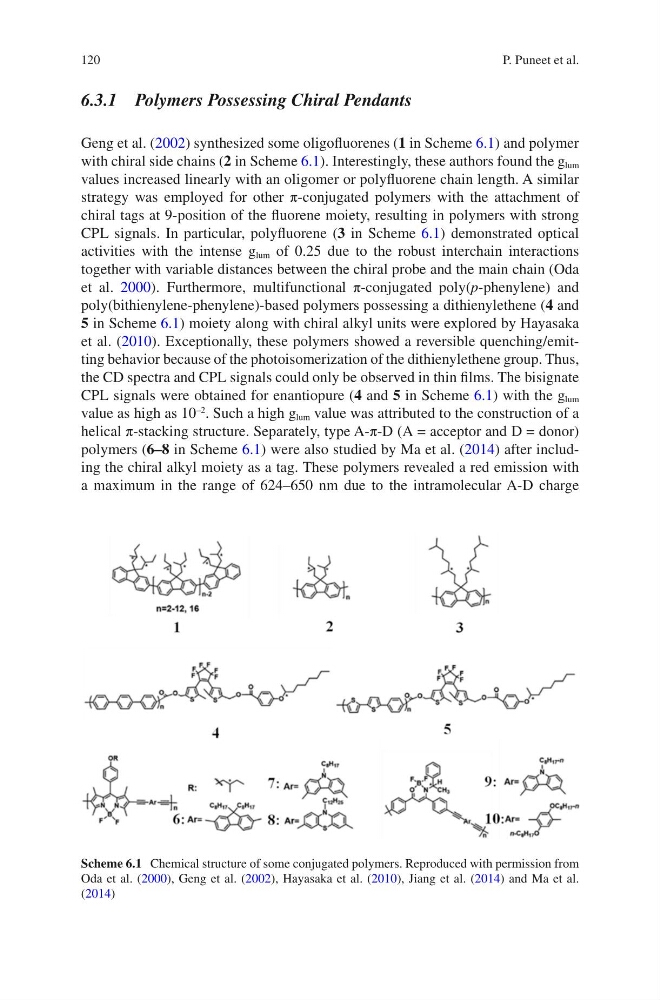
Geng et al. (2002) synthesized some oligofluorenes (1 in Scheme 6.1) and polymer
with chiral side chains (2 in Scheme 6.1). Interestingly, these authors found the g lum
values increased linearly with an oligomer or polyfluorene chain length. A similar
strategy was employed for other π-conjugated polymers with the attachment of
chiral tags at 9-position of the fluorene moiety, resulting in polymers with strong
CPL signals. In particular, polyfluorene (3 in Scheme 6.1) demonstrated optical
activities with the intense g lum of 0.25 due to the robust interchain interactions
together with variable distances between the chiral probe and the main chain (Oda
et al. 2000). Furthermore, multifunctional π-conjugated poly(p-phenylene) and
poly(bithienylene- phenylene)-based polymers possessing a dithienylethene (4 and
5 in Scheme 6.1) moiety along with chiral alkyl units were explored by Hayasaka
et al. (2010). Exceptionally, these polymers showed a reversible quenching/emitting behavior because of the photoisomerization of the dithienylethene group. Thus,
the CD spectra and CPL signals could only be observed in thin films. The bisignate
CPL signals were obtained for enantiopure (4 and 5 in Scheme 6.1) with the g lum
value as high as 10
–2
. Such a high g lum value was attributed to the construction of a
helical π-stacking structure. Separately, type A-π-D (A = acceptor and D = donor)
polymers (6–8 in Scheme 6.1) were also studied by Ma et al. (2014) after including the chiral alkyl moiety as a tag. These polymers revealed a red emission with
a maximum in the range of 624–650 nm due to the intramolecular A-D charge
Scheme 6.1 Chemical structure of some conjugated polymers. Reproduced with permission from
Oda et al. (2000), Geng et al. (2002), Hayasaka et al. (2010), Jiang et al. (2014) and Ma et al.
(2014)
P. Puneet et al.
6.3.1 Polymers Possessing Chiral Pendants
Geng et al. (2002) synthesized some oligofluorenes (1 in Scheme 6.1) and polymer
with chiral side chains (2 in Scheme 6.1). Interestingly, these authors found the g lum
values increased linearly with an oligomer or polyfluorene chain length. A similar
strategy was employed for other π-conjugated polymers with the attachment of
chiral tags at 9-position of the fluorene moiety, resulting in polymers with strong
CPL signals. In particular, polyfluorene (3 in Scheme 6.1) demonstrated optical
activities with the intense g lum of 0.25 due to the robust interchain interactions
together with variable distances between the chiral probe and the main chain (Oda
et al. 2000). Furthermore, multifunctional π-conjugated poly(p-phenylene) and
poly(bithienylene- phenylene)-based polymers possessing a dithienylethene (4 and
5 in Scheme 6.1) moiety along with chiral alkyl units were explored by Hayasaka
et al. (2010). Exceptionally, these polymers showed a reversible quenching/emitting behavior because of the photoisomerization of the dithienylethene group. Thus,
the CD spectra and CPL signals could only be observed in thin films. The bisignate
CPL signals were obtained for enantiopure (4 and 5 in Scheme 6.1) with the g lum
value as high as 10
–2
. Such a high g lum value was attributed to the construction of a
helical π-stacking structure. Separately, type A-π-D (A = acceptor and D = donor)
polymers (6–8 in Scheme 6.1) were also studied by Ma et al. (2014) after including the chiral alkyl moiety as a tag. These polymers revealed a red emission with
a maximum in the range of 624–650 nm due to the intramolecular A-D charge
Scheme 6.1 Chemical structure of some conjugated polymers. Reproduced with permission from
Oda et al. (2000), Geng et al. (2002), Hayasaka et al. (2010), Jiang et al. (2014) and Ma et al.
(2014)
P. Puneet et al.