

119
vectors i and j (i↔j), both CD and CPL can be expressed in terms of a different
molecular electronic parameter, the rotatory strength (Eq. 6.1) (Riehl and
Richardson 1986):
R
Im i j j m i
ij = ‹
›.‹
›
m
(6.1)
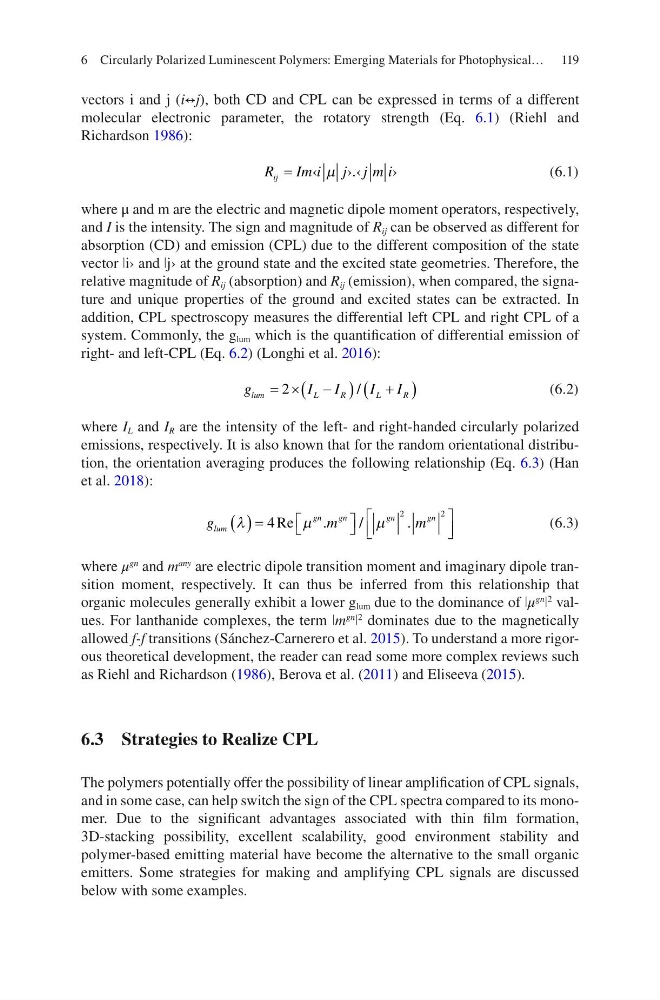
where μ and m are the electric and magnetic dipole moment operators, respectively,
and I is the intensity. The sign and magnitude of R ij can be observed as different for
absorption (CD) and emission (CPL) due to the different composition of the state
vector ǀi› and ǀj› at the ground state and the excited state geometries. Therefore, the
relative magnitude of R ij (absorption) and R ij (emission), when compared, the signature and unique properties of the ground and excited states can be extracted. In
addition, CPL spectroscopy measures the differential left CPL and right CPL of a
system. Commonly, the g lum which is the quantification of differential emission of
right- and left-CPL (Eq. 6.2) (Longhi et al. 2016):
g
I I
I I
lum
L
R
L
R
= ´
-
(
)
+
(
)
2
/
(6.2)
where I L and I R are the intensity of the left- and right-handed circularly polarized
emissions, respectively. It is also known that for the random orientational distribution, the orientation averaging produces the following relationship (Eq. 6.3) (Han
et al. 2018):
g
m
m
lum
gn
gn
gn
gn
l
m
m
( ) =
é ë
ù û
é
ë ê
ù
û ú
4
2
2
Re
.
/
.
(6.3)
where μ
gn
and m
any
are electric dipole transition moment and imaginary dipole transition moment, respectively. It can thus be inferred from this relationship that
organic molecules generally exhibit a lower g lum due to the dominance of ǀμ
gn
ǀ
2
values. For lanthanide complexes, the term ǀm
gn
ǀ
2
dominates due to the magnetically
allowed f-f transitions (Sánchez-Carnerero et al. 2015). To understand a more rigorous theoretical development, the reader can read some more complex reviews such
as Riehl and Richardson (1986), Berova et al. (2011) and Eliseeva (2015).
6.3 Strategies to Realize CPL
The polymers potentially offer the possibility of linear amplification of CPL signals,
and in some case, can help switch the sign of the CPL spectra compared to its monomer. Due to the significant advantages associated with thin film formation,
3D-stacking possibility, excellent scalability, good environment stability and
polymer- based emitting material have become the alternative to the small organic
emitters. Some strategies for making and amplifying CPL signals are discussed
below with some examples.
6 Circularly Polarized Luminescent Polymers: Emerging Materials for Photophysical…
vectors i and j (i↔j), both CD and CPL can be expressed in terms of a different
molecular electronic parameter, the rotatory strength (Eq. 6.1) (Riehl and
Richardson 1986):
R
Im i j j m i
ij = ‹
›.‹
›
m
(6.1)
where μ and m are the electric and magnetic dipole moment operators, respectively,
and I is the intensity. The sign and magnitude of R ij can be observed as different for
absorption (CD) and emission (CPL) due to the different composition of the state
vector ǀi› and ǀj› at the ground state and the excited state geometries. Therefore, the
relative magnitude of R ij (absorption) and R ij (emission), when compared, the signature and unique properties of the ground and excited states can be extracted. In
addition, CPL spectroscopy measures the differential left CPL and right CPL of a
system. Commonly, the g lum which is the quantification of differential emission of
right- and left-CPL (Eq. 6.2) (Longhi et al. 2016):
g
I I
I I
lum
L
R
L
R
= ´
-
(
)
+
(
)
2
/
(6.2)
where I L and I R are the intensity of the left- and right-handed circularly polarized
emissions, respectively. It is also known that for the random orientational distribution, the orientation averaging produces the following relationship (Eq. 6.3) (Han
et al. 2018):
g
m
m
lum
gn
gn
gn
gn
l
m
m
( ) =
é ë
ù û
é
ë ê
ù
û ú
4
2
2
Re
.
/
.
(6.3)
where μ
gn
and m
any
are electric dipole transition moment and imaginary dipole transition moment, respectively. It can thus be inferred from this relationship that
organic molecules generally exhibit a lower g lum due to the dominance of ǀμ
gn
ǀ
2
values. For lanthanide complexes, the term ǀm
gn
ǀ
2
dominates due to the magnetically
allowed f-f transitions (Sánchez-Carnerero et al. 2015). To understand a more rigorous theoretical development, the reader can read some more complex reviews such
as Riehl and Richardson (1986), Berova et al. (2011) and Eliseeva (2015).
6.3 Strategies to Realize CPL
The polymers potentially offer the possibility of linear amplification of CPL signals,
and in some case, can help switch the sign of the CPL spectra compared to its monomer. Due to the significant advantages associated with thin film formation,
3D-stacking possibility, excellent scalability, good environment stability and
polymer- based emitting material have become the alternative to the small organic
emitters. Some strategies for making and amplifying CPL signals are discussed
below with some examples.
6 Circularly Polarized Luminescent Polymers: Emerging Materials for Photophysical…