

174
S. Majidi et al.
Therefore, the best efficiency was achieved by sN-BN@4 membrane. Water transport
across sN-BN membranes was also found very high in comparison with that of
common reverse osmosis (RO) polyamide membranes.
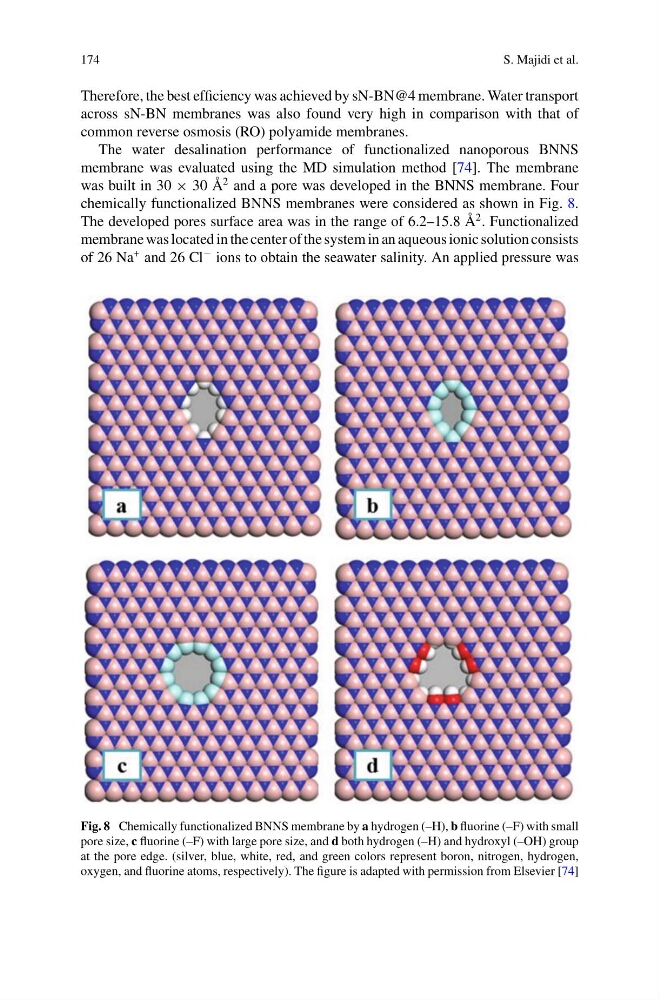
The water desalination performance of functionalized nanoporous BNNS
membrane was evaluated using the MD simulation method [74]. The membrane
was built in 30 × 30 Å
2 and a pore was developed in the BNNS membrane. Four
chemically functionalized BNNS membranes were considered as shown in Fig. 8.
The developed pores surface area was in the range of 6.2–15.8 Å
2 . Functionalized
membrane was located in the center of the system in an aqueous ionic solution consists
of 26 Na
+ and 26 Cl
− ions to obtain the seawater salinity. An applied pressure was
Fig. 8 Chemically functionalized BNNS membrane by a hydrogen (–H), b fluorine (–F) with small
pore size, c fluorine (–F) with large pore size, and d both hydrogen (–H) and hydroxyl (–OH) group
at the pore edge. (silver, blue, white, red, and green colors represent boron, nitrogen, hydrogen,
oxygen, and fluorine atoms, respectively). The figure is adapted with permission from Elsevier [74]
S. Majidi et al.
Therefore, the best efficiency was achieved by sN-BN@4 membrane. Water transport
across sN-BN membranes was also found very high in comparison with that of
common reverse osmosis (RO) polyamide membranes.
The water desalination performance of functionalized nanoporous BNNS
membrane was evaluated using the MD simulation method [74]. The membrane
was built in 30 × 30 Å
2 and a pore was developed in the BNNS membrane. Four
chemically functionalized BNNS membranes were considered as shown in Fig. 8.
The developed pores surface area was in the range of 6.2–15.8 Å
2 . Functionalized
membrane was located in the center of the system in an aqueous ionic solution consists
of 26 Na
+ and 26 Cl
− ions to obtain the seawater salinity. An applied pressure was
Fig. 8 Chemically functionalized BNNS membrane by a hydrogen (–H), b fluorine (–F) with small
pore size, c fluorine (–F) with large pore size, and d both hydrogen (–H) and hydroxyl (–OH) group
at the pore edge. (silver, blue, white, red, and green colors represent boron, nitrogen, hydrogen,
oxygen, and fluorine atoms, respectively). The figure is adapted with permission from Elsevier [74]